
Recent from talks
Klamath Project
Knowledge base stats:
Talk channels stats:
Members stats:
Klamath Project
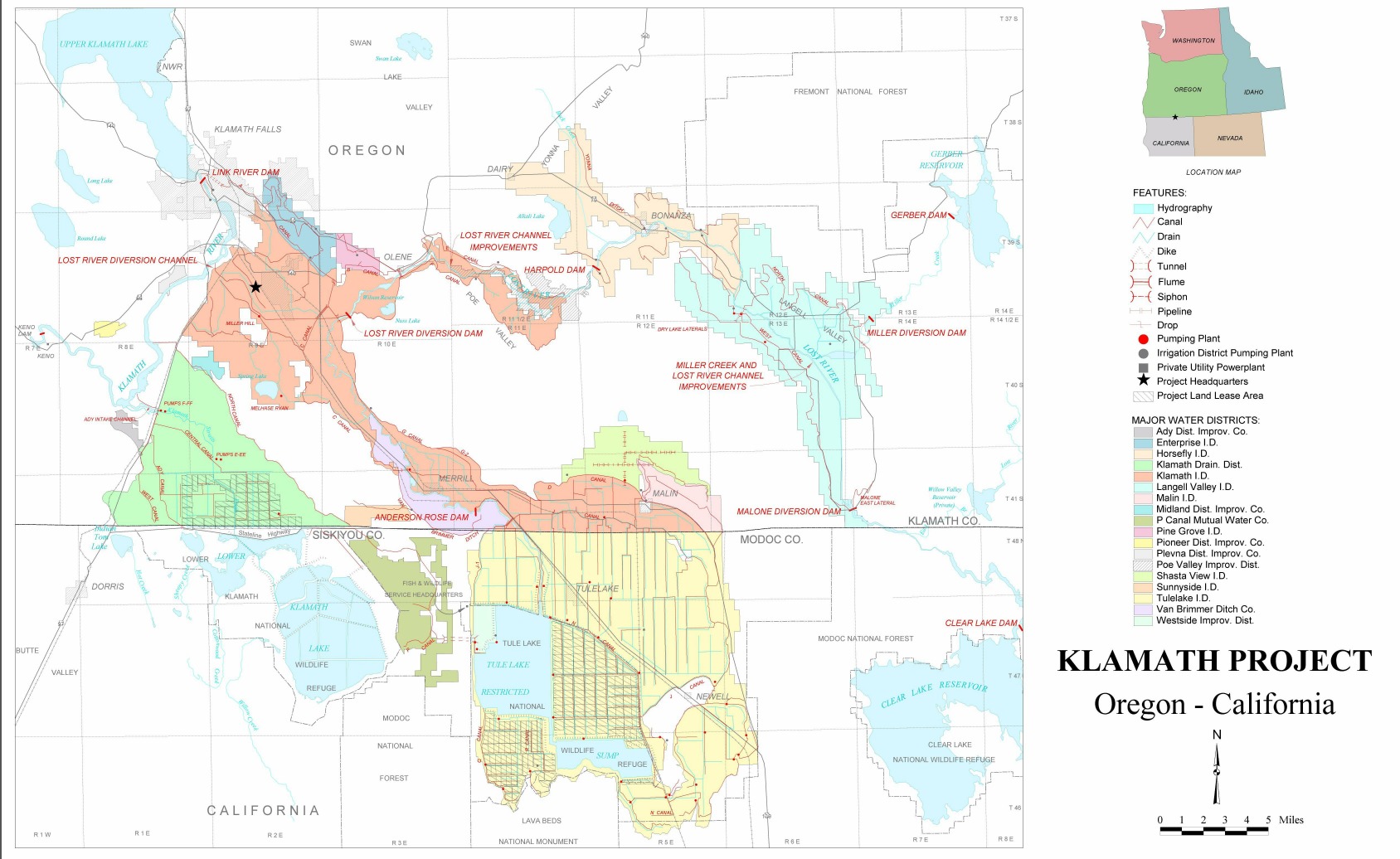
The Klamath Project is a water-management project developed by the United States Bureau of Reclamation to supply farmers with irrigation water and farmland in the Klamath Basin. The project also supplies water to the Tule Lake National Wildlife Refuge, and the Lower Klamath National Wildlife Refuge. The project was one of the first to be developed by the Reclamation Service, which later became the Bureau of Reclamation.
The two main water supply sources for the project are Upper Klamath Lake and the Klamath River. The main bodies of water in the Klamath Project are Clear Lake Reservoir, Klamath River, Link River, Lost River, Lower Klamath Lake, Tule Lake, and Upper Klamath Lake. The project fills these reservoirs from the spring runoff, peaking generally in March and April, and keeps the runoff from flooding the historical marshes that are a large portion of the present farmland. There are also many minor streams in the area. Lost River historically drained into Tule Lake, an endorheic lake. The project now diverts excess Lost River water to the Klamath River, allowing portions of Tule Lake to be reclaimed.
Some 225,000 acres (91,000 ha) of rangeland have been transformed into active farmland through the Klamath Project. Of that total, 80,000 acres (32,000 ha) were recovered by draining a portion of Lower Klamath Lake, a shallow marsh straddling the Oregon-California border between the California towns of Dorris and Tulelake. Tule Lake was also reduced in size by diverting water from Lost River to the Klamath River.
Farmers in the project raise barley, alfalfa hay, and other hay, oats, potatoes, and wheat. The Klamath Basin is on the Pacific Flyway and the Klamath Basin National Wildlife Refuges Complex is visited by migratory game birds every year.
The project can be distinguished the Klamath River Hydroelectric Project, which is a set of hydro dams on the mainstem of the Klamath operated by for-profit energy company PacifiCorp. The Link River Dam belongs to both.
Construction began on the project in 1906 with the building of the main "A" Canal. Water was first made available May 22, 1907. The Clear Lake Dam was completed in 1910, the Lost River Diversion Dam and many of the distribution structures in 1912, and the Anderson-Rose Diversion Dam (formally Lower Lost River Diversion Dam) in 1921. The Malone Diversion Dam on Lost River was built in 1923 to divert water to Langell Valley.
A contract executed February 24, 1917, between the California-Oregon Power Company (now Pacific Power) and the United States authorized the company to construct the Link River Dam for the benefit of the project and for the company's use, and in particular extended to the water users of the Klamath Project certain preferential power rates. The dam was completed in 1921.
In more recent times, the Klamath Project has been the focus of nationwide controversy. The Lost River and Shortnose suckers were listed as endangered in 1988. This, as well as concerns for salmon runs, led to a cutoff of irrigation water to local farmers on April 6, 2001. After many protests by farmers and concerned citizens alike, the decision was reversed the next year. The impact of the salmon kill was detailed in the book Salmon is Everything. A 2002 report by the National Research Council however, determined that the decision to stop delivery of irrigation water in 2001 was not scientifically justified and that the 2002 fish kill was caused by a combination of natural factors.
Hub AI
Klamath Project AI simulator
(@Klamath Project_simulator)
Klamath Project
The Klamath Project is a water-management project developed by the United States Bureau of Reclamation to supply farmers with irrigation water and farmland in the Klamath Basin. The project also supplies water to the Tule Lake National Wildlife Refuge, and the Lower Klamath National Wildlife Refuge. The project was one of the first to be developed by the Reclamation Service, which later became the Bureau of Reclamation.
The two main water supply sources for the project are Upper Klamath Lake and the Klamath River. The main bodies of water in the Klamath Project are Clear Lake Reservoir, Klamath River, Link River, Lost River, Lower Klamath Lake, Tule Lake, and Upper Klamath Lake. The project fills these reservoirs from the spring runoff, peaking generally in March and April, and keeps the runoff from flooding the historical marshes that are a large portion of the present farmland. There are also many minor streams in the area. Lost River historically drained into Tule Lake, an endorheic lake. The project now diverts excess Lost River water to the Klamath River, allowing portions of Tule Lake to be reclaimed.
Some 225,000 acres (91,000 ha) of rangeland have been transformed into active farmland through the Klamath Project. Of that total, 80,000 acres (32,000 ha) were recovered by draining a portion of Lower Klamath Lake, a shallow marsh straddling the Oregon-California border between the California towns of Dorris and Tulelake. Tule Lake was also reduced in size by diverting water from Lost River to the Klamath River.
Farmers in the project raise barley, alfalfa hay, and other hay, oats, potatoes, and wheat. The Klamath Basin is on the Pacific Flyway and the Klamath Basin National Wildlife Refuges Complex is visited by migratory game birds every year.
The project can be distinguished the Klamath River Hydroelectric Project, which is a set of hydro dams on the mainstem of the Klamath operated by for-profit energy company PacifiCorp. The Link River Dam belongs to both.
Construction began on the project in 1906 with the building of the main "A" Canal. Water was first made available May 22, 1907. The Clear Lake Dam was completed in 1910, the Lost River Diversion Dam and many of the distribution structures in 1912, and the Anderson-Rose Diversion Dam (formally Lower Lost River Diversion Dam) in 1921. The Malone Diversion Dam on Lost River was built in 1923 to divert water to Langell Valley.
A contract executed February 24, 1917, between the California-Oregon Power Company (now Pacific Power) and the United States authorized the company to construct the Link River Dam for the benefit of the project and for the company's use, and in particular extended to the water users of the Klamath Project certain preferential power rates. The dam was completed in 1921.
In more recent times, the Klamath Project has been the focus of nationwide controversy. The Lost River and Shortnose suckers were listed as endangered in 1988. This, as well as concerns for salmon runs, led to a cutoff of irrigation water to local farmers on April 6, 2001. After many protests by farmers and concerned citizens alike, the decision was reversed the next year. The impact of the salmon kill was detailed in the book Salmon is Everything. A 2002 report by the National Research Council however, determined that the decision to stop delivery of irrigation water in 2001 was not scientifically justified and that the 2002 fish kill was caused by a combination of natural factors.
Recent media