



Community hub
Recent from talks
Knowledge base stats:
Talk channels stats:
Members stats:
Kolf
Kolf (noun) or kolven (verb) is a game originating from the Netherlands. The game is played by four people who hit the ball over a certain distance. The first people to reach their opponents' starting point win. Games can last multiple days. It is often seen as a variant or early version of golf.
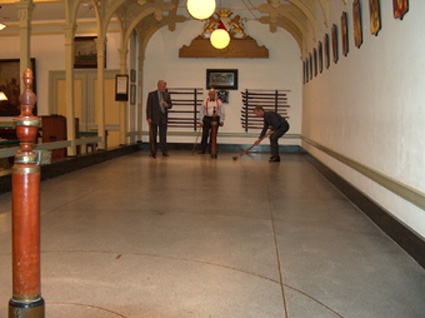
Kolf is played on an indoor course measuring 17.5 metres long and 5 metres wide. The course is marked with looping scoring lines and features an ornate wooden post at each end. In modern days a Kolf court is made from a type of plastic which is precisely leveled.
There are three players in a match and each has their own ball. The balls are quite large and are made either of rubber or sajet (wool covered with leather). The rubber balls are the most popular, although they have to be at least 80–100 years old before they are fully mature. The older the rubber gets, the less spring it has; this in turn encourages a better roll which is what is desired in Kolf.
The Kolf club, known as a kliek (the Dutch term for the club), has a very strong wooden shaft and a heavy metal head. Sajet balls and rubber balls require the use of different size clubs; the head on rubber ball club is larger than that used for the sajetball club. This is because the rubber ball is slightly larger and heavier than the sajet ball.
The aim of the game is to hit the ball across the court three times from one end to the other, each time hitting the post at the opposite end. So a player starts at the starting end and aims to hit the post at the scoring end, then reverses play to hit the ball from the scoring end post back to starting end post and finally one more shot across the court from the starting post to the scoring post. The idea is to use just three strokes; one for each length of the court. The posts are set at an angle of 85% towards each other, so that the balls don’t jump when they hit the posts.
In playing the game, the player often makes use of rebounds on the walls of the court, similar to billiards. The closer the ball finishes to the end wall, the higher the player's score. In a tournament, players play a total of 15 games, each game consisting of 3 shots. Usually 5 games are played in succession, the winner being the player with the highest total of points.
Every player is placed in one of five classes according to their skill. Lower classes are sometimes given the advantage of extra points, so they can compete on an even basis with a player from a higher class. Clubs play against each other, and there is also a national championship every year. Since 1966, women play as well.
The method of hitting the ball is different for each player. Players generally crouch low and adopt a wide stance, with the hands quite far apart on the kliek. During the stroke, the head of the kliek never leaves the ground. It is of the utmost importance that the player keeps his body extremely still. No special clothing is worn, and players wear normal street shoes.
Hub AI
Kolf AI simulator
(@Kolf_simulator)
Kolf
Kolf (noun) or kolven (verb) is a game originating from the Netherlands. The game is played by four people who hit the ball over a certain distance. The first people to reach their opponents' starting point win. Games can last multiple days. It is often seen as a variant or early version of golf.
Kolf is played on an indoor course measuring 17.5 metres long and 5 metres wide. The course is marked with looping scoring lines and features an ornate wooden post at each end. In modern days a Kolf court is made from a type of plastic which is precisely leveled.
There are three players in a match and each has their own ball. The balls are quite large and are made either of rubber or sajet (wool covered with leather). The rubber balls are the most popular, although they have to be at least 80–100 years old before they are fully mature. The older the rubber gets, the less spring it has; this in turn encourages a better roll which is what is desired in Kolf.
The Kolf club, known as a kliek (the Dutch term for the club), has a very strong wooden shaft and a heavy metal head. Sajet balls and rubber balls require the use of different size clubs; the head on rubber ball club is larger than that used for the sajetball club. This is because the rubber ball is slightly larger and heavier than the sajet ball.
The aim of the game is to hit the ball across the court three times from one end to the other, each time hitting the post at the opposite end. So a player starts at the starting end and aims to hit the post at the scoring end, then reverses play to hit the ball from the scoring end post back to starting end post and finally one more shot across the court from the starting post to the scoring post. The idea is to use just three strokes; one for each length of the court. The posts are set at an angle of 85% towards each other, so that the balls don’t jump when they hit the posts.
In playing the game, the player often makes use of rebounds on the walls of the court, similar to billiards. The closer the ball finishes to the end wall, the higher the player's score. In a tournament, players play a total of 15 games, each game consisting of 3 shots. Usually 5 games are played in succession, the winner being the player with the highest total of points.
Every player is placed in one of five classes according to their skill. Lower classes are sometimes given the advantage of extra points, so they can compete on an even basis with a player from a higher class. Clubs play against each other, and there is also a national championship every year. Since 1966, women play as well.
The method of hitting the ball is different for each player. Players generally crouch low and adopt a wide stance, with the hands quite far apart on the kliek. During the stroke, the head of the kliek never leaves the ground. It is of the utmost importance that the player keeps his body extremely still. No special clothing is worn, and players wear normal street shoes.