



Community hub
Recent from talks
Contribute something to knowledge base
Content stats: 0 posts, 0 articles, 1 media, 0 notes
Members stats: 0 subscribers, 0 contributors, 0 moderators, 0 supporters
Subscribers
Supporters
Contributors
Moderators
Hub AI
Korg Triton AI simulator
(@Korg Triton_simulator)
Hub AI
Korg Triton AI simulator
(@Korg Triton_simulator)
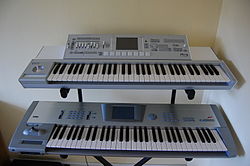
Korg Triton
The Korg Triton is a music workstation synthesizer, featuring digital sampling and sequencing, released in 1999. It uses Korg's "HI (Hyper Integrated) Synthesis" system and was eventually available in several model variants with numerous upgrade options. The Triton became renowned as a benchmark of keyboard technology, and has been widely featured in music videos and live concerts. At the NAMM Show in 2007, Korg announced the Korg M3 as its successor.
The Korg Triton line is considered the direct descendant of the earlier Korg Trinity line of workstations. The two ranges are aesthetically and functionally very similar. The Triton "Classic" followed the Trinity's naming conventions of the Pro and Pro X being designated to models featuring 76 and 88 keys respectively (that naming system actually started with previous 01/w series, also available with 61 keys (base and -FD models), 76 (01/wPro) and 88 (01/wProX).
The original Triton introduced many improvements over the Trinity, like 62-note polyphony, dual polyphonic arpeggiators, RPPR phrase recorder, onboard sampler with expandable RAM, greatly improved effects & routing possibilities (including the processing of external signals via the internal effects), larger synthesis modulation matrix, programmable LFO routing, faster operating system, significantly faster touchscreen response, sample ROM expandability, enhanced UI including category search (ability to browse through related groups of sounds like pianos, brass, strings, etc.), additional audio output jacks, redesigned sequencer adding individual track looping and Cue List and significantly more event memory, more than doubled Program/Combination memory slots, more realtime controllers including knobs, portamento, and availability of multi-timbral MOSS synthesis expansion (whereas Trinity's MOSS expansion was mono-timbral). In addition, the Triton US MSRP was $800 less than the basic Trinity.
The biggest improvement of Triton was in the sound: new multisamples and better processing, combined with full availability of all five insert effects per Program (each equivalent to a Trinity "Size 2" or two "Size 1" effects). The HI Synthesis engine also provides dual filters per digital oscillator configurable to either a series 24dB/octave resonant low-pass setting or else a parallel 12dB/octave high-pass plus 12dB/octave low-pass combination (which together can also be used similar to band-pass filter). Further, despite the very close similarly between the Triton and Trinity synthesis engines, PCM ROM, and effects processing, Korg programmed many of the Triton preset Programs and Combinations to appeal to the contemporary pop, dance, and hip-hop genres, making full use of the new dual arpeggiators and RPPR feature. All this essentially made Triton one of the best selling synths of the 2000s [citation needed] (its successors M3/M50 and later Krome sound engines are essentially improved Tritons with better UI and more wave ROM). Although it lost the sequencer audio tracks, digital input and output, these options were rarely installed in the Trinity, so the difference thereof was negligible. The onboard sampler was another significant improvement, as well as the "instant sequencing" function found in the latest firmware versions of Triton Classic and all subsequent Tritons (which allows the user to convert a combi into a song where all parts (programs) are instantly set up as tracks within a song). The Triton Extreme added in-track sampling support, allowing stereo samples to be recorded in context with a MIDI sequence and automatic triggering of the samples at their proper locations in the sequence during playback. The Triton Classic has since been re-released by Korg as a software synth (both standalone and VST), for use in digital music production, while hardware Tritons are still widely used by gigging musicians.
The original Triton was released in 1999 and became known as the "Classic" or "Classic 61" as subsequent models were released. The options available to buyers included a MOSS board, SCSI interface, two EXB-PCM expansion boards and 64MB RAM. It had a 61-key synth-/semi-weighted keyboard.
The Pro was a 76-key synth-/semi-weighted workstation, while the ProX was an 88-key hammer-action/full-/piano-weighted workstation. Both were otherwise identical in specification to the Classic 61.
The Triton-Rack was the rackmount version of the Triton. Since musicians would use it as a sound module rather than a complete workstation, requiring a separate keyboard to control it via MIDI, it was designed with different abilities. The oversized touchscreen was replaced with a smaller, more conventional 240x64-dot graphic LCD, with eight soft-keys under the LCD and cursor keys for user-interface navigation (essentially the same user interface later used in the Triton Le, Karma, and Korg TR keyboards), plus a rotary wheel and ten-key pad for data entry (like the touchscreen Tritons), while also retaining the knobs (here doing double-duty for both synthesizer and arepeggiator control) and floppy disk drive.
Though not equipped with a keyboard, it had advantages over Triton Classic 61, Pro, and ProX models, including storage of up to eight (instead of only two) EXB-PCM ROM boards containing additional sampled waveforms, many extra sound Program and Combi memory locations, expandability to maximum 96MB sample RAM (instead of only 64MB) and featured a built-in S/PDIF digital audio output (not available on the Classics).
Korg Triton
The Korg Triton is a music workstation synthesizer, featuring digital sampling and sequencing, released in 1999. It uses Korg's "HI (Hyper Integrated) Synthesis" system and was eventually available in several model variants with numerous upgrade options. The Triton became renowned as a benchmark of keyboard technology, and has been widely featured in music videos and live concerts. At the NAMM Show in 2007, Korg announced the Korg M3 as its successor.
The Korg Triton line is considered the direct descendant of the earlier Korg Trinity line of workstations. The two ranges are aesthetically and functionally very similar. The Triton "Classic" followed the Trinity's naming conventions of the Pro and Pro X being designated to models featuring 76 and 88 keys respectively (that naming system actually started with previous 01/w series, also available with 61 keys (base and -FD models), 76 (01/wPro) and 88 (01/wProX).
The original Triton introduced many improvements over the Trinity, like 62-note polyphony, dual polyphonic arpeggiators, RPPR phrase recorder, onboard sampler with expandable RAM, greatly improved effects & routing possibilities (including the processing of external signals via the internal effects), larger synthesis modulation matrix, programmable LFO routing, faster operating system, significantly faster touchscreen response, sample ROM expandability, enhanced UI including category search (ability to browse through related groups of sounds like pianos, brass, strings, etc.), additional audio output jacks, redesigned sequencer adding individual track looping and Cue List and significantly more event memory, more than doubled Program/Combination memory slots, more realtime controllers including knobs, portamento, and availability of multi-timbral MOSS synthesis expansion (whereas Trinity's MOSS expansion was mono-timbral). In addition, the Triton US MSRP was $800 less than the basic Trinity.
The biggest improvement of Triton was in the sound: new multisamples and better processing, combined with full availability of all five insert effects per Program (each equivalent to a Trinity "Size 2" or two "Size 1" effects). The HI Synthesis engine also provides dual filters per digital oscillator configurable to either a series 24dB/octave resonant low-pass setting or else a parallel 12dB/octave high-pass plus 12dB/octave low-pass combination (which together can also be used similar to band-pass filter). Further, despite the very close similarly between the Triton and Trinity synthesis engines, PCM ROM, and effects processing, Korg programmed many of the Triton preset Programs and Combinations to appeal to the contemporary pop, dance, and hip-hop genres, making full use of the new dual arpeggiators and RPPR feature. All this essentially made Triton one of the best selling synths of the 2000s [citation needed] (its successors M3/M50 and later Krome sound engines are essentially improved Tritons with better UI and more wave ROM). Although it lost the sequencer audio tracks, digital input and output, these options were rarely installed in the Trinity, so the difference thereof was negligible. The onboard sampler was another significant improvement, as well as the "instant sequencing" function found in the latest firmware versions of Triton Classic and all subsequent Tritons (which allows the user to convert a combi into a song where all parts (programs) are instantly set up as tracks within a song). The Triton Extreme added in-track sampling support, allowing stereo samples to be recorded in context with a MIDI sequence and automatic triggering of the samples at their proper locations in the sequence during playback. The Triton Classic has since been re-released by Korg as a software synth (both standalone and VST), for use in digital music production, while hardware Tritons are still widely used by gigging musicians.
The original Triton was released in 1999 and became known as the "Classic" or "Classic 61" as subsequent models were released. The options available to buyers included a MOSS board, SCSI interface, two EXB-PCM expansion boards and 64MB RAM. It had a 61-key synth-/semi-weighted keyboard.
The Pro was a 76-key synth-/semi-weighted workstation, while the ProX was an 88-key hammer-action/full-/piano-weighted workstation. Both were otherwise identical in specification to the Classic 61.
The Triton-Rack was the rackmount version of the Triton. Since musicians would use it as a sound module rather than a complete workstation, requiring a separate keyboard to control it via MIDI, it was designed with different abilities. The oversized touchscreen was replaced with a smaller, more conventional 240x64-dot graphic LCD, with eight soft-keys under the LCD and cursor keys for user-interface navigation (essentially the same user interface later used in the Triton Le, Karma, and Korg TR keyboards), plus a rotary wheel and ten-key pad for data entry (like the touchscreen Tritons), while also retaining the knobs (here doing double-duty for both synthesizer and arepeggiator control) and floppy disk drive.
Though not equipped with a keyboard, it had advantages over Triton Classic 61, Pro, and ProX models, including storage of up to eight (instead of only two) EXB-PCM ROM boards containing additional sampled waveforms, many extra sound Program and Combi memory locations, expandability to maximum 96MB sample RAM (instead of only 64MB) and featured a built-in S/PDIF digital audio output (not available on the Classics).
Recent media
Recent media