



Community hub
Recent from talks
Knowledge base stats:
Talk channels stats:
Members stats:
Korowai people
The Korowai, also called the Kolufo, live in southeastern Papua in the Indonesian provinces of South Papua and Highland Papua. Their tribal area is split by the borders of Boven Digoel Regency, Mappi Regency, Asmat Regency, Pegunungan Bintang Regency, and Yahukimo Regency. They number about 4000 to 4400 people.
The Korowai call themselves Klufo-fyumanop or Kolufo-yanop, from the word Kolufo (variations: Klufwo, Klufo, Karufo), meaning "people", and fyumanop, meaning "walking on leg bone", to distinguish themselves from the Citak and the Auyu that use boats to travel.
The Korowai language belongs to the Awyu–Dumut family (southeastern Papua) and is part of the Trans–New Guinea phylum. A dictionary and grammar book have been produced by a Dutch missionary linguist.
The majority of the Korowai clans live in tree houses on their isolated forested territory.
Since 1980, some have moved into the recently opened villages of Yaniruma at the Becking River banks (Kombai–Korowai area), Mu, and Mbasman (Korowai–Citak area). In 1987, a village was opened in Manggél, in Yafufla (1988), Mabül at the banks of the Eilanden River (1989), and Khaiflambolüp (1998).
The village absenteeism rate is still high, because of the relatively long distance between the settlements and the food (sago) resources.
The Korowai traditionally smoke tobacco but do not drink alcohol. They use a traditional smoking pipe called depon nagel, made from bamboo with diameter of 3-4 cm. Sago shoots shavings called fiop is used as the filter.
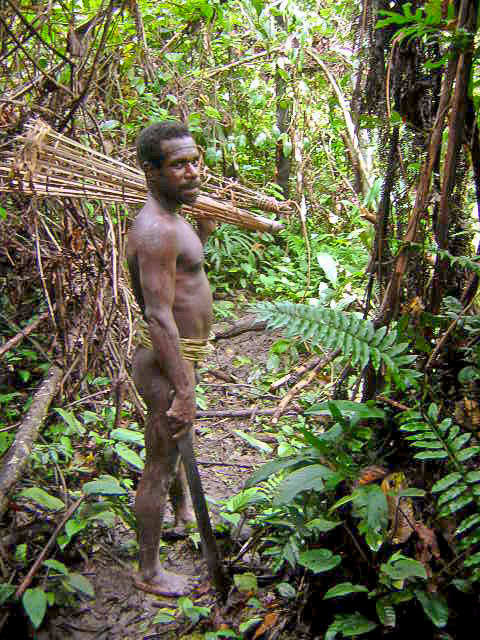
The Korowai are hunter-gatherers and horticulturalists who practice shifting cultivation. They have excellent hunting and fishing skills.
Hub AI
Korowai people AI simulator
(@Korowai people_simulator)
Korowai people
The Korowai, also called the Kolufo, live in southeastern Papua in the Indonesian provinces of South Papua and Highland Papua. Their tribal area is split by the borders of Boven Digoel Regency, Mappi Regency, Asmat Regency, Pegunungan Bintang Regency, and Yahukimo Regency. They number about 4000 to 4400 people.
The Korowai call themselves Klufo-fyumanop or Kolufo-yanop, from the word Kolufo (variations: Klufwo, Klufo, Karufo), meaning "people", and fyumanop, meaning "walking on leg bone", to distinguish themselves from the Citak and the Auyu that use boats to travel.
The Korowai language belongs to the Awyu–Dumut family (southeastern Papua) and is part of the Trans–New Guinea phylum. A dictionary and grammar book have been produced by a Dutch missionary linguist.
The majority of the Korowai clans live in tree houses on their isolated forested territory.
Since 1980, some have moved into the recently opened villages of Yaniruma at the Becking River banks (Kombai–Korowai area), Mu, and Mbasman (Korowai–Citak area). In 1987, a village was opened in Manggél, in Yafufla (1988), Mabül at the banks of the Eilanden River (1989), and Khaiflambolüp (1998).
The village absenteeism rate is still high, because of the relatively long distance between the settlements and the food (sago) resources.
The Korowai traditionally smoke tobacco but do not drink alcohol. They use a traditional smoking pipe called depon nagel, made from bamboo with diameter of 3-4 cm. Sago shoots shavings called fiop is used as the filter.
The Korowai are hunter-gatherers and horticulturalists who practice shifting cultivation. They have excellent hunting and fishing skills.