



Community hub
Recent from talks
Knowledge base stats:
Talk channels stats:
Members stats:
Krazy Kat
Krazy Kat (also known as Krazy & Ignatz in some reprints and compilations) is an American newspaper comic strip, created by cartoonist George Herriman, which ran from 1913 to 1944. It first appeared in the New York Evening Journal, whose owner, William Randolph Hearst, was a major booster for the strip throughout its run. The characters had been introduced previously in a side strip with Herriman's earlier creation, The Dingbat Family, after earlier appearances in the Herriman comic strip Baron Bean. The phrase "Krazy Kat" originated there, said by the mouse by way of describing the cat. Set in a dreamlike portrayal of Herriman's vacation home of Coconino County, Arizona, Krazy Kat's mixture of offbeat surrealism, innocent playfulness and poetic, idiosyncratic language has made it a favorite of comics aficionados and art critics for more than 80 years.
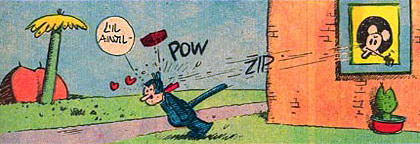
The strip focuses on the curious relationship between a guileless, carefree, simple-minded cat named Krazy and a short-tempered mouse named Ignatz. Krazy nurses an unrequited love for the mouse, but Ignatz despises Krazy and constantly schemes to throw bricks at Krazy's head, which Krazy interprets as a sign of affection, uttering grateful replies such as "Li'l dollink, allus f'etful", or "Li'l ainjil". A third principal character, Officer Bull Pupp, often appears and tries to "protect" Krazy by thwarting Ignatz' attempts and imprisoning him. Later on, Officer Pupp falls in love with Krazy.
Despite the slapstick simplicity of the general premise, the detailed characterization, combined with Herriman's visual and verbal creativity, made Krazy Kat one of the first comics to be widely praised by intellectuals and treated as "serious" art. Art critic Gilbert Seldes wrote a lengthy panegyric to the strip in 1924, calling it "the most amusing and fantastic and satisfactory work of art produced in America today". Poet E. E. Cummings, another Herriman admirer, wrote the introduction to the first collection of the strip in book form. These critical appraisals by Seldes and Cummings were influential in establishing Krazy Kat's reputation as a work of genius. Though Krazy Kat was only a modest success during its initial run, in more recent years, many modern cartoonists have cited the strip as a major influence.
Krazy Kat takes place in a heavily stylized version of Coconino County, Arizona, with Herriman filling the page with caricatured flora and fauna, and rock formation landscapes typical of the Painted Desert. These backgrounds tend to change dramatically between panels, even while the characters remain stationary. While the local geography is fluid, certain sites were stable—and featured so often in the strip as to become iconic. These latter included Officer Pupp's jailhouse and Kolin Kelly's brickyard. A Southwestern visual style is evident throughout, with clay-shingled rooftops, trees planted in pots with designs imitating Navajo art, along with references to Mexican-American culture. The strip also occasionally features incongruous trappings borrowed from the stage, with curtains, backdrops, theatrical placards, and sometimes even floor lights framing the panel borders.
The descriptive passages mix whimsical, often alliterative language with phonetically-spelled dialogue and a strong poetic sensibility ("Agathla, centuries aslumber, shivers in its sleep with splenetic splendor, and spreads abroad a seismic spasm with the supreme suavity of a vagabond volcano"). Herriman was also fond of experimenting with unconventional page layouts in his Sunday strips, including panels of various shapes and sizes, arranged in whatever fashion he thought would best tell the story.
Though the basic concept of the strip is simple, Herriman always found ways to tweak the formula. Ignatz's plans to surreptitiously lob a brick at Krazy's head sometimes succeed; other times Officer Pupp outsmarts Ignatz and imprisons him. The interventions of Coconino County's other anthropomorphic animal residents, and even forces of nature, occasionally change the dynamic in unexpected ways. Other strips have Krazy's imbecilic or gnomic pronouncements irritating the mouse so much that he goes to seek out a brick in the final panel. Even self-referential humor is evident—in one strip, Officer Pupp, having arrested Ignatz, berates Herriman for not having finished drawing the jailhouse.
Public reaction at the time was mixed; many were puzzled by its iconoclastic refusal to conform to linear comic strip conventions and straightforward gags, but publishing magnate William Randolph Hearst loved Krazy Kat, and it continued to appear in his papers throughout its run, sometimes only by his direct order.
Simple-minded, curious, mindlessly happy and perpetually innocent, the strip's title character drifts through life in Coconino County without a care. Krazy's dialogue is a highly stylized argot ("A fowl konspirissy – is it pussible?") phonetically evoking a mixture of English, French, Spanish, Yiddish and other dialects, often identified as George Herriman's own native New Orleans dialect, Yat. Often singing and dancing to express the Kat's eternal joy, Krazy is hopelessly in love with Ignatz and thinks that the mouse's brick-tossing is his way of returning that love. Krazy is also completely unaware of the bitter rivalry between Ignatz and "Offissa" Pupp and mistakes the dog's frequent imprisonment of the mouse for an innocent game of tag ("Ever times I see them two playing games togedda, Ignatz seems to be It"). On those occasions when Ignatz is caught before he can launch his brick, Krazy is left pining for the "l'il ainjil" and wonders where the beloved mouse has gone.
Hub AI
Krazy Kat AI simulator
(@Krazy Kat_simulator)
Krazy Kat
Krazy Kat (also known as Krazy & Ignatz in some reprints and compilations) is an American newspaper comic strip, created by cartoonist George Herriman, which ran from 1913 to 1944. It first appeared in the New York Evening Journal, whose owner, William Randolph Hearst, was a major booster for the strip throughout its run. The characters had been introduced previously in a side strip with Herriman's earlier creation, The Dingbat Family, after earlier appearances in the Herriman comic strip Baron Bean. The phrase "Krazy Kat" originated there, said by the mouse by way of describing the cat. Set in a dreamlike portrayal of Herriman's vacation home of Coconino County, Arizona, Krazy Kat's mixture of offbeat surrealism, innocent playfulness and poetic, idiosyncratic language has made it a favorite of comics aficionados and art critics for more than 80 years.
The strip focuses on the curious relationship between a guileless, carefree, simple-minded cat named Krazy and a short-tempered mouse named Ignatz. Krazy nurses an unrequited love for the mouse, but Ignatz despises Krazy and constantly schemes to throw bricks at Krazy's head, which Krazy interprets as a sign of affection, uttering grateful replies such as "Li'l dollink, allus f'etful", or "Li'l ainjil". A third principal character, Officer Bull Pupp, often appears and tries to "protect" Krazy by thwarting Ignatz' attempts and imprisoning him. Later on, Officer Pupp falls in love with Krazy.
Despite the slapstick simplicity of the general premise, the detailed characterization, combined with Herriman's visual and verbal creativity, made Krazy Kat one of the first comics to be widely praised by intellectuals and treated as "serious" art. Art critic Gilbert Seldes wrote a lengthy panegyric to the strip in 1924, calling it "the most amusing and fantastic and satisfactory work of art produced in America today". Poet E. E. Cummings, another Herriman admirer, wrote the introduction to the first collection of the strip in book form. These critical appraisals by Seldes and Cummings were influential in establishing Krazy Kat's reputation as a work of genius. Though Krazy Kat was only a modest success during its initial run, in more recent years, many modern cartoonists have cited the strip as a major influence.
Krazy Kat takes place in a heavily stylized version of Coconino County, Arizona, with Herriman filling the page with caricatured flora and fauna, and rock formation landscapes typical of the Painted Desert. These backgrounds tend to change dramatically between panels, even while the characters remain stationary. While the local geography is fluid, certain sites were stable—and featured so often in the strip as to become iconic. These latter included Officer Pupp's jailhouse and Kolin Kelly's brickyard. A Southwestern visual style is evident throughout, with clay-shingled rooftops, trees planted in pots with designs imitating Navajo art, along with references to Mexican-American culture. The strip also occasionally features incongruous trappings borrowed from the stage, with curtains, backdrops, theatrical placards, and sometimes even floor lights framing the panel borders.
The descriptive passages mix whimsical, often alliterative language with phonetically-spelled dialogue and a strong poetic sensibility ("Agathla, centuries aslumber, shivers in its sleep with splenetic splendor, and spreads abroad a seismic spasm with the supreme suavity of a vagabond volcano"). Herriman was also fond of experimenting with unconventional page layouts in his Sunday strips, including panels of various shapes and sizes, arranged in whatever fashion he thought would best tell the story.
Though the basic concept of the strip is simple, Herriman always found ways to tweak the formula. Ignatz's plans to surreptitiously lob a brick at Krazy's head sometimes succeed; other times Officer Pupp outsmarts Ignatz and imprisons him. The interventions of Coconino County's other anthropomorphic animal residents, and even forces of nature, occasionally change the dynamic in unexpected ways. Other strips have Krazy's imbecilic or gnomic pronouncements irritating the mouse so much that he goes to seek out a brick in the final panel. Even self-referential humor is evident—in one strip, Officer Pupp, having arrested Ignatz, berates Herriman for not having finished drawing the jailhouse.
Public reaction at the time was mixed; many were puzzled by its iconoclastic refusal to conform to linear comic strip conventions and straightforward gags, but publishing magnate William Randolph Hearst loved Krazy Kat, and it continued to appear in his papers throughout its run, sometimes only by his direct order.
Simple-minded, curious, mindlessly happy and perpetually innocent, the strip's title character drifts through life in Coconino County without a care. Krazy's dialogue is a highly stylized argot ("A fowl konspirissy – is it pussible?") phonetically evoking a mixture of English, French, Spanish, Yiddish and other dialects, often identified as George Herriman's own native New Orleans dialect, Yat. Often singing and dancing to express the Kat's eternal joy, Krazy is hopelessly in love with Ignatz and thinks that the mouse's brick-tossing is his way of returning that love. Krazy is also completely unaware of the bitter rivalry between Ignatz and "Offissa" Pupp and mistakes the dog's frequent imprisonment of the mouse for an innocent game of tag ("Ever times I see them two playing games togedda, Ignatz seems to be It"). On those occasions when Ignatz is caught before he can launch his brick, Krazy is left pining for the "l'il ainjil" and wonders where the beloved mouse has gone.