


Community hub
Recent from talks
Contribute something to knowledge base
Content stats: 0 posts, 0 articles, 1 media, 0 notes
Members stats: 0 subscribers, 0 contributors, 0 moderators, 0 supporters
Subscribers
Supporters
Contributors
Moderators
Hub AI
Kujula Kadphises AI simulator
(@Kujula Kadphises_simulator)
Hub AI
Kujula Kadphises AI simulator
(@Kujula Kadphises_simulator)
Kujula Kadphises
Kujula Kadphises (Kushan language: Κοζουλου Καδφιζου, also Κοζολα Καδαφες; Kharosthi: 𐨐𐨂𐨗𐨂𐨫 𐨐𐨯, IAST: Ku-ju-la Ka-sa, Kujula Kasa; Chinese: 丘就卻; pinyin: Qiūjiùquè; r. 30–80 CE, or 40–90 CE according to Bopearachchi. 25–85 CE as per Benjamin.) was a Kushan prince who united the Yuezhi confederation in Bactria during the 1st century CE, and became the first Kushan emperor. According to the Rabatak inscription, he was the great grandfather of Kanishka I. He is considered the founder of the Kushan Empire.
The origins of Kujula Kadphises are quite obscure, and he is usually believed to be a descendant of the Kushan ruler Heraios, or possibly identical with him. However, Kujula shares his name (Kushan: Κοζουλου on some of his "Hermaeus" coins, or Κοζολα on his "Augustus" coins) with some of the last Indo-Scythian rulers, such as Liaka Kusulaka (Greek: Λιακα Κοζουλο), or his son Patika Kusulaka, which might suggest some family connection. Kujula Kadphises, referred to himself on his coins, inscribed in the Indian Kharosthi script, as Maharaja Rajarajasa Devaputra Kujula Kara Kadphises, which translates to "Great King of Kings, Son of the Divine Being, Kujula Kadphises."
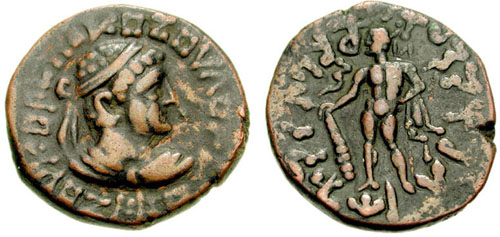
Kujula Kadphises' reign is estimated to have lasted from approximately 25 to 85 CE, though the chronology of the Kushan rulers remains uncertain. During his reign, Kujula was a contemporary of Roman emperors such as Claudius, Nero, Vespasian, Titus, and Domitian. Latin sources mention "Indian" ambassadors received by some of these emperors, though it is unclear whether these representatives were independent merchants from the Indian subcontinent or officials of the Kushan Empire. Numismatic evidence points to Roman influence on early Kushan coinage. One notable series of copper tetradrachms issued by Kujula features an obverse bust modeled after Augustus and a curule chair on the reverse.
In the process of their expansion eastward, Kujula Kadphises and his son Vima Takto (or Vema Tahktu) seem to have displaced the Indo-Parthian kingdom, established in northwestern India by the Parthian Gondophares since around 20 CE:
His son, Yangaozhen [probably Vema Tahktu or, possibly, his brother Sadaṣkaṇa], became king in his place. He defeated Tianzhu [North-western India] and installed Generals to supervise and lead it. The Yuezhi then became extremely rich. All the kingdoms call [their king] the Guishuang [Kushan] king, but the Han call them by their original name, Da Yuezhi [Great Yuezhi].
The invasion of the Indo-Parthian kingdom led by Kujula Kadphises is thought to have occurred some time after 45 CE, during the reign of Gondophares's successors: Abdagases and Sases.
The connection of Kujula with other Kushan rulers is described in the Rabatak inscription, discovered in Rabatak in what was once Bactria in 1993, which was inscribed by Kanishka. Kanishka states Kujula Kadphises to be his great-grandfather, Vima Taktu to be his grandfather, Vima Kadphises to be his father, and himself Kanishka:
And he [Kanishka] gave orders to make images of the same, (namely) of these gods who are written herein, and he gave orders to make (them) for these kings: for King Kujula Kadphises (his) great grandfather, and for King Vima Taktu (his) grandfather, and for King Vima Kadphises (his) father, and for himself, King Kanishka.
Kujula Kadphises
Kujula Kadphises (Kushan language: Κοζουλου Καδφιζου, also Κοζολα Καδαφες; Kharosthi: 𐨐𐨂𐨗𐨂𐨫 𐨐𐨯, IAST: Ku-ju-la Ka-sa, Kujula Kasa; Chinese: 丘就卻; pinyin: Qiūjiùquè; r. 30–80 CE, or 40–90 CE according to Bopearachchi. 25–85 CE as per Benjamin.) was a Kushan prince who united the Yuezhi confederation in Bactria during the 1st century CE, and became the first Kushan emperor. According to the Rabatak inscription, he was the great grandfather of Kanishka I. He is considered the founder of the Kushan Empire.
The origins of Kujula Kadphises are quite obscure, and he is usually believed to be a descendant of the Kushan ruler Heraios, or possibly identical with him. However, Kujula shares his name (Kushan: Κοζουλου on some of his "Hermaeus" coins, or Κοζολα on his "Augustus" coins) with some of the last Indo-Scythian rulers, such as Liaka Kusulaka (Greek: Λιακα Κοζουλο), or his son Patika Kusulaka, which might suggest some family connection. Kujula Kadphises, referred to himself on his coins, inscribed in the Indian Kharosthi script, as Maharaja Rajarajasa Devaputra Kujula Kara Kadphises, which translates to "Great King of Kings, Son of the Divine Being, Kujula Kadphises."
Kujula Kadphises' reign is estimated to have lasted from approximately 25 to 85 CE, though the chronology of the Kushan rulers remains uncertain. During his reign, Kujula was a contemporary of Roman emperors such as Claudius, Nero, Vespasian, Titus, and Domitian. Latin sources mention "Indian" ambassadors received by some of these emperors, though it is unclear whether these representatives were independent merchants from the Indian subcontinent or officials of the Kushan Empire. Numismatic evidence points to Roman influence on early Kushan coinage. One notable series of copper tetradrachms issued by Kujula features an obverse bust modeled after Augustus and a curule chair on the reverse.
In the process of their expansion eastward, Kujula Kadphises and his son Vima Takto (or Vema Tahktu) seem to have displaced the Indo-Parthian kingdom, established in northwestern India by the Parthian Gondophares since around 20 CE:
His son, Yangaozhen [probably Vema Tahktu or, possibly, his brother Sadaṣkaṇa], became king in his place. He defeated Tianzhu [North-western India] and installed Generals to supervise and lead it. The Yuezhi then became extremely rich. All the kingdoms call [their king] the Guishuang [Kushan] king, but the Han call them by their original name, Da Yuezhi [Great Yuezhi].
The invasion of the Indo-Parthian kingdom led by Kujula Kadphises is thought to have occurred some time after 45 CE, during the reign of Gondophares's successors: Abdagases and Sases.
The connection of Kujula with other Kushan rulers is described in the Rabatak inscription, discovered in Rabatak in what was once Bactria in 1993, which was inscribed by Kanishka. Kanishka states Kujula Kadphises to be his great-grandfather, Vima Taktu to be his grandfather, Vima Kadphises to be his father, and himself Kanishka:
And he [Kanishka] gave orders to make images of the same, (namely) of these gods who are written herein, and he gave orders to make (them) for these kings: for King Kujula Kadphises (his) great grandfather, and for King Vima Taktu (his) grandfather, and for King Vima Kadphises (his) father, and for himself, King Kanishka.
Recent media
Recent media