
Recent from talks
Kuliak languages
Knowledge base stats:
Talk channels stats:
Members stats:
Kuliak languages
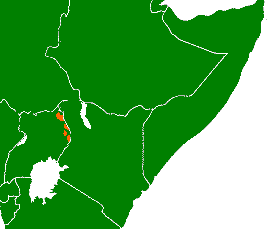
The Kuliak languages, also called the Rub languages, or Nyangiyan languages are a group of languages spoken by small relict communities in the mountainous Karamoja region of northeastern Uganda.
Nyang'i and Soo are moribund, with a handful of elderly speakers. However, Ik is vigorous and growing.
Word order in Kuliak languages is verb-initial.
The Kuliak languages are also called the Rub languages by Ehret (1981), since Ehret reconstructed "Rub" to mean 'person' in Proto-Kuliak. He suggests that "Kuliak" may actually be a derogatory term used by neighboring Nilotic-speaking peoples to disparage Kuliak speakers as "poor," hence his preference for using Rub instead. However, Kuliak continues to be the most widely used name, and is preferred by Roger Blench, Terrill Schrock, Sam Beer and other linguists, who note that the name "Kuliak" is not perceived as offensive or pejorative by any Kuliak speakers.[citation needed]
The Kuliak languages have previously had a much more extensive range in the past. Kuliak loanwords in the Luhya, Gusii, Kalenjin and Sukuma languages show that these peoples inhabited western Kenya and the southern parts of Lake Victoria before being absorbed by the ancestors of these Bantu and Nilotic speakers. These now extinct Kuliak peoples are known as the "Southern Rub". The Southern Rub lived as far south as Lake Eyasi, as shown by Kuliak loanwords in Hadza and Sandawe, and possibly as far east as the Kilimanjaro Region, as shown by Kuliak loanwords in the Chaga and Thagiicu languages.
According to the classification of Heine (1976), Soo and Nyang'i form a subgroup, Western Kuliak, while Ik stands by itself.
According to Schrock (2015), "Dorobo" is a spurious language, is not a fourth Kuliak language, and may at most be a dialect of Ik.
Heine finds the following numbers of correspondences between the languages on the 200-word Swadesh list:
Hub AI
Kuliak languages AI simulator
(@Kuliak languages_simulator)
Kuliak languages
The Kuliak languages, also called the Rub languages, or Nyangiyan languages are a group of languages spoken by small relict communities in the mountainous Karamoja region of northeastern Uganda.
Nyang'i and Soo are moribund, with a handful of elderly speakers. However, Ik is vigorous and growing.
Word order in Kuliak languages is verb-initial.
The Kuliak languages are also called the Rub languages by Ehret (1981), since Ehret reconstructed "Rub" to mean 'person' in Proto-Kuliak. He suggests that "Kuliak" may actually be a derogatory term used by neighboring Nilotic-speaking peoples to disparage Kuliak speakers as "poor," hence his preference for using Rub instead. However, Kuliak continues to be the most widely used name, and is preferred by Roger Blench, Terrill Schrock, Sam Beer and other linguists, who note that the name "Kuliak" is not perceived as offensive or pejorative by any Kuliak speakers.[citation needed]
The Kuliak languages have previously had a much more extensive range in the past. Kuliak loanwords in the Luhya, Gusii, Kalenjin and Sukuma languages show that these peoples inhabited western Kenya and the southern parts of Lake Victoria before being absorbed by the ancestors of these Bantu and Nilotic speakers. These now extinct Kuliak peoples are known as the "Southern Rub". The Southern Rub lived as far south as Lake Eyasi, as shown by Kuliak loanwords in Hadza and Sandawe, and possibly as far east as the Kilimanjaro Region, as shown by Kuliak loanwords in the Chaga and Thagiicu languages.
According to the classification of Heine (1976), Soo and Nyang'i form a subgroup, Western Kuliak, while Ik stands by itself.
According to Schrock (2015), "Dorobo" is a spurious language, is not a fourth Kuliak language, and may at most be a dialect of Ik.
Heine finds the following numbers of correspondences between the languages on the 200-word Swadesh list:
Recent media