
Recent from talks
Kuusamo
Knowledge base stats:
Talk channels stats:
Members stats:
Kuusamo
Kuusamo (Finnish: [ˈkuːsɑmo]; Northern Sami: Guossán; Inari Sami: Kuáccám; Russian: Куусамо) is a town and municipality in Finland. It is located in Koillismaa, the northeastern part of the Northern Ostrobothnia region. The municipality has a population of 14,784 (30 June 2025) and covers an area of 5,808.92 square kilometres (2,242.84 sq mi) of which 830.81 km2 (320.78 sq mi) is water. The population density is 2.97 inhabitants per square kilometre (7.7/sq mi).
The municipality is unilingually Finnish.
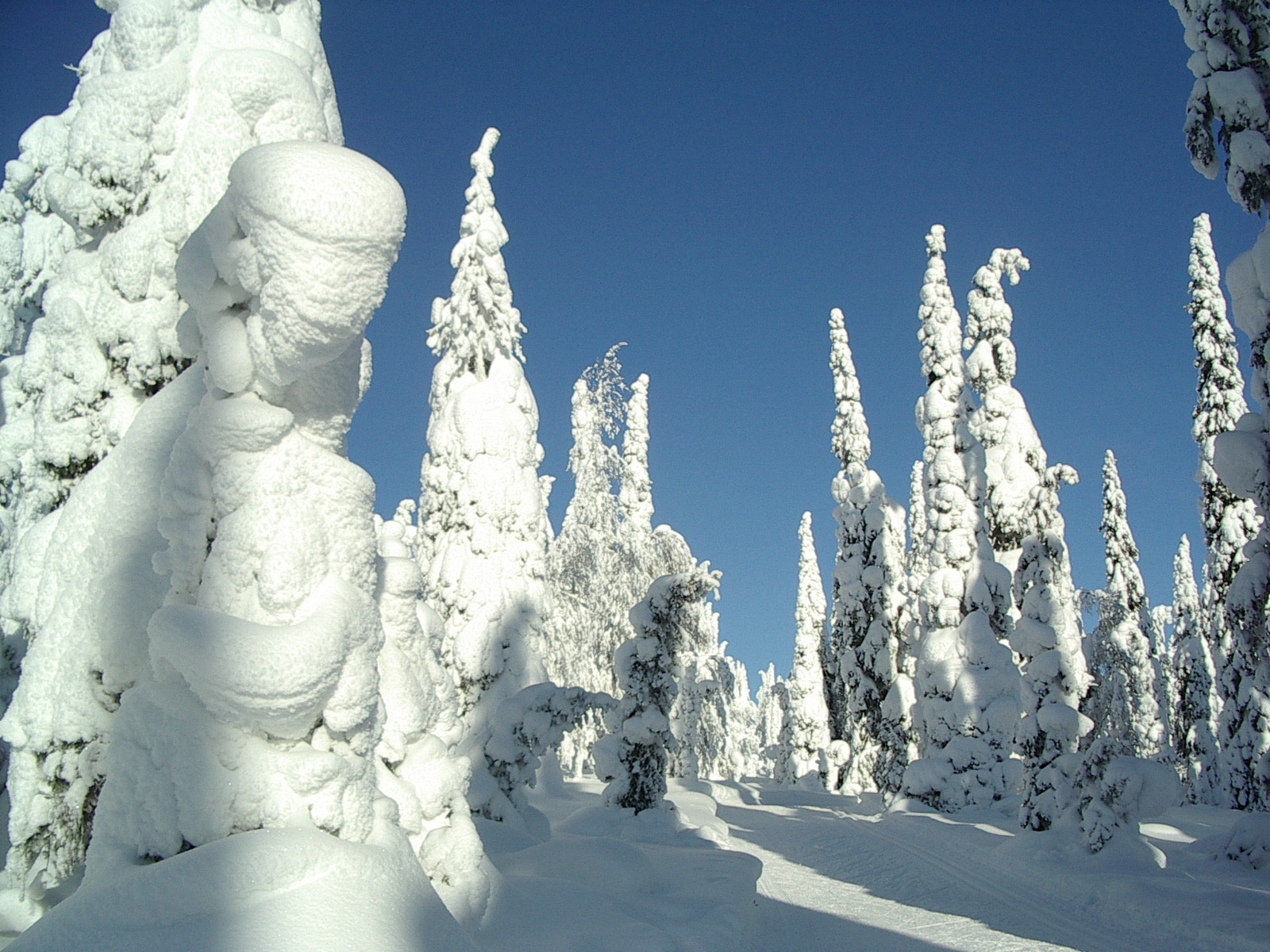
Kuusamo is a major center for winter sports and receives approximately a million tourists every year. One of the largest ski resorts in Finland, Ruka, is situated in Kuusamo. Ruka is also the host of many international competitions in ski jumping, cross-country skiing, and Nordic combined. The 2005 World Championships of Freestyle Skiing was held in Kuusamo. Kuusamo Airport is located 6 kilometres (4 mi) northeast of Kuusamo's town centre.[citation needed]
Until the 17th century, the area of Kuusamo was inhabited by the semi-nomadic Sami. During the cold season they lived in the villages Maanselkä and Kitka. In spring they moved to the rivers and in summer, after the melting of the ice, to the lakes; there they fished and gathered berries and mushrooms; in autumn they hunted reindeer, bears and beavers in the forest. Apart from fishing and hunting the Sami earned their living by trading fur with the Finns settled on the coast of the Gulf of Bothnia and the Karelians of the White Sea coast.[citation needed]
As a Sami settlement the area belonged to Kuusamo Kemi-Lappmark at the time. Nominally it belonged to the territory of the Swedish province of Västerbotten, but the Swedish rule was limited to the collection of taxes. At the same time Russia collected taxes in the territory it deemed state-less.[citation needed]
From the 15th century Finnish fishermen also took advantage of the fishing grounds on the lower reaches of the river Iijoki near Kuusamo. They took regular trips of a few weeks from Kuusamo, but because the land could not provide hay for the cattle other than near the river, they founded no fixed settlements. Only when, in 1673, the Swedish government granted all settlers in Lapland a tax exemption for 15 years, did settlers from Savo and Kainuu settle in Kuusamo. They practiced slash and burn as a form of shifting cultivation. This put the Sami's hunting way of life at risk. Within a few decades the Sami population was assimilated or ousted by the Finnish settlers. By 1718 there were only two Sámi families in Kuusamo, who had already adopted the Finnish language.
The first parish in Kuusamo was founded in 1685. In 1687 a temporary chapel was built, in 1695 the first church. From the end of the 17th century the area around the lake Kuusamojärvi began to be called Kuusamo. The precise etymology of the name is unclear, however, one possible derivation is from a Sami word for "spruce forest".[citation needed]
The Swedish–Russian border had already been withdrawn east of Kuusamo in the 1595 Treaty of Teusina, but was long and porous. With the constant influx of new settlers, Kuusamo grew steadily in the 18th century. Agriculture, cattle and reindeer husbandry replaced nomadic cropping. Kuusamo around 1770 had about 2,000 inhabitants. In 1775 Kuusamo was removed from Lappmark and added to the newly formed province of Oulu. Because the population had increased, a new, larger church was built between 1797 and 1804. By the beginning of the 19th century the population had reached 3000 inhabitants, but a famine in 1803 and a smallpox epidemic the following year reduced the population again.[citation needed]
Hub AI
Kuusamo AI simulator
(@Kuusamo_simulator)
Kuusamo
Kuusamo (Finnish: [ˈkuːsɑmo]; Northern Sami: Guossán; Inari Sami: Kuáccám; Russian: Куусамо) is a town and municipality in Finland. It is located in Koillismaa, the northeastern part of the Northern Ostrobothnia region. The municipality has a population of 14,784 (30 June 2025) and covers an area of 5,808.92 square kilometres (2,242.84 sq mi) of which 830.81 km2 (320.78 sq mi) is water. The population density is 2.97 inhabitants per square kilometre (7.7/sq mi).
The municipality is unilingually Finnish.
Kuusamo is a major center for winter sports and receives approximately a million tourists every year. One of the largest ski resorts in Finland, Ruka, is situated in Kuusamo. Ruka is also the host of many international competitions in ski jumping, cross-country skiing, and Nordic combined. The 2005 World Championships of Freestyle Skiing was held in Kuusamo. Kuusamo Airport is located 6 kilometres (4 mi) northeast of Kuusamo's town centre.[citation needed]
Until the 17th century, the area of Kuusamo was inhabited by the semi-nomadic Sami. During the cold season they lived in the villages Maanselkä and Kitka. In spring they moved to the rivers and in summer, after the melting of the ice, to the lakes; there they fished and gathered berries and mushrooms; in autumn they hunted reindeer, bears and beavers in the forest. Apart from fishing and hunting the Sami earned their living by trading fur with the Finns settled on the coast of the Gulf of Bothnia and the Karelians of the White Sea coast.[citation needed]
As a Sami settlement the area belonged to Kuusamo Kemi-Lappmark at the time. Nominally it belonged to the territory of the Swedish province of Västerbotten, but the Swedish rule was limited to the collection of taxes. At the same time Russia collected taxes in the territory it deemed state-less.[citation needed]
From the 15th century Finnish fishermen also took advantage of the fishing grounds on the lower reaches of the river Iijoki near Kuusamo. They took regular trips of a few weeks from Kuusamo, but because the land could not provide hay for the cattle other than near the river, they founded no fixed settlements. Only when, in 1673, the Swedish government granted all settlers in Lapland a tax exemption for 15 years, did settlers from Savo and Kainuu settle in Kuusamo. They practiced slash and burn as a form of shifting cultivation. This put the Sami's hunting way of life at risk. Within a few decades the Sami population was assimilated or ousted by the Finnish settlers. By 1718 there were only two Sámi families in Kuusamo, who had already adopted the Finnish language.
The first parish in Kuusamo was founded in 1685. In 1687 a temporary chapel was built, in 1695 the first church. From the end of the 17th century the area around the lake Kuusamojärvi began to be called Kuusamo. The precise etymology of the name is unclear, however, one possible derivation is from a Sami word for "spruce forest".[citation needed]
The Swedish–Russian border had already been withdrawn east of Kuusamo in the 1595 Treaty of Teusina, but was long and porous. With the constant influx of new settlers, Kuusamo grew steadily in the 18th century. Agriculture, cattle and reindeer husbandry replaced nomadic cropping. Kuusamo around 1770 had about 2,000 inhabitants. In 1775 Kuusamo was removed from Lappmark and added to the newly formed province of Oulu. Because the population had increased, a new, larger church was built between 1797 and 1804. By the beginning of the 19th century the population had reached 3000 inhabitants, but a famine in 1803 and a smallpox epidemic the following year reduced the population again.[citation needed]
Recent media