Hubbry Logo
Kuwaiti passportKuwaiti passportMain
Open search
Kuwaiti passport
Community hub
Kuwaiti passport
logo
8 pages, 0 posts
0 subscribers
Be the first to start a discussion here.
Kuwaiti passport
Kuwaiti passport
from Wikipedia

Kuwaiti passport
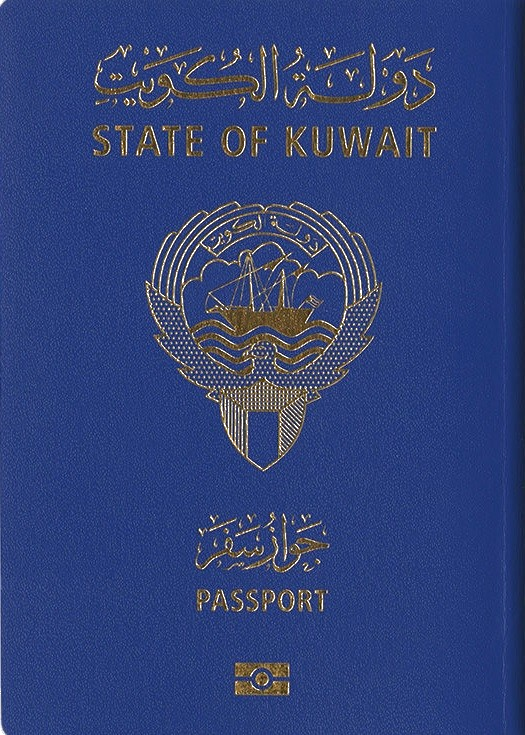
The front cover of a Kuwaiti biometric passport
TypePassport
Issued by Kuwait
First issued1920 (Sheikhdom of Kuwait)
1961 (State of Kuwait)
1998 (Machine Readable Passport)
2017 (Biometric passport)[1]
PurposeIdentification
EligibilityKuwaiti citizenship
Expiration5 years

10 years (30 years and older)

6 months (Article 14 or Stateless passport)
Cost5 years Validity 3KD 10 years Validity 6KD

The Kuwaiti passport (Arabic: جواز السفر الكويتي) is a passport document issued to citizens of Kuwait for international travel.

Types

[edit]

There are four types of Kuwaiti passports:[2]

  1. Regular passport (blue cover): issued to citizens of Kuwait.
  2. Special passport (green cover): a special passport issued to the Kuwaiti ruling family, members of parliament and high-ranking government officials.
  3. Diplomatic passport (red cover): a diplomatic passport issued to diplomats serving in Kuwaiti embassies abroad and to high-ranking officials from the executive branch.
  4. Article 14 passport (gray cover): a passport issued to stateless individuals in Kuwait who require to travel. These passports do not have the same visa policy as the regular passport.

Appearance characteristics

[edit]

The passport of a Kuwaiti citizen is distinguished by its blue colour and contains 64 pages. Each biometric passport contains an electronic chip that stores the passport holder's text and biometric personal data. The article 14 passport does not contain a biometric chip and is only valid for 6 months. [3]

Identification page

[edit]

The identity page of Kuwaiti passport  includes the following data:

  • Passport holder photo 4x5 cm with blue background
  • Type ("P" for passport)
  • Code of the country
  • Serial number of the passport
  • Surname and first name of the passport holder
  • Citizenship
  • Date of birth (DD.MM.YYYY)
  • Gender (M for men or F for women)
  • Place of Birth
  • Date of issue (DD.MM.YYYY)
  • Passport holder's signature
  • Expiry date (DD.MM.YYYY)

Passport note

[edit]

The following message is written on the front page of the passport in Arabic and English.

Arabic:

«باسم حضرة صاحب السمو أمير دولة الكويت أطلب من موظفي دولة الكويت وممثليها في الخارج، وأرجو من كل سلطة أخرى تعمل باسمها ومن السلطات الأجنبية المختصة أن يسمحو لحامل هذا الجواز بحرية المرور وأن يقدموا كل ما يحتاج إليه من مساعدة ورعاية.»

English:

"In The Name Of H.H The Amir of The State Of Kuwait, I request from all officials of The State Of Kuwait and its representatives abroad and all authorities acting in his name and the competent foreign authorities to allow the bearer of this passport to pass freely and to afford every assistance and protection of which the bearer my stand in need."

Visa requirements

[edit]
Countries and territories with visa-free or visa on arrival entry for holders of regular Kuwaiti passports
  Kuwait
  Freedom of movement
  Visa not required
  Visa on arrival
  eVisa
  Visa available both on arrival or online
  Visa required

As of April 2025, Kuwaiti citizens had visa-free or visa on arrival access to 98 countries and territories, ranking the Kuwaiti passport 50th in terms of travel freedom according to the Henley Passport Index.[4]

See also

[edit]

References

[edit]
Revisions and contributorsEdit on WikipediaRead on Wikipedia
from Grokipedia
The Kuwaiti passport is an international issued by the General Directorate of and Travel Documents under Kuwait's Ministry of Interior to nationals of the State of , enabling them to travel abroad and serve as proof of identity and . Governed by Law No. 11 of 1962, it allows for the inclusion of spouses and minor children in the holder's document under specific conditions. As of October 2025, the passport ranks 55th globally on the , providing visa-free or visa-on-arrival access to 99 countries and territories, which positions it as strongest passport in the behind those of the and . This ranking reflects Kuwait's diplomatic relations and reciprocal agreements, though access remains limited compared to top-tier passports and is subject to geopolitical factors influencing visa policies.

History

Origins and Early Issuance

The origins of formal travel documentation in Kuwait trace back to the Anglo-Kuwaiti Agreement of 1899, which granted the Sheikhdom of Kuwait the authority to issue its own travel permits, supplanting previous issuance by British viceroys. These early documents were rudimentary, consisting of single sheets of paper priced at 1 (equivalent to 75 fils) for one-year validity or 2 rupees for single-trip use to , reflecting limited international mobility and administrative capacity in the pre-oil era Sheikhdom. Issuance evolved in the mid-20th century amid economic transformation from oil revenues discovered in 1938. By the early , the Department assumed responsibility for issuance, marking the shift toward more structured documentation to facilitate growing travel for , pilgrimage, and labor migration. This period saw passports as basic booklets permitting travel primarily to neighboring Arab states such as , , , , , and , underscoring Kuwait's regional orientation before broader global engagement. Regulatory formalization occurred with Act 15 of 1959, enacted under Sheikh Abdullah Al-Salem Al-Sabah, which established a dedicated police and public security apparatus for issuing travel documents, aligning administrative practices with impending independence. Following Kuwait's independence from British protection on June 19, 1961, the first official State of Kuwait passports were issued by the Ministry of Interior on July 10, 1962, pursuant to Law No. 11 of 1962 on Passports. This law codified eligibility, procedures, and security, primarily for native-born citizens and naturalized individuals under the 1959 nationality decree, while excluding nomadic groups like the Bidoon from full citizenship documentation at independence. Early post-independence passports emphasized national sovereignty, featuring the Kuwaiti emblem and Arabic text, with validity periods typically of five years, issued manually through police directorates.

Post-Independence Developments

Following from British protection on June 19, 1961, established a sovereign framework for passport issuance through Law No. 11 of 1962, which regulated the granting, renewal, extension, replacement, and cancellation of travel documents exclusively for Kuwaiti nationals. Enacted during the reign of Amir Sheikh Abdullah Al-Salim Al-Sabah, the law marked a transition from pre- travel documents managed by the Department under British oversight, formalizing passports as instruments of state administered by the Ministry of Interior. Validity periods were set at five years for adults and minors, with provisions for diplomatic and service passports to support official travel. The legislation included Article 17, permitting the issuance of Kuwaiti passports to non-citizen government employees for executing duties abroad, thereby enabling administrative and diplomatic operations without reliance on foreign documents. It also imposed travel restrictions on married women, requiring spousal or guardian approval for departure, aligned with mid-20th-century Kuwaiti social structures but later amended by Law No. 11 of 1968 to ease such controls. Passport eligibility tied directly to the 1959 Nationality Law, which prioritized descent from pre-1920 residents and limited naturalization, resulting in controlled issuance volumes amid population growth from oil-driven migration. In the initial decades, issuance expanded to accommodate naturalized citizens and economic expatriates, but excluded Bidoon residents—stateless Arabs of nomadic origin—who received temporary travel documents rather than full passports until mid-1980s policy tightenings curtailed even those amid security concerns post-Gulf War. This period saw passports evolve from basic sovereignty markers to tools of , with the Ministry's of Nationality and Passports centralizing operations to handle rising demand from a citizenry numbering around 100,000 in , growing to over 500,000 by 1980.

Modernization and Technological Upgrades

Kuwait transitioned to machine-readable passports in 1998, incorporating a machine-readable zone (MRZ) at the bottom of the data page to enable automated scanning and processing at international borders, reducing manual errors and expediting verification. This upgrade aligned the document with emerging global standards for travel documentation, facilitating integration with computerized immigration systems. A major advancement occurred in 2017 with the introduction of biometric e-passports, featuring an embedded (RFID) chip that stores the holder's personal details, including name, date of birth, and a digital facial image for biometric verification. The chip employs (PKI) for digital signatures, ensuring and authenticity against tampering or forgery during border checks. Compliance with (ICAO) Doc 9303 standards allows contactless reading by authorized readers, enhancing security while supporting seamless travel to e-passport-enabled destinations. These e-passports include anti-counterfeiting measures such as optically variable inks, holograms, and data pages resistant to alteration, building on earlier manual designs to minimize replication risks. Enrollment processes were modernized with mobile biometric capture units for data collection, and an offline emergency mode permits chip functionality without network access, addressing operational resilience in remote or disrupted environments. Ongoing enhancements under Kuwait's Vision 2035 initiative integrate passport data with national systems, enabling electronic verification services like certified digital copies issued via the Ministry of Interior portal, further streamlining issuance and renewal while bolstering fraud detection through centralized biometric registries. By late 2018, non-biometric passports had largely expired, ensuring widespread adoption of these upgraded versions among citizens.

Eligibility and Issuance

Citizenship Criteria for Passport Eligibility

Kuwaiti , which determines eligibility for a Kuwaiti passport, is governed by Ministerial Decree No. 15 of 1959 promulgating the , emphasizing through paternal descent. Under Article 2, any person born to a Kuwaiti father—whether in or abroad—acquires Kuwaiti nationality at birth, provided the father held Kuwaiti nationality at the time of birth. This criterion privileges lineage from pre-independence inhabitants, reflecting Kuwait's policy to limit citizenship to those with historical ties to the original citizenry established around 1920. Article 3 extends nationality to persons born in Kuwait whose paternity is unknown or unestablished, with foundlings presumed Kuwaiti unless proven otherwise; children of Kuwaiti mothers married to foreign fathers may also receive it by Amiri decree in cases of or paternal death, if residing in Kuwait until majority. Naturalization offers a secondary, highly restrictive pathway under Article 4, requiring applicants to be of full age, with 20 consecutive years of lawful residence in (reduced to 15 years for from other Arab countries), a lawful source, good conduct without convictions related to honor or , proficiency in , and either being Muslim by birth or having converted to at least five years prior (with possible upon ). Approval is discretionary via Amiri and contingent on rendering valuable services to or meeting exceptional residency thresholds predating 1945 for or 1930 for others, per Article 5. In practice, naturalizations are infrequent, with annual grants typically numbering in the low hundreds and prioritized for those demonstrating and integration, amid concerns over demographic balance in a where citizens comprise about 30% of residents. Amendments enacted via Decree Law No. 116/2024, published in January 2025, further tightened criteria by permanently barring foreign women married to Kuwaiti men from acquiring through , previously possible after extended residency, to safeguard against perceived fraudulent claims and demographic shifts. Passport eligibility strictly requires verified Kuwaiti , typically proven via a civil ID card or certificate from the Ministry of Interior's of and , without which applications are rejected; dual is not formally recognized for Kuwaitis, though tolerated in some cases. can be revoked for reasons including abroad, criminal convictions, or disloyalty, as expanded under the 2024 decree, potentially rendering affected individuals ineligible for renewal or issuance.

Application Procedures and Validity Periods

Kuwaiti passports are issued exclusively to Kuwaiti through the Ministry of Interior's General Department of . First-time applications require the presence of a legal representative for minors, along with submission of the applicant's civil ID card and a copy thereof, adhering to specified passport photo requirements such as a 4x5 cm size with a blue background. Applicants must visit designated service centers to complete the process, which involves form submission and fee payment; processing typically occurs in person without pre-application for initial issuance. Renewal procedures mandate visiting the General Department of Citizenship, where applicants submit required documents including the existing (if applicable), civil ID, and compliant photographs, followed by completing an application form and settling fees. Legal representatives handle renewals for minors, with distinct services available for renewal specifically for those under 18, requiring the physical and photos meeting the 4x5 cm blue-background standard. Replacement for lost or damaged passports follows a similar in-person protocol at the department, involving verification of identity via civil ID and additional fees. Standard validity periods for ordinary Kuwaiti passports are 5 years, with fixed fees of 3 Kuwaiti dinars (KD); however, since a policy update by the Ministry of Interior, applicants aged 21 and older may opt for or receive 10-year validity at a fee of 6 KD, particularly those over 30 years old. This extension applies to renewals and new issuances for eligible adults, reflecting administrative streamlining while maintaining biometric and security standards. Minors' passports generally align with the 5-year term, subject to parental discretion in application.

Types and Variants

Standard Ordinary Passports

The standard ordinary , referred to interchangeably as the regular , serves as the principal for Kuwaiti citizens engaging in personal, , or business-related international travel. It is issued by the Ministry of Interior's of Nationality and Passports to individuals holding Kuwaiti , excluding those eligible for diplomatic or special variants. Unlike diplomatic passports, which are reserved for officials on official duties, or special passports allocated to members of the ruling family, the ordinary lacks privileges such as enhanced diplomatic protections or expedited consular services. Eligibility for the ordinary passport requires proof of Kuwaiti nationality, typically demonstrated via a valid civil identification card, , or documents, with applications submitted either in-person at designated service centers or through the app for eligible citizens. For first-time applicants, required materials include a recent 4x5 cm with a background, the applicant's civil ID (original and copy), and for minors, parental civil IDs, the child's , and proof of custody if applicable. Adult citizens aged 21 and older can apply for issuance or renewal independently, while minors under 21 require guardian accompaniment or . Processing occurs at Ministry of Interior facilities, with renewals accepted only for passports having six months or less remaining validity to ensure timely updates. Since 2010, ordinary passports incorporate biometric "smart" technology, including an embedded electronic chip storing facial recognition data, fingerprints, and iris scans for enhanced identity verification and anti-forgery measures, aligning with standards. The document features a blue cover emblazoned with the State of emblem and , distinguishing it from the red diplomatic and green special covers. It facilitates access to approximately 98 visa-free or visa-on-arrival destinations as of 2025, though actual mobility depends on bilateral agreements and holder compliance with entry requirements.

Diplomatic and Special-Issue Passports

Kuwaiti diplomatic passports feature a cover and are issued to posted at Kuwaiti embassies and consulates abroad, as well as to high-ranking executive branch officials performing official state functions. These passports are produced as biometric documents, with the diplomatic variant first introduced in its current e-passport format on January 1, 2016. Issuance falls under the ' Protocol Affairs Department, which handles diplomatic passport applications without fees, aligning with standard practices for such documents to facilitate international representation without financial barriers. In March 2025, the Kuwaiti government directed ministries to compile lists of entitled officials to curb misuse, reflecting efforts to restrict distribution to verified diplomatic roles amid concerns over proliferation. Special-issue passports, identifiable by their green cover, are allocated to select categories of senior government personnel and dignitaries not qualifying for diplomatic variants, including certain protocol-exempt individuals. Like diplomatic passports, the special type incorporates biometric features and was standardized in e-passport form starting January 1, 2016. These documents, also fee-free, support official travel for non-diplomatic state purposes, such as missions requiring elevated access without full diplomatic status. The Ministry of Interior oversees broader passport issuance, but special variants coordinate with protocols to ensure alignment with 's international commitments. An additional special-issue category, known as Article 17 passports with grey covers, addresses exceptional circumstances under , typically for individuals with restricted citizenship status or temporary travel needs approved by . These are issued sparingly to mitigate access gaps while maintaining national security controls, though exact eligibility remains administratively opaque and tied to interior ministry discretion. Both diplomatic and special passports generally carry five-year validity periods, renewable upon role verification, and provide enhanced visa privileges in bilateral agreements, such as exemptions with countries like and for holders.

Physical Characteristics and Security Features

External Design and Cover

The standard ordinary Kuwaiti passport features a blue hard cover constructed from plastic material, forming a single booklet measuring 88 mm in width and 125 mm in height. The exterior includes gold hot foil stamping for embossing, prominently displaying the text "PASSPORT," "STATE OF KUWAIT," and the Kuwaiti coat of arms, which depicts a golden eagle clutching a shield bearing the national flag. A feature on the cover consists of a fluorescent , invisible under normal light but detectable under illumination at 365 nm. This design aligns with ICAO standards for machine-readable documents, emphasizing durability and tamper resistance. Variant passports differ in cover color to denote type: diplomatic passports use red covers, special-issue passports green covers, and Article 17 documents for stateless residents grey covers, each retaining similar embossing and elements adapted to their category.

Internal Pages and Data Page

The data page of the Kuwaiti ordinary , designated as page 1, records the holder's personal details in and English, including document type ("P" for personal), issuing country code ("KWT"), passport number, , given names, ("Kuwaiti"), date of birth, sex, , date of issue, issuing authority (Ministry of Interior), and expiry date. It incorporates a color of the holder, positioned to the right, alongside a secondary ghost image for . The machine-readable zone (MRZ) spans two lines at the bottom, compliant with ICAO standards, encoding key biographical data. An embedded biometric chip, located beneath the photo, stores digitized facial image, fingerprints, and iris scans for electronic verification. Security integrations on this or equivalent laminate page include UV-fluorescent overprints visible under 365 nm , a centered , laser-engraved personalized numbering, and a diffractive optically variable image device (DOVID) in the laminate to deter tampering. The passport booklet totals 64 pages, with pages 2 and 3 typically reserved for notes on regulations and observations. Visa pages, spanning pages 4 through 64, consist of featuring varying Kuwaiti national motifs—such as architectural or cultural elements—and are designed for stamps and endorsements. These pages embed UV-fluorescent fibers detectable under , along with full-page watermarks observable under transmitted and sequential numbering for checks. Construction utilizes paper with integrated security threads running vertically, enhancing resistance to . Printing employs intaglio for raised tactile elements and holographic features for optical variability. Inside the front and back covers, additional protections include UV-reactive patterns, embedded security threads, multi-tonal watermarks, and laminate-embedded UV elements, collectively forming a layered anti-counterfeiting system aligned with international standards.

Biometric Integration and Anti-Counterfeiting Measures

The Kuwaiti e-passport, introduced in February 2017, integrates a contactless RFID chip compliant with (ICAO) standards for machine-readable travel documents (eMRTD). This chip stores the holder's digitized as the primary biometric identifier, along with and an for individuals aged 12 and older, enabling automated verification at international borders to confirm identity against physical presentation. Biometric is securely transferred from the Ministry of Interior's Information Systems Department to the Passports Department via fiber-optic networks, with the chip programmed locally to enhance sovereignty over personalization processes. Children under 12 are exempt from fingerprint and signature enrollment, relying primarily on . To protect chip data from skimming and eavesdropping, the e-passport employs access control mechanisms such as Basic Access Control (BAC), which requires physical scanning of the machine-readable zone before unlocking contents, a standard feature in ICAO-compliant documents. The data page integrates laser-engraved personal details and a secondary ghost facial image, fusing the chip's digital with tamper-evident physical elements for multi-layered . Anti-counterfeiting measures in the 2017 redesign incorporate over 52 specialized features, including diffractive optically variable image devices (DOVID) in the laminate, UV-fluorescent overprints visible only under 365 nm light, multi-tonal watermarks discernible under transmitted light, and hot-foil embossing on the cover. Internal pages feature varying UV motifs, , and intaglio printing techniques, while the overall design draws on Kuwaiti cultural motifs to complicate without specialized equipment. These elements, combined with the biometric chip's cryptographic protections, align with global efforts to reduce document rates, as evidenced by ICAO benchmarks for resistance. Special-issue variants, such as diplomatic passports, exhibit analogous features including fluorescent security threads and personalized holographics, ensuring uniformity in tamper detection across types.

Global Mobility and Visa Access

Visa-Free and Visa-on-Arrival Destinations

Kuwaiti passport holders benefit from visa-free access or visa on arrival to approximately 99 destinations worldwide, as reported by the Henley Passport Index in 2025, ranking the passport 55th globally in terms of travel freedom. This figure encompasses countries where no prior visa is required, including visa-free entry, visas on arrival, and electronic travel authorizations, based on data from the International Air Transport Association (IATA). Alternative indices, such as Passport Index, report a combined total of around 87 such destinations, reflecting variations in methodology regarding electronic visas and territorial inclusions. Within the Gulf Cooperation Council (GCC), Kuwaiti citizens enjoy freedom of movement, permitting indefinite stays for residence, work, and other purposes in Bahrain, Oman, Qatar, Saudi Arabia, and the United Arab Emirates without any visa requirements, as stipulated in the GCC Economic Agreement. This intra-GCC mobility facilitates seamless regional travel and economic integration among member states. Beyond GCC countries, visa-free access is available to select destinations across continents. In Asia, notable visa-free entries include (90 days), (30 days), (60 days), and (90 days), alongside visa on arrival options in (30 days), (30 days), and (150 days). In Europe, access is restricted primarily to non-Schengen states such as Georgia (360 days), (90 days), and (90 days), with countries generally requiring prior visas. African destinations include visa-free entry to (90 days) and (90 days), and visa on arrival in (90 days) and (30 days). In the Americas, visa-free access covers (90 days), (90 days), and several Caribbean nations like St. Vincent and the Grenadines (90 days), with limited options elsewhere. These arrangements are subject to change based on bilateral agreements and diplomatic relations; for instance, extended visa-free stays to 30 days for Kuwaitis starting , 2025. Travelers must verify current requirements, as durations and conditions can vary, and some entries impose additional fees or mandates.

Passport Power Rankings and Comparative Strength

The ranks 55th globally in the 2025 , granting holders visa-free or visa-on-arrival access to 99 destinations out of 227 analyzed. This positions it as the third-strongest in the , behind the (11th globally with 184 destinations) and (approximately 20th with around 150 destinations), reflecting Kuwait's diplomatic ties within the (GCC) that facilitate seamless intra-regional travel. In contrast, the Arton Capital Passport Index for 2025 places the Kuwaiti passport at 41st worldwide, with access to 111 destinations, a figure that incorporates a broader interpretation of visa-on-arrival facilitations compared to Henley's stricter IATA-sourced methodology focused on confirmed entry permissions. These rankings underscore the passport's mid-tier global mobility, stronger than passports from populous developing nations like India (85th in Henley with 62 destinations) but significantly below top-tier Western and East Asian passports such as those of Singapore or Japan, which exceed 190 destinations. Comparatively, the Kuwaiti passport's strength derives primarily from reciprocal agreements with GCC states, select Asian and African countries, and limited European Schengen access requiring visas, limiting its utility for unrestricted Western travel amid geopolitical and security-related restrictions imposed by some destinations. VisaIndex.com, drawing from government and airline data, ranks it 52nd with 97 destinations, highlighting variability across indices due to differing counts of e-visas and short-term waivers, yet consistently affirming its adequacy for regional and travel rather than broad global freedom.

Controversies and Policy Challenges

Citizenship Revocations and Passport Invalidation

Kuwait's (Law No. 15 of 1959, as amended) authorizes the revocation of citizenship in cases involving fraudulent acquisition, submission of false information during , possession of multiple nationalities without permission, or threats to . Such revocations extend to descendants of naturalized individuals if the original grant was deemed irregular, targeting primarily those naturalized post-1965 under discretionary provisions like Article 8 for "outstanding services" or familial ties. Government officials describe these actions as corrective measures against historical over-naturalization and document , with over 1,060 citizenships revoked in 2025 alone amid a investigation involving fabricated family lineages. Upon revocation, affected individuals' Kuwaiti passports are immediately invalidated, rendering them unusable for international travel except for one-time returns to Kuwait if holders are abroad at the time of notification. The Ministry of Interior requires surrender of physical documents, and electronic systems block access to passport services, effectively stranding many domestically or limiting mobility. In 2025, this process accelerated, with nearly 42,000 revocations by March, including 464 in a single day on March 6, often without prior notice or judicial appeal, leading to abrupt statelessness. Temporary grace periods have been granted sporadically, such as a four-month window from July 19, 2025, for appeals or status regularization, though the October 1, 2025, expiration of leniency for Article 8 cases ended such allowances for many. These invalidations have disproportionately impacted naturalized women (over 37,000 by mid-2025, many via marriage) and Shiite or tribal groups suspected of irregular grants, exacerbating among an estimated 100,000-120,000 already undocumented Bidoon. organizations, including Minority Rights Group International, criticize the policy for lacking due process and violating international norms against arbitrary deprivation, though authorities maintain it preserves citizenship's exclusivity to pre-1965 lineages. Revocations have even applied retroactively to deceased persons, as in August 2025 when citizenship was stripped from two actors years after their deaths to purge alleged fraudulent lines. Affected parties face loss of public services, employment rights, and residency, with no automatic path to reinstatement absent proven eligibility under stricter inheritance rules.

Stateless Populations and Access Restrictions

The Bidoon (also spelled Bidun), a stateless Arab population in Kuwait numbering approximately 100,000 to 200,000 individuals, primarily descendants of nomadic tribes who resided in the region prior to 's independence in 1961, are denied Kuwaiti citizenship and thus excluded from obtaining standard Kuwaiti passports. Classified by the Kuwaiti government as "illegal residents" despite their long-term presence, Bidoon lack access to civil documentation, including birth certificates and national IDs, which further bars them from passport issuance. This exclusion stems from 's , which restricts citizenship to those registered in official censuses by specific deadlines in the and 1960s, leaving many Bidoon undocumented as the state prioritizes ethnic Kuwaiti lineage tied to pre-oil-era settlements. Travel for Bidoon is severely restricted, with the generally refusing to issue any form of documents, rendering international mobility impossible for most and confining them within Kuwait's borders. In exceptional cases, a limited "Article 17 " or temporary permit may be granted on a discretionary basis, often requiring proof of foreign or humanitarian need, but these are rarely approved and permit only to designated countries, such as for medical treatment or . Kuwait's refusal to formally recognize within its territory exacerbates these barriers, as Bidoon are treated as concealed foreign nationals rather than a distinct apatrid group deserving protections under international conventions like the 1954 UN Convention Relating to the Status of Stateless Persons, which Kuwait has not ratified. Recent policies of mass citizenship revocation have expanded Kuwait's stateless population beyond the traditional Bidoon, creating new categories of individuals stripped of passports and facing identical access restrictions. Between late 2024 and mid-2025, Kuwaiti authorities revoked from over 42,000 persons, often citing dual nationality violations or administrative irregularities, rendering them stateless overnight without or appeal mechanisms compliant with . Affected individuals have their Kuwaiti immediately invalidated and blocked from use, prohibiting foreign travel and exposing them to risks despite lifelong residency. This practice, accelerated under decrees targeting women, naturalized citizens, and those accused of holding foreign passports, aligns with Kuwait's jus sanguinis-based nationality framework but has drawn criticism from observers for arbitrarily increasing without providing alternative documentation or residency permits. As a result, these newly stateless persons encounter the same passport denial and mobility constraints as Bidoon, including inability to renew expired documents or obtain exit visas, effectively stranding them domestically.

References

Add your contribution
Related Hubs
User Avatar
No comments yet.