
Recent from talks
LHCb experiment
Knowledge base stats:
Talk channels stats:
Members stats:
LHCb experiment
46°14′28″N 06°05′49″E / 46.24111°N 6.09694°E
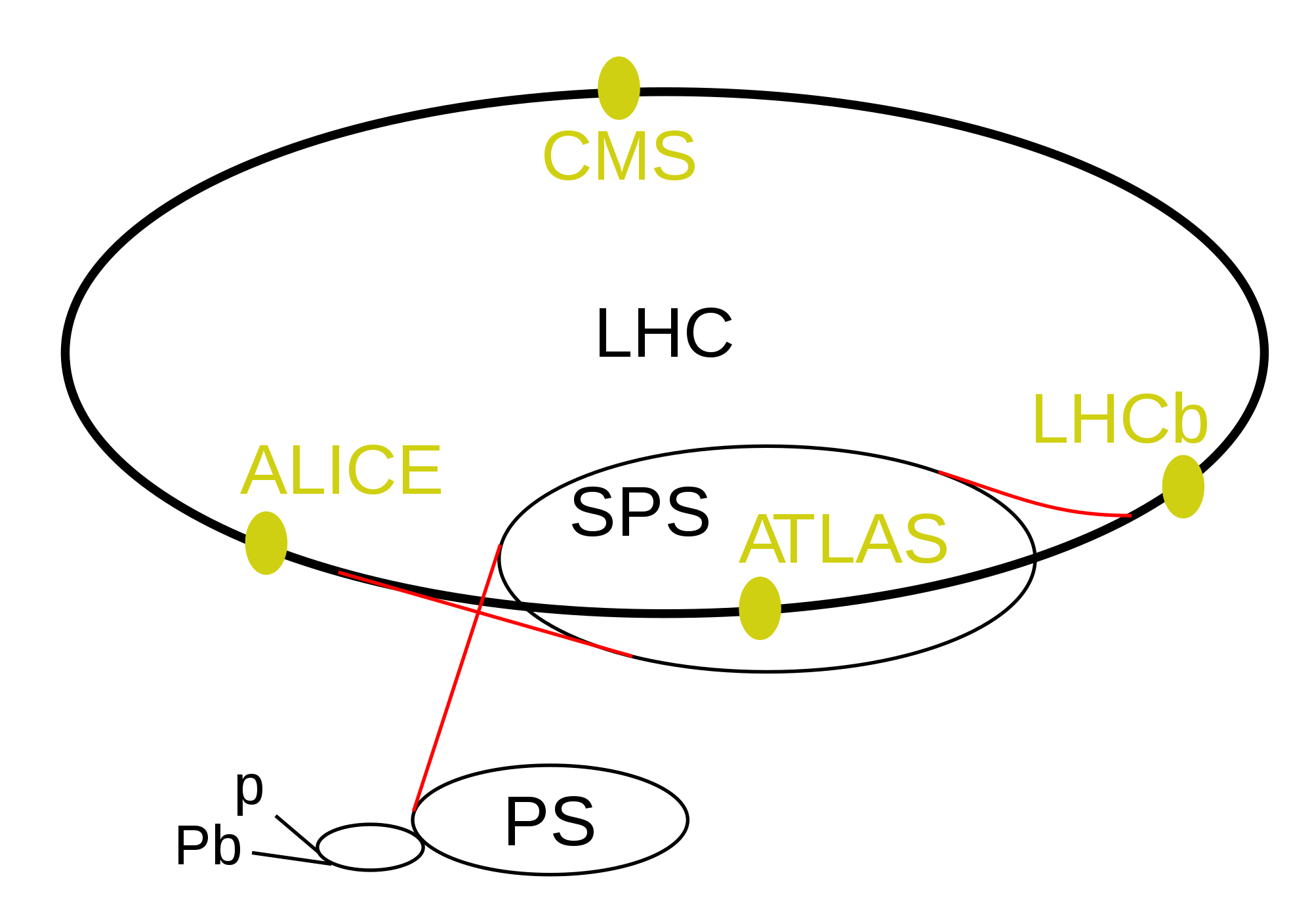
The LHCb (Large Hadron Collider beauty) experiment is a particle physics detector collecting data at the Large Hadron Collider at CERN. LHCb specializes in the measurements of the parameters of CP violation in the interactions of b- and c-hadrons (heavy particles containing a bottom and charm quarks). Such studies can help to explain the matter-antimatter asymmetry of the Universe. The detector is also able to perform measurements of production cross sections, exotic hadron spectroscopy, and electroweak physics in the forward region. The LHCb collaborators, who built, operate and analyse data from the experiment, are composed of approximately 1650 people from 98 scientific institutes, representing 22 countries. Vincenzo Vagnoni succeeded on July 1, 2023 as spokesperson for the collaboration from Chris Parkes (spokesperson 2020–2023). The experiment is located at point 8 on the LHC tunnel close to Ferney-Voltaire, France just over the border from Geneva. The (small) MoEDAL experiment shares the same cavern.
The experiment has wide physics program covering many important aspects of heavy flavour (both beauty and charm), electroweak and quantum chromodynamics (QCD) physics. Six key measurements have been identified involving B mesons. These are described in a roadmap document that formed the core physics programme for the first high energy LHC running in 2010–2012. They include:
The fact that the two b-hadrons are predominantly produced in the same forward cone is exploited in the layout of the LHCb detector. The LHCb detector is a single arm forward spectrometer with a polar angular coverage from 10 to 300 milliradians (mrad) in the horizontal and 250 mrad in the vertical plane. The asymmetry between the horizontal and vertical plane is determined by a large dipole magnet with the main field component in the vertical direction.
The Vertex Locator (VELO) is built around the proton interaction region. It is used to measure the particle trajectories close to the interaction point in order to precisely separate primary and secondary vertices.
The detector operates at 7 millimetres (0.28 in) from the LHC beam. This implies an enormous flux of particles; VELO has been designed to withstand integrated fluences of more than 1014 p/cm2 per year for a period of about three years. The detector operates in vacuum and is cooled to approximately −25 °C (−13 °F) using a biphase CO2 system. The data of the VELO detector are amplified and read out by the Beetle ASIC.
The RICH-1 detector (Ring imaging Cherenkov detector) is located directly after the vertex detector. It is used for particle identification of low-momentum tracks.
The main tracking system is placed before and after the dipole magnet. It is used to reconstruct the trajectories of charged particles and to measure their momenta. The tracker consists of three subdetectors:
Hub AI
LHCb experiment AI simulator
(@LHCb experiment_simulator)
LHCb experiment
46°14′28″N 06°05′49″E / 46.24111°N 6.09694°E
The LHCb (Large Hadron Collider beauty) experiment is a particle physics detector collecting data at the Large Hadron Collider at CERN. LHCb specializes in the measurements of the parameters of CP violation in the interactions of b- and c-hadrons (heavy particles containing a bottom and charm quarks). Such studies can help to explain the matter-antimatter asymmetry of the Universe. The detector is also able to perform measurements of production cross sections, exotic hadron spectroscopy, and electroweak physics in the forward region. The LHCb collaborators, who built, operate and analyse data from the experiment, are composed of approximately 1650 people from 98 scientific institutes, representing 22 countries. Vincenzo Vagnoni succeeded on July 1, 2023 as spokesperson for the collaboration from Chris Parkes (spokesperson 2020–2023). The experiment is located at point 8 on the LHC tunnel close to Ferney-Voltaire, France just over the border from Geneva. The (small) MoEDAL experiment shares the same cavern.
The experiment has wide physics program covering many important aspects of heavy flavour (both beauty and charm), electroweak and quantum chromodynamics (QCD) physics. Six key measurements have been identified involving B mesons. These are described in a roadmap document that formed the core physics programme for the first high energy LHC running in 2010–2012. They include:
The fact that the two b-hadrons are predominantly produced in the same forward cone is exploited in the layout of the LHCb detector. The LHCb detector is a single arm forward spectrometer with a polar angular coverage from 10 to 300 milliradians (mrad) in the horizontal and 250 mrad in the vertical plane. The asymmetry between the horizontal and vertical plane is determined by a large dipole magnet with the main field component in the vertical direction.
The Vertex Locator (VELO) is built around the proton interaction region. It is used to measure the particle trajectories close to the interaction point in order to precisely separate primary and secondary vertices.
The detector operates at 7 millimetres (0.28 in) from the LHC beam. This implies an enormous flux of particles; VELO has been designed to withstand integrated fluences of more than 1014 p/cm2 per year for a period of about three years. The detector operates in vacuum and is cooled to approximately −25 °C (−13 °F) using a biphase CO2 system. The data of the VELO detector are amplified and read out by the Beetle ASIC.
The RICH-1 detector (Ring imaging Cherenkov detector) is located directly after the vertex detector. It is used for particle identification of low-momentum tracks.
The main tracking system is placed before and after the dipole magnet. It is used to reconstruct the trajectories of charged particles and to measure their momenta. The tracker consists of three subdetectors:
Recent media