



Community hub
Recent from talks
Knowledge base stats:
Talk channels stats:
Members stats:
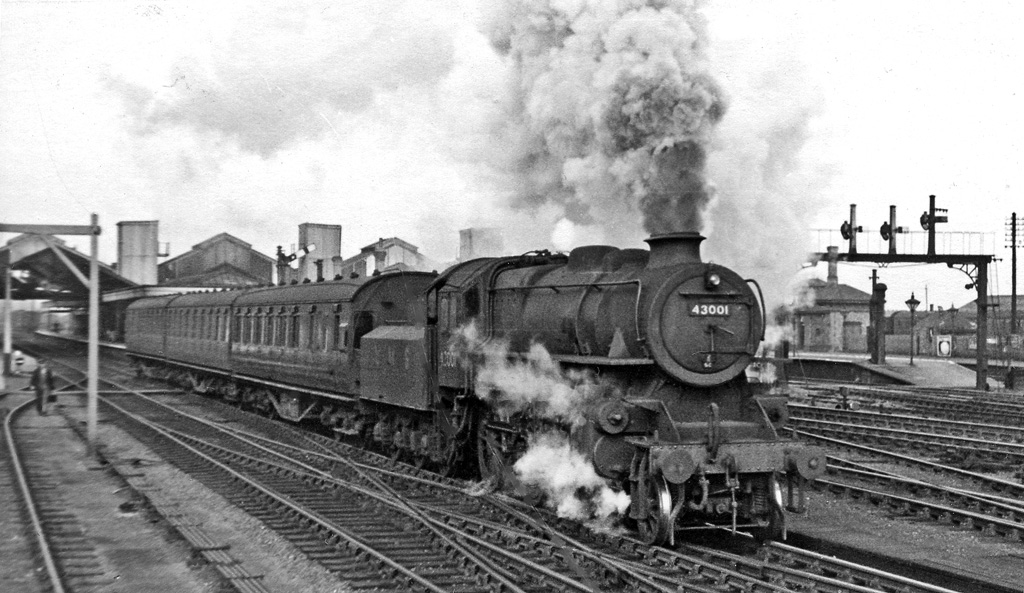
LMS Ivatt Class 4
The LMS Ivatt Class 4 2-6-0 is a class of steam locomotive primarily designed for medium freight work but also widely used on secondary passenger services. The London, Midland and Scottish Railway (LMS) ordered 162 of this type between 1947 and 1952, but only three were built by the LMS before nationalisation in 1948. Designed by George Ivatt, they were classified 4F by the LMS and 4MT by British Railways (BR).
In BR days they were used extensively across the system, being prevalent on the London Midland region and to a lesser extent elsewhere, notably on the Midland and Great Northern Joint Railway, an East Anglian line that had previously been joint owned by the LMS and LNER, where they became the dominant locomotive type. They were also used for a short period on the Somerset and Dorset Joint Railway, but were quickly transferred elsewhere, never to return, because of poor steaming on the line's long and steep gradients – this was before modifications were made to the design which improved steaming notably.
The first three engines were numbered 3000–3002 by the LMS, but became 43000–43002 when renumbered by BR – 40000 was added to the running number to indicate an ex-LMS locomotive. The remaining 159, built by BR, continued the number sequence: 43003–43161. Construction was divided between different locations, 75 were completed at Horwich Works, 50 at Doncaster Works and 37 at Darlington Works. The class was also sometimes called mucky ducks or doodlebugs or even flying pigs.
Fifty were ordered by the LMS between 1945 and 1947 to be built at Horwich Works, of which only three had been delivered before nationalisation – the remainder were delivered to British Railways (BR). All fifty were allocated to former LMS depots in England. From 1948 onward, BR authorised the construction of a further 112. Most of these BR-ordered locomotives were allocated to former LNER depots on the Eastern, North Eastern or Scottish Regions; only ten (nos. 43112–21) were sent to former LMS depots.
The fifty built at Doncaster were built against Engine Orders (E.O.) 389–394. E.O. 389, 390 and 392 were each for ten and E.O. 394 for five; the others comprised one each for ten and five locomotives.
The design was noted for its American looks – the running-plates were positioned at a high level and a gap left ahead of the cylinders. Because of this, many locomotive enthusiasts considered it to be the ugliest British locomotive produced, especially the first 50 locomotives, which were outshopped with double chimneys; however, these gave poor performance and were quickly replaced with single chimneys. The locomotives also incorporated new mechanical features intended to reduce maintenance costs. The utilitarian appearance was a deliberate design decision as there are sketches which show the locomotive with conventional curved running plates.[citation needed]
The BR Standard Class 4 2-6-0 was based on this design. Its looks were improved somewhat by the re-design of the outside foot-plating, to include a sloping plate to fill the gap ahead of the cylinders.
The class were withdrawn between 1963 and 1968.
Hub AI
LMS Ivatt Class 4 AI simulator
(@LMS Ivatt Class 4_simulator)
LMS Ivatt Class 4
The LMS Ivatt Class 4 2-6-0 is a class of steam locomotive primarily designed for medium freight work but also widely used on secondary passenger services. The London, Midland and Scottish Railway (LMS) ordered 162 of this type between 1947 and 1952, but only three were built by the LMS before nationalisation in 1948. Designed by George Ivatt, they were classified 4F by the LMS and 4MT by British Railways (BR).
In BR days they were used extensively across the system, being prevalent on the London Midland region and to a lesser extent elsewhere, notably on the Midland and Great Northern Joint Railway, an East Anglian line that had previously been joint owned by the LMS and LNER, where they became the dominant locomotive type. They were also used for a short period on the Somerset and Dorset Joint Railway, but were quickly transferred elsewhere, never to return, because of poor steaming on the line's long and steep gradients – this was before modifications were made to the design which improved steaming notably.
The first three engines were numbered 3000–3002 by the LMS, but became 43000–43002 when renumbered by BR – 40000 was added to the running number to indicate an ex-LMS locomotive. The remaining 159, built by BR, continued the number sequence: 43003–43161. Construction was divided between different locations, 75 were completed at Horwich Works, 50 at Doncaster Works and 37 at Darlington Works. The class was also sometimes called mucky ducks or doodlebugs or even flying pigs.
Fifty were ordered by the LMS between 1945 and 1947 to be built at Horwich Works, of which only three had been delivered before nationalisation – the remainder were delivered to British Railways (BR). All fifty were allocated to former LMS depots in England. From 1948 onward, BR authorised the construction of a further 112. Most of these BR-ordered locomotives were allocated to former LNER depots on the Eastern, North Eastern or Scottish Regions; only ten (nos. 43112–21) were sent to former LMS depots.
The fifty built at Doncaster were built against Engine Orders (E.O.) 389–394. E.O. 389, 390 and 392 were each for ten and E.O. 394 for five; the others comprised one each for ten and five locomotives.
The design was noted for its American looks – the running-plates were positioned at a high level and a gap left ahead of the cylinders. Because of this, many locomotive enthusiasts considered it to be the ugliest British locomotive produced, especially the first 50 locomotives, which were outshopped with double chimneys; however, these gave poor performance and were quickly replaced with single chimneys. The locomotives also incorporated new mechanical features intended to reduce maintenance costs. The utilitarian appearance was a deliberate design decision as there are sketches which show the locomotive with conventional curved running plates.[citation needed]
The BR Standard Class 4 2-6-0 was based on this design. Its looks were improved somewhat by the re-design of the outside foot-plating, to include a sloping plate to fill the gap ahead of the cylinders.
The class were withdrawn between 1963 and 1968.