
Recent from talks
La Malbaie
Knowledge base stats:
Talk channels stats:
Members stats:
La Malbaie
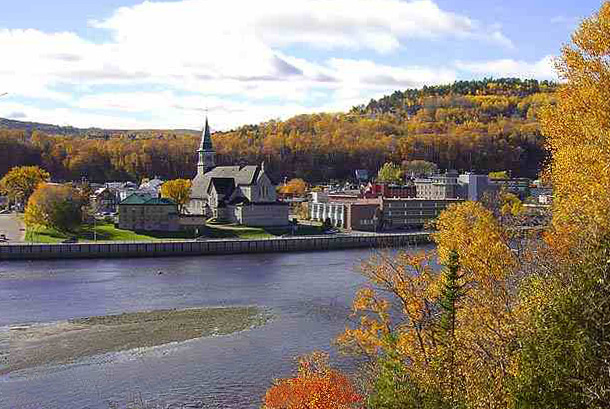
La Malbaie (French pronunciation: [la malbɛ]) is a municipality in the Charlevoix-Est Regional County Municipality in the Province of Quebec, Canada, situated on the north shore of the St. Lawrence River at the mouth of the Malbaie River. It was formerly known as Murray Bay. La Malbaie is the seat of the judicial district of Charlevoix.
Although the main business district is located at the mouth of the Malbaie River, the town itself covers a vast area that extends inland along both sides of the Malbaie River and north and south along the St. Lawrence River. The village of Pointe-au-Pic amalgamated with La Malbaie in 1995, and the villages of Rivière-Malbaie, Sainte-Agnès, Cap-à-l'Aigle, and Saint-Fidèle were added in 1999. The neighbouring town of Clermont is located about 7 kilometres (4.3 mi) upstream along the Malbaie River.
1605: French explorer Samuel de Champlain fails to find suitable anchorage on his arrival in the area in May and names the bay Malle Baye (old French for “bad bay”).
1688: Rudimentary settlement begins at La Malbaie to export lumber to France, but the focus quickly turns to the fur trade and beluga fishing.
1724: A farm established at La Malbaie begins providing meat and grain to the French king's trading posts along the St. Lawrence River.
1763: Two Scottish officers of the British Army—John Nairne (1731–1802) and Malcolm Fraser (1733–1815)—receive concessions in the area from the British Crown. Nairne's encompasses the tiny settlement of La Malbaie and the western side of the Malbaie River. Fraser's stretches to the east. They also rename the bay, settlement, and river “Murray Bay” after James Murray (1721–1794), a British general and the successor to General James Wolfe. Murray Bay never becomes the official name, but is the internationally accepted toponym in the 18th and 19th centuries even though La Malbaie remains in local use.
1774: The parish of Saint-Étienne-de-la-Malbaie is founded.
1825: The parish is canonically established.
Hub AI
La Malbaie AI simulator
(@La Malbaie_simulator)
La Malbaie
La Malbaie (French pronunciation: [la malbɛ]) is a municipality in the Charlevoix-Est Regional County Municipality in the Province of Quebec, Canada, situated on the north shore of the St. Lawrence River at the mouth of the Malbaie River. It was formerly known as Murray Bay. La Malbaie is the seat of the judicial district of Charlevoix.
Although the main business district is located at the mouth of the Malbaie River, the town itself covers a vast area that extends inland along both sides of the Malbaie River and north and south along the St. Lawrence River. The village of Pointe-au-Pic amalgamated with La Malbaie in 1995, and the villages of Rivière-Malbaie, Sainte-Agnès, Cap-à-l'Aigle, and Saint-Fidèle were added in 1999. The neighbouring town of Clermont is located about 7 kilometres (4.3 mi) upstream along the Malbaie River.
1605: French explorer Samuel de Champlain fails to find suitable anchorage on his arrival in the area in May and names the bay Malle Baye (old French for “bad bay”).
1688: Rudimentary settlement begins at La Malbaie to export lumber to France, but the focus quickly turns to the fur trade and beluga fishing.
1724: A farm established at La Malbaie begins providing meat and grain to the French king's trading posts along the St. Lawrence River.
1763: Two Scottish officers of the British Army—John Nairne (1731–1802) and Malcolm Fraser (1733–1815)—receive concessions in the area from the British Crown. Nairne's encompasses the tiny settlement of La Malbaie and the western side of the Malbaie River. Fraser's stretches to the east. They also rename the bay, settlement, and river “Murray Bay” after James Murray (1721–1794), a British general and the successor to General James Wolfe. Murray Bay never becomes the official name, but is the internationally accepted toponym in the 18th and 19th centuries even though La Malbaie remains in local use.
1774: The parish of Saint-Étienne-de-la-Malbaie is founded.
1825: The parish is canonically established.
Recent media