



Community hub
Recent from talks
Knowledge base stats:
Talk channels stats:
Members stats:
Labyrinthodontia
"Labyrinthodontia" (Greek, 'maze-toothed') is an informal grouping of extinct predatory amphibians which were major components of ecosystems in the late Paleozoic and early Mesozoic eras (about 390 to 150 million years ago). Traditionally considered a subclass of the class Amphibia, modern classification systems recognize that labyrinthodonts are not a formal natural group (clade) exclusive of other tetrapods. Instead, they consistute an evolutionary grade (a paraphyletic group), ancestral to living tetrapods such as lissamphibians (modern amphibians) and amniotes (reptiles, mammals, and kin). "Labyrinthodont"-grade vertebrates evolved from lobe-finned fishes in the Devonian, though a formal boundary between fish and amphibian is difficult to define at this point in time.
"Labyrinthodont" generally refers to extinct four-limbed tetrapods with a large body size and a crocodile-like lifestyle. The name describes the pattern of infolding of the dentin and enamel of the teeth, which are often the only part of the creatures that fossilize. They are also distinguished by a broad, strongly-built skull roof composed of many small heavily-textured skull bones. "Labyrinthodonts" generally have complex multi-part vertebrae, and several classification schemes have utilized vertebrae to define subgroups.
Because labyrinthodonts do not form a monophyletic group, many modern researchers have abandoned the term. However, some have continued to use the group in their classifications, at least informally, pending more detailed study of their relationships. Many authors prefer to simply use the term tetrapod, while others have redefined the previously obsolete term Stegocephalia ("roof heads") as a cladistic alternative to "Labyrinthodontia" or "Tetrapoda".
The labyrinthodonts flourished for more than 200 million years. Particularly the early forms exhibited a lot of variation, yet there are still a few basic anatomical traits that make their fossils very distinct and easily recognizable in the field:
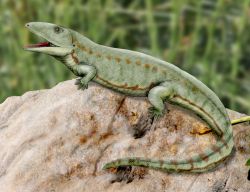
Labyrinthodonts were generally amphibian-like in build. They were short-legged and mostly large headed, with moderately short to long tails. Many groups, and all the early forms, were large animals. Primitive members of all labyrinthodont groups were probably true water predators, and various degrees of amphibious, semi-aquatic and semi terrestrial modes of living arose independently in different groups. Some lineages remained waterbound or became secondarily fully aquatic with reduced limbs and elongated, eel-like bodies.
With the exception of the snake-like aïstopods, the skulls of labyrinthodonts were massive. The broad head and short neck may have been a result of respiratory constraints. Their jaws were lined with small, sharp, conical teeth and the roof of the mouth bore larger tusk-like teeth. The teeth were replaced in waves that traveled from the front of the jaw to the back in such a way that every other tooth was mature, and the ones in between were young. All teeth were labyrinthodont. The sole exception were the chisel-like teeth of some of the advanced herbivorous diadectomorphs. The skull had prominent otic notches behind each eye and a parietal eye.
The vertebrae were complex and not particularly strong, consisting of numerous, often poorly ossified elements. The long bones of the limbs were short and broad and the ankle had limited mobility and the toes lacked claws, limiting the amount of traction the feet could produce. This would have made most labyrinthodonts slow and clumsy on land. In adulthood, most of the larger species were likely confined to water. Some late Paleozoic groups, particularly microsaurs and seymouriamorphs, were small to medium-sized and appear to have been competent terrestrial animals. The advanced diadectomorphs from the Late Carboniferous and Early Permian were fully terrestrial with stout skeletons, and were the heaviest land animals of their time. The Mesozoic labyrinthodonts were primarily aquatic with increasingly cartilaginous skeleton.
The eyes of most labyrinthodonts were situated at the top of the skull, offering good vision upwards, but very little lateral vision. The parietal eye was prominent, although there is uncertainty as to whether it was a true image producing organ or one that could only register light and dark, like that of the modern tuatara.
Hub AI
Labyrinthodontia AI simulator
(@Labyrinthodontia_simulator)
Labyrinthodontia
"Labyrinthodontia" (Greek, 'maze-toothed') is an informal grouping of extinct predatory amphibians which were major components of ecosystems in the late Paleozoic and early Mesozoic eras (about 390 to 150 million years ago). Traditionally considered a subclass of the class Amphibia, modern classification systems recognize that labyrinthodonts are not a formal natural group (clade) exclusive of other tetrapods. Instead, they consistute an evolutionary grade (a paraphyletic group), ancestral to living tetrapods such as lissamphibians (modern amphibians) and amniotes (reptiles, mammals, and kin). "Labyrinthodont"-grade vertebrates evolved from lobe-finned fishes in the Devonian, though a formal boundary between fish and amphibian is difficult to define at this point in time.
"Labyrinthodont" generally refers to extinct four-limbed tetrapods with a large body size and a crocodile-like lifestyle. The name describes the pattern of infolding of the dentin and enamel of the teeth, which are often the only part of the creatures that fossilize. They are also distinguished by a broad, strongly-built skull roof composed of many small heavily-textured skull bones. "Labyrinthodonts" generally have complex multi-part vertebrae, and several classification schemes have utilized vertebrae to define subgroups.
Because labyrinthodonts do not form a monophyletic group, many modern researchers have abandoned the term. However, some have continued to use the group in their classifications, at least informally, pending more detailed study of their relationships. Many authors prefer to simply use the term tetrapod, while others have redefined the previously obsolete term Stegocephalia ("roof heads") as a cladistic alternative to "Labyrinthodontia" or "Tetrapoda".
The labyrinthodonts flourished for more than 200 million years. Particularly the early forms exhibited a lot of variation, yet there are still a few basic anatomical traits that make their fossils very distinct and easily recognizable in the field:
Labyrinthodonts were generally amphibian-like in build. They were short-legged and mostly large headed, with moderately short to long tails. Many groups, and all the early forms, were large animals. Primitive members of all labyrinthodont groups were probably true water predators, and various degrees of amphibious, semi-aquatic and semi terrestrial modes of living arose independently in different groups. Some lineages remained waterbound or became secondarily fully aquatic with reduced limbs and elongated, eel-like bodies.
With the exception of the snake-like aïstopods, the skulls of labyrinthodonts were massive. The broad head and short neck may have been a result of respiratory constraints. Their jaws were lined with small, sharp, conical teeth and the roof of the mouth bore larger tusk-like teeth. The teeth were replaced in waves that traveled from the front of the jaw to the back in such a way that every other tooth was mature, and the ones in between were young. All teeth were labyrinthodont. The sole exception were the chisel-like teeth of some of the advanced herbivorous diadectomorphs. The skull had prominent otic notches behind each eye and a parietal eye.
The vertebrae were complex and not particularly strong, consisting of numerous, often poorly ossified elements. The long bones of the limbs were short and broad and the ankle had limited mobility and the toes lacked claws, limiting the amount of traction the feet could produce. This would have made most labyrinthodonts slow and clumsy on land. In adulthood, most of the larger species were likely confined to water. Some late Paleozoic groups, particularly microsaurs and seymouriamorphs, were small to medium-sized and appear to have been competent terrestrial animals. The advanced diadectomorphs from the Late Carboniferous and Early Permian were fully terrestrial with stout skeletons, and were the heaviest land animals of their time. The Mesozoic labyrinthodonts were primarily aquatic with increasingly cartilaginous skeleton.
The eyes of most labyrinthodonts were situated at the top of the skull, offering good vision upwards, but very little lateral vision. The parietal eye was prominent, although there is uncertainty as to whether it was a true image producing organ or one that could only register light and dark, like that of the modern tuatara.