
Recent from talks
Lacrimal nerve
Knowledge base stats:
Talk channels stats:
Members stats:
Lacrimal nerve
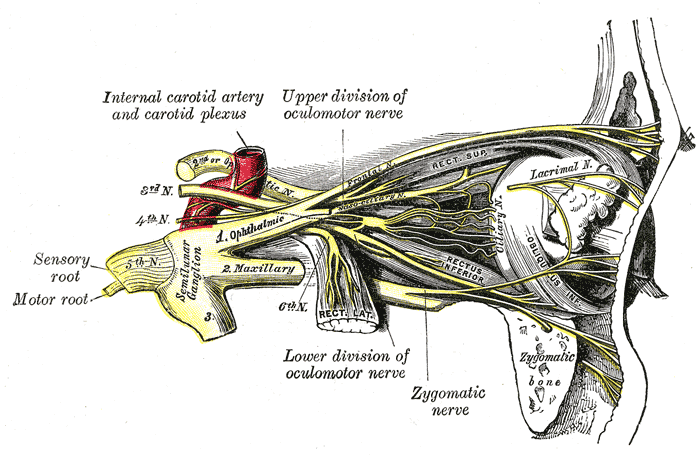
The lacrimal nerve is the smallest of the three main branches of the ophthalmic nerve (CN V1) (itself a branch of the trigeminal nerve (CN V)).
It enters the orbit outside the common tendinous ring and passes forward along the side wall of the orbit.
It provides sensory innervation to the skin and both surfaces of conjunctiva at the lateral portion of the upper eyelid.
It also receives a parasympathetic secretomotor communicating branch for the lacrimal gland which it conveys to the gland.
The lacrimal nerve branches from the ophthalmic nerve immediately before traveling through the superior orbital fissure to enter the orbit.[citation needed]
At the superior portion of the lateral wall of the orbit, it also receives a secretomotor communicating parasympathetic branch from the zygomaticotemporal nerve for the lacrimal gland.
It enters the orbit through the superior orbital fissure outside (lateral to) the common tendinous ring, coursing lateral to the frontal nerve and trochlear nerve (CN IV). Once inside the orbit, it travels anteriorly along (the superior portion of) the lateral wall of the orbit upon the superior margin of the lateral rectus muscle; here, it receives a secretomotor branch for the lacrimal gland from the zygomaticotemporal nerve. It is accompanied by the lacrimal artery along its course through the orbit.[citation needed] It travels through the lacrimal gland, supplying the gland with sensory and parasympathetic branches, then continuing anteriorly as a few small sensory branches.[citation needed] It pierces the orbital septum to reach its terminal target tissues.
The lacrimal nerve provides sensory innervation to:
Hub AI
Lacrimal nerve AI simulator
(@Lacrimal nerve_simulator)
Lacrimal nerve
The lacrimal nerve is the smallest of the three main branches of the ophthalmic nerve (CN V1) (itself a branch of the trigeminal nerve (CN V)).
It enters the orbit outside the common tendinous ring and passes forward along the side wall of the orbit.
It provides sensory innervation to the skin and both surfaces of conjunctiva at the lateral portion of the upper eyelid.
It also receives a parasympathetic secretomotor communicating branch for the lacrimal gland which it conveys to the gland.
The lacrimal nerve branches from the ophthalmic nerve immediately before traveling through the superior orbital fissure to enter the orbit.[citation needed]
At the superior portion of the lateral wall of the orbit, it also receives a secretomotor communicating parasympathetic branch from the zygomaticotemporal nerve for the lacrimal gland.
It enters the orbit through the superior orbital fissure outside (lateral to) the common tendinous ring, coursing lateral to the frontal nerve and trochlear nerve (CN IV). Once inside the orbit, it travels anteriorly along (the superior portion of) the lateral wall of the orbit upon the superior margin of the lateral rectus muscle; here, it receives a secretomotor branch for the lacrimal gland from the zygomaticotemporal nerve. It is accompanied by the lacrimal artery along its course through the orbit.[citation needed] It travels through the lacrimal gland, supplying the gland with sensory and parasympathetic branches, then continuing anteriorly as a few small sensory branches.[citation needed] It pierces the orbital septum to reach its terminal target tissues.
The lacrimal nerve provides sensory innervation to:
Recent media