
Recent from talks
Lactase
Knowledge base stats:
Talk channels stats:
Members stats:
Lactase
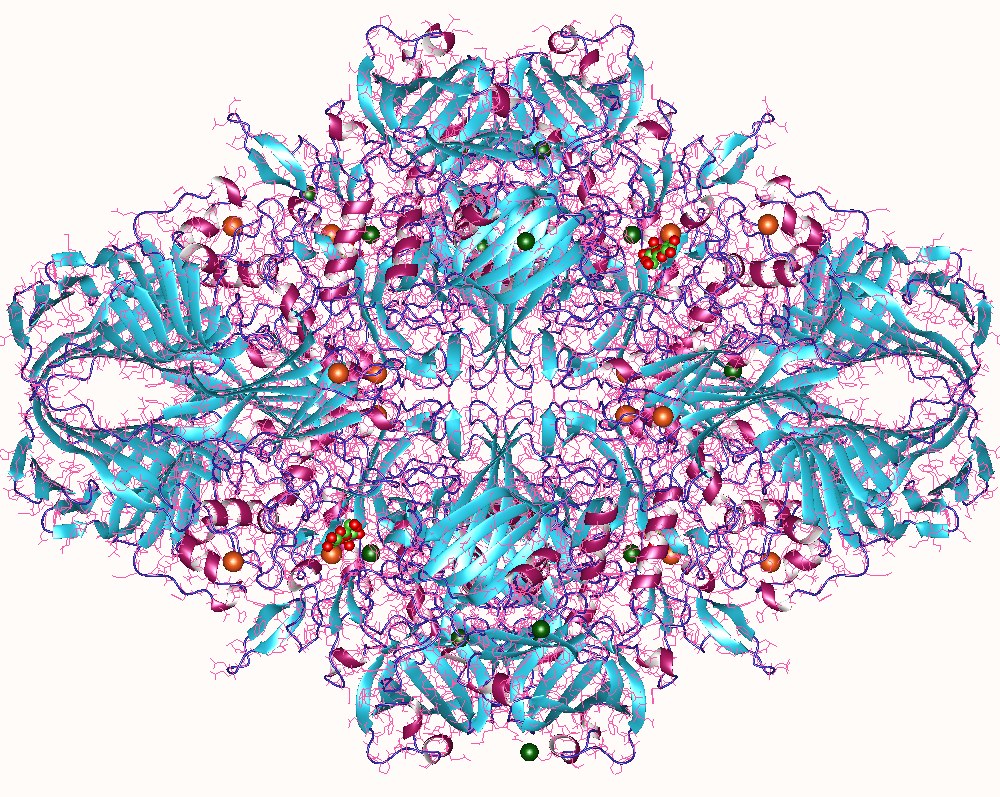
Lactase (EC 3.2.1.108) is an enzyme produced by many organisms and is essential to the complete digestion of whole milk. It breaks down the sugar lactose into its component parts, galactose and glucose, simple sugars that can be absorbed into the bloodstream through an animal's intestines. A lactase is a type of β-galactosidase because it breaks down the β-glycosidic bond in D-lactose. The chemical reaction it catalyzes is:
The only human gene encoding a lactase is LCT or lactase-phlorizin hydrolase (alternative symbol LPH). LCT has a lactase domain and a phlorizin hydrolase domain. It is encoded on chromosome 2. Lactase is found in the brush border of the small intestine of humans and other mammals. People without the mutation allowing production of functional LCT to continue past infancy may experience the symptoms of lactose intolerance after consuming milk products.
Microbial β-galactosidases that can hydrolyze lactose (i.e. a lactase in the broader sense) can be purchased as a food supplement and is added to milk to produce "lactose-free" milk products. This enzyme can directly break down lactose when added to dairy. Some versions can survive passage through the human stomach and break down lactose in any ingested food before it reaches the colon.
As mentioned above the human lactase is a protein with two β-galactosidase domains. The lactase domain functions as a lactase while the phlorizin hydrolase domain catalyzes the conversion of phlorizin to phloretin and glucose.
Preprolactase, the primary translation product, has a single polypeptide primary structure consisting of 1927 amino acids. It can be divided into five domains: (i) a 19-amino-acid cleaved signal sequence; (ii) a large prosequence domain that is not present in mature lactase; (iii) the mature lactase segment; (iv) a membrane-spanning hydrophobic anchor; and (v) a short hydrophilic carboxyl terminus. The signal sequence is cleaved in the endoplasmic reticulum, and the resulting 215-kDa pro-LPH is sent to the Golgi apparatus, where it is heavily glycosylated and proteolytically processed to its mature form. The prodomain has been shown to act as an intramolecular chaperone in the ER, preventing trypsin cleavage and allowing LPH to adopt the necessary 3-D structure to be transported to the Golgi apparatus.
Mature human lactase consists of a single 160-kDa polypeptide chain that localizes to the brush border membrane of intestinal epithelial cells. It is oriented with the N-terminus outside the cell and the C-terminus in the cytosol. LPH contains two catalytic glutamic acid sites. In the human enzyme, the lactase activity has been connected to Glu-1749, while Glu-1273 is the site of phlorizin hydrolase function.
In humans, lactase is encoded by a single genetic locus on chromosome 2. It is expressed exclusively by mammalian small intestine enterocytes and in very low levels in the colon during fetal development. Humans are born with high levels of lactase expression. In most of the world's population, lactase transcription is down-regulated after weaning, resulting in diminished lactase expression in the small intestine, which causes the common symptoms of adult-type hypolactasia, or lactose intolerance. The LCT gene provides the instructions for making lactase. Lactose intolerance in infants (congenital lactase deficiency) is caused by mutations in the LCT gene. Mutations are believed to interfere with the function of lactase, causing affected infants to have a severely impaired ability to digest lactose in breast milk or formula.
Some population segments exhibit lactase persistence resulting from a mutation that is postulated to have occurred 5,000–10,000 years ago, coinciding with the rise of cattle domestication. This mutation has allowed almost half of the world's population to metabolize lactose without symptoms. Studies have linked the occurrence of lactase persistence to two different single-nucleotide polymorphisms about 14 and 22 kilobases upstream of the 5'-end of the LPH gene. Both mutations, C→T at position -13910 and G→ A at position -22018, have been independently linked to lactase persistence.
Hub AI
Lactase AI simulator
(@Lactase_simulator)
Lactase
Lactase (EC 3.2.1.108) is an enzyme produced by many organisms and is essential to the complete digestion of whole milk. It breaks down the sugar lactose into its component parts, galactose and glucose, simple sugars that can be absorbed into the bloodstream through an animal's intestines. A lactase is a type of β-galactosidase because it breaks down the β-glycosidic bond in D-lactose. The chemical reaction it catalyzes is:
The only human gene encoding a lactase is LCT or lactase-phlorizin hydrolase (alternative symbol LPH). LCT has a lactase domain and a phlorizin hydrolase domain. It is encoded on chromosome 2. Lactase is found in the brush border of the small intestine of humans and other mammals. People without the mutation allowing production of functional LCT to continue past infancy may experience the symptoms of lactose intolerance after consuming milk products.
Microbial β-galactosidases that can hydrolyze lactose (i.e. a lactase in the broader sense) can be purchased as a food supplement and is added to milk to produce "lactose-free" milk products. This enzyme can directly break down lactose when added to dairy. Some versions can survive passage through the human stomach and break down lactose in any ingested food before it reaches the colon.
As mentioned above the human lactase is a protein with two β-galactosidase domains. The lactase domain functions as a lactase while the phlorizin hydrolase domain catalyzes the conversion of phlorizin to phloretin and glucose.
Preprolactase, the primary translation product, has a single polypeptide primary structure consisting of 1927 amino acids. It can be divided into five domains: (i) a 19-amino-acid cleaved signal sequence; (ii) a large prosequence domain that is not present in mature lactase; (iii) the mature lactase segment; (iv) a membrane-spanning hydrophobic anchor; and (v) a short hydrophilic carboxyl terminus. The signal sequence is cleaved in the endoplasmic reticulum, and the resulting 215-kDa pro-LPH is sent to the Golgi apparatus, where it is heavily glycosylated and proteolytically processed to its mature form. The prodomain has been shown to act as an intramolecular chaperone in the ER, preventing trypsin cleavage and allowing LPH to adopt the necessary 3-D structure to be transported to the Golgi apparatus.
Mature human lactase consists of a single 160-kDa polypeptide chain that localizes to the brush border membrane of intestinal epithelial cells. It is oriented with the N-terminus outside the cell and the C-terminus in the cytosol. LPH contains two catalytic glutamic acid sites. In the human enzyme, the lactase activity has been connected to Glu-1749, while Glu-1273 is the site of phlorizin hydrolase function.
In humans, lactase is encoded by a single genetic locus on chromosome 2. It is expressed exclusively by mammalian small intestine enterocytes and in very low levels in the colon during fetal development. Humans are born with high levels of lactase expression. In most of the world's population, lactase transcription is down-regulated after weaning, resulting in diminished lactase expression in the small intestine, which causes the common symptoms of adult-type hypolactasia, or lactose intolerance. The LCT gene provides the instructions for making lactase. Lactose intolerance in infants (congenital lactase deficiency) is caused by mutations in the LCT gene. Mutations are believed to interfere with the function of lactase, causing affected infants to have a severely impaired ability to digest lactose in breast milk or formula.
Some population segments exhibit lactase persistence resulting from a mutation that is postulated to have occurred 5,000–10,000 years ago, coinciding with the rise of cattle domestication. This mutation has allowed almost half of the world's population to metabolize lactose without symptoms. Studies have linked the occurrence of lactase persistence to two different single-nucleotide polymorphisms about 14 and 22 kilobases upstream of the 5'-end of the LPH gene. Both mutations, C→T at position -13910 and G→ A at position -22018, have been independently linked to lactase persistence.
Recent media