



Community hub
Recent from talks
Contribute something to knowledge base
Content stats: 0 posts, 0 articles, 1 media, 0 notes
Members stats: 0 subscribers, 0 contributors, 0 moderators, 0 supporters
Subscribers
Supporters
Contributors
Moderators
Hub AI
Lactobacillus AI simulator
(@Lactobacillus_simulator)
Hub AI
Lactobacillus AI simulator
(@Lactobacillus_simulator)
Lactobacillus
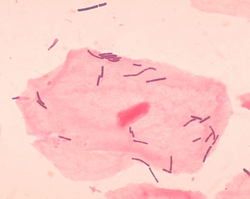
Lactobacillus is a genus of gram-positive within the Lactobacillaceae family, aerotolerant anaerobes or microaerophilic, rod-shaped, non-spore-forming bacteria. Until 2020, the genus Lactobacillus comprised over 260 phylogenetically, ecologically, and metabolically diverse species; a taxonomic revision of the genus assigned lactobacilli to 25 genera (see § Taxonomy below).
Lactobacillus species constitute a significant component of the human and animal microbiota at a number of body sites, such as the digestive system and the female genital system. In women of European ancestry, Lactobacillus species are normally a major part of the vaginal microbiota. Lactobacillus forms biofilms in the vaginal and gut microbiota, allowing them to persist in harsh environmental conditions and maintain ample populations. Lactobacillus exhibits a mutualistic relationship with the human body, as it protects the host against potential invasions by pathogens, and in turn, the host provides a source of nutrients. Lactobacilli are among the most common probiotic found in food such as yogurt, and the bacteria are diverse in their application in maintaining human well-being, by helping to treat diarrhea, vaginal infections, and skin disorders such as eczema.
Lactobacilli are homofermentative, i.e., hexoses are metabolized by glycolysis to lactate as the major end product, or heterofermentative, i.e., hexoses are metabolized by the phosphoketolase pathway to lactate, CO2, and acetate or ethanol as major end products. Most lactobacilli are aerotolerant and some species respire if heme and menaquinone are present in the growth medium. Aerotolerance of lactobacilli is manganese-dependent and has been explored (and explained) in Lactiplantibacillus plantarum (previously Lactobacillus plantarum). Lactobacilli generally do not require iron for growth.
The Lactobacillaceae are the only family of the lactic acid bacteria (LAB) that includes homofermentative and heterofermentative organisms; in the Lactobacillaceae, homofermentative or heterofermentative metabolism is shared by all strains of a genus. Lactobacillus species are all homofermentative, do not express pyruvate formate lyase, and most species do not ferment pentoses. In L. crispatus, pentose metabolism is strain specific and acquired by lateral gene transfer.
The genomes of lactobacilli are highly variable, ranging in size from 1.2 to 4.9 Mb (megabases). Accordingly, the number of protein-coding genes ranges from 1,267 to about 4,758 genes (in Fructilactobacillus sanfranciscensis and Lentilactobacillus parakefiri, respectively). Even within a single species, there can be substantial variation. For instance, strains of L. crispatus have genome sizes ranging from 1.83 to 2.7 Mb, or 1,839 to 2,688 open reading frames. Lactobacillus contains a wealth of compound microsatellites in the coding region of the genome, which are imperfect and have variant motifs. Many lactobacilli also contain multiple plasmids. A recent study has revealed that plasmids encode the genes which are required for adaptation of lactobacilli to the given environment.
The genus Lactobacillus comprises the following species:
The genus Lactobacillus currently contains 44 species which are adapted to vertebrate hosts or to insects. In recent years, other members of the genus Lactobacillus (formerly known as the Leuconostoc branch of Lactobacillus) have been reclassified into the genera Atopobium, Carnobacterium, Weissella, Oenococcus, and Leuconostoc. The Pediococcus species P. dextrinicus has been reclassified as a Lapidilactobacillus dextrinicus and most lactobacilli were assigned to Paralactobacillus or one of the 23 novel genera of the Lactobacillaceae. Two websites inform on the assignment of species to the novel genera or species (http://www.lactobacillus.uantwerpen.be/; http://www.lactobacillus.ualberta.ca/).
The currently accepted taxonomy is based on the List of Prokaryotic names with Standing in Nomenclature and the phylogeny is based on whole-genome sequences.
Lactobacillus
Lactobacillus is a genus of gram-positive within the Lactobacillaceae family, aerotolerant anaerobes or microaerophilic, rod-shaped, non-spore-forming bacteria. Until 2020, the genus Lactobacillus comprised over 260 phylogenetically, ecologically, and metabolically diverse species; a taxonomic revision of the genus assigned lactobacilli to 25 genera (see § Taxonomy below).
Lactobacillus species constitute a significant component of the human and animal microbiota at a number of body sites, such as the digestive system and the female genital system. In women of European ancestry, Lactobacillus species are normally a major part of the vaginal microbiota. Lactobacillus forms biofilms in the vaginal and gut microbiota, allowing them to persist in harsh environmental conditions and maintain ample populations. Lactobacillus exhibits a mutualistic relationship with the human body, as it protects the host against potential invasions by pathogens, and in turn, the host provides a source of nutrients. Lactobacilli are among the most common probiotic found in food such as yogurt, and the bacteria are diverse in their application in maintaining human well-being, by helping to treat diarrhea, vaginal infections, and skin disorders such as eczema.
Lactobacilli are homofermentative, i.e., hexoses are metabolized by glycolysis to lactate as the major end product, or heterofermentative, i.e., hexoses are metabolized by the phosphoketolase pathway to lactate, CO2, and acetate or ethanol as major end products. Most lactobacilli are aerotolerant and some species respire if heme and menaquinone are present in the growth medium. Aerotolerance of lactobacilli is manganese-dependent and has been explored (and explained) in Lactiplantibacillus plantarum (previously Lactobacillus plantarum). Lactobacilli generally do not require iron for growth.
The Lactobacillaceae are the only family of the lactic acid bacteria (LAB) that includes homofermentative and heterofermentative organisms; in the Lactobacillaceae, homofermentative or heterofermentative metabolism is shared by all strains of a genus. Lactobacillus species are all homofermentative, do not express pyruvate formate lyase, and most species do not ferment pentoses. In L. crispatus, pentose metabolism is strain specific and acquired by lateral gene transfer.
The genomes of lactobacilli are highly variable, ranging in size from 1.2 to 4.9 Mb (megabases). Accordingly, the number of protein-coding genes ranges from 1,267 to about 4,758 genes (in Fructilactobacillus sanfranciscensis and Lentilactobacillus parakefiri, respectively). Even within a single species, there can be substantial variation. For instance, strains of L. crispatus have genome sizes ranging from 1.83 to 2.7 Mb, or 1,839 to 2,688 open reading frames. Lactobacillus contains a wealth of compound microsatellites in the coding region of the genome, which are imperfect and have variant motifs. Many lactobacilli also contain multiple plasmids. A recent study has revealed that plasmids encode the genes which are required for adaptation of lactobacilli to the given environment.
The genus Lactobacillus comprises the following species:
The genus Lactobacillus currently contains 44 species which are adapted to vertebrate hosts or to insects. In recent years, other members of the genus Lactobacillus (formerly known as the Leuconostoc branch of Lactobacillus) have been reclassified into the genera Atopobium, Carnobacterium, Weissella, Oenococcus, and Leuconostoc. The Pediococcus species P. dextrinicus has been reclassified as a Lapidilactobacillus dextrinicus and most lactobacilli were assigned to Paralactobacillus or one of the 23 novel genera of the Lactobacillaceae. Two websites inform on the assignment of species to the novel genera or species (http://www.lactobacillus.uantwerpen.be/; http://www.lactobacillus.ualberta.ca/).
The currently accepted taxonomy is based on the List of Prokaryotic names with Standing in Nomenclature and the phylogeny is based on whole-genome sequences.
Recent media
Recent media