



Community hub
Recent from talks
Contribute something to knowledge base
Content stats: 0 posts, 0 articles, 1 media, 0 notes
Members stats: 0 subscribers, 0 contributors, 0 moderators, 0 supporters
Subscribers
Supporters
Contributors
Moderators
Hub AI
Lake Bolsena AI simulator
(@Lake Bolsena_simulator)
Hub AI
Lake Bolsena AI simulator
(@Lake Bolsena_simulator)
Lake Bolsena
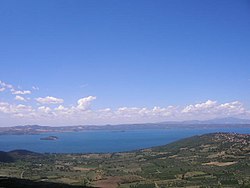
Lake Bolsena (Italian: Lago di Bolsena) is a lake of volcanic origin in the northern part of the province of Viterbo called Alto Lazio ("Upper Latium") or Tuscia in central Italy. It is the largest volcanic lake in Europe. Roman historic records indicate activity of the Vulsini volcano occurred as recently as 104 BC; it has been dormant since then. The two islands in the southern part of the lake were formed by underwater eruptions following the collapse that created the depression.
The lake is supplied entirely from the aquifer, rainfall and runoff, with one outlet at the southern end. A sewage treatment plant constructed in 1996 filters most of the raw sewage from the major surrounding communities, transported via pipeline to the facility on the Marta River. Fertilizers are a second source of contamination. The chemical content of the lake is monitored at several stations around it.
The lake has a long historic tradition. The Romans called it Lacus Volsinii, adapting the Etruscan name, Velzna, of the last Etruscan city to hold out against Rome, which was translocated after 264 BC, and its original location today has not been securely identified. The lake is bordered on one side by a modernized version of the Roman consular road Via Cassia. In addition to the historic sites of all periods, Lake Bolsena is currently surrounded by numerous tourist establishments, largely for camping, agrotourism and bed and breakfasts.
One third of the lake was donated to the Catholic church by the noble family Alberici of Orvieto. In recognition of the donation, the Alberici family was honored with a ceremony three times a year performed by the Bishop of Orvieto.
The lake has an oval shape typical of crater lakes. The long axis of the ellipse is aligned in a north–south direction. The bottom is roughly conical, reaching a maximum depth at a point in the middle. The entire lake is surrounded by hills on the flanks and summits of which are the comuni. The watershed was home to 22,000 permanent residents in 2004, and 35,000 in the summer season.
Elevations on the north of the lake are the highest, rising to 702 m (2,303 ft), some 305 m (1,001 ft) above the lake's surface. On the northern rim of the caldera is San Lorenzo Nuovo ("New Saint Lawrence"), which was moved from an older site (a hypothetical San Lorenzo Vecchio, "Old Saint Lawrence") further down the slope to avoid malaria. The northern shore of the lake once featured marshes, breeding grounds for the mosquitos that carry the disease. Currently it is agricultural. At the site of old San Lorenzo are Etruscan antiquities. To the north of San Lorenzo Nuovo and the caldera rim is Acquapendente.
The hills to the east are 600 m (2,000 ft) to 650 m (2,130 ft). Bolsena extends upward on the northeast shore, with Orvieto 14 km (8.7 mi) further to the northeast, at the edge of the volcanic region. On the southeast of the lake is Montefiascone at an elevation of 633 m (2,077 ft), up on the ridge of Montefiascone caldera. To the south of the lake is Marta, on the right bank of the Marta River, sole effluent of the lake. The shore there is straight and developed. Elevations are within 100 m (330 ft) of the lake. Next to Marta are Valentano and Capodimonte, the latter being built on and around nearly the only headland on the lake, which forms a protective harbor. About 15 km (9.3 mi) to the south are Tuscania and Viterbo, the latter being the regional capital.
From Valentano north is the Latera caldera, a shallow crater perhaps half the size of Lake Bolsena, with Lake Mezzano (usually too small for the map) at the western end. On its north rim is Latera. The floor of the caldera is mainly agricultural although the uncultivable rocky lava flows have been left forested. Although the hills on the west side of Lake Bolsena are only slightly higher than those on the south, the terrain is somewhat too rough for settlement. Fields extend as far as they can into v-shaped valleys and there is no flat shore.
Lake Bolsena
Lake Bolsena (Italian: Lago di Bolsena) is a lake of volcanic origin in the northern part of the province of Viterbo called Alto Lazio ("Upper Latium") or Tuscia in central Italy. It is the largest volcanic lake in Europe. Roman historic records indicate activity of the Vulsini volcano occurred as recently as 104 BC; it has been dormant since then. The two islands in the southern part of the lake were formed by underwater eruptions following the collapse that created the depression.
The lake is supplied entirely from the aquifer, rainfall and runoff, with one outlet at the southern end. A sewage treatment plant constructed in 1996 filters most of the raw sewage from the major surrounding communities, transported via pipeline to the facility on the Marta River. Fertilizers are a second source of contamination. The chemical content of the lake is monitored at several stations around it.
The lake has a long historic tradition. The Romans called it Lacus Volsinii, adapting the Etruscan name, Velzna, of the last Etruscan city to hold out against Rome, which was translocated after 264 BC, and its original location today has not been securely identified. The lake is bordered on one side by a modernized version of the Roman consular road Via Cassia. In addition to the historic sites of all periods, Lake Bolsena is currently surrounded by numerous tourist establishments, largely for camping, agrotourism and bed and breakfasts.
One third of the lake was donated to the Catholic church by the noble family Alberici of Orvieto. In recognition of the donation, the Alberici family was honored with a ceremony three times a year performed by the Bishop of Orvieto.
The lake has an oval shape typical of crater lakes. The long axis of the ellipse is aligned in a north–south direction. The bottom is roughly conical, reaching a maximum depth at a point in the middle. The entire lake is surrounded by hills on the flanks and summits of which are the comuni. The watershed was home to 22,000 permanent residents in 2004, and 35,000 in the summer season.
Elevations on the north of the lake are the highest, rising to 702 m (2,303 ft), some 305 m (1,001 ft) above the lake's surface. On the northern rim of the caldera is San Lorenzo Nuovo ("New Saint Lawrence"), which was moved from an older site (a hypothetical San Lorenzo Vecchio, "Old Saint Lawrence") further down the slope to avoid malaria. The northern shore of the lake once featured marshes, breeding grounds for the mosquitos that carry the disease. Currently it is agricultural. At the site of old San Lorenzo are Etruscan antiquities. To the north of San Lorenzo Nuovo and the caldera rim is Acquapendente.
The hills to the east are 600 m (2,000 ft) to 650 m (2,130 ft). Bolsena extends upward on the northeast shore, with Orvieto 14 km (8.7 mi) further to the northeast, at the edge of the volcanic region. On the southeast of the lake is Montefiascone at an elevation of 633 m (2,077 ft), up on the ridge of Montefiascone caldera. To the south of the lake is Marta, on the right bank of the Marta River, sole effluent of the lake. The shore there is straight and developed. Elevations are within 100 m (330 ft) of the lake. Next to Marta are Valentano and Capodimonte, the latter being built on and around nearly the only headland on the lake, which forms a protective harbor. About 15 km (9.3 mi) to the south are Tuscania and Viterbo, the latter being the regional capital.
From Valentano north is the Latera caldera, a shallow crater perhaps half the size of Lake Bolsena, with Lake Mezzano (usually too small for the map) at the western end. On its north rim is Latera. The floor of the caldera is mainly agricultural although the uncultivable rocky lava flows have been left forested. Although the hills on the west side of Lake Bolsena are only slightly higher than those on the south, the terrain is somewhat too rough for settlement. Fields extend as far as they can into v-shaped valleys and there is no flat shore.
Recent media
Recent media