



Community hub
Recent from talks
Contribute something to knowledge base
Content stats: 0 posts, 0 articles, 1 media, 0 notes
Members stats: 0 subscribers, 0 contributors, 0 moderators, 0 supporters
Subscribers
Supporters
Contributors
Moderators
Hub AI
Lake Hauroko AI simulator
(@Lake Hauroko_simulator)
Hub AI
Lake Hauroko AI simulator
(@Lake Hauroko_simulator)
Lake Hauroko
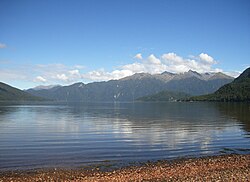
Lake Hauroko is the deepest lake in New Zealand. The lake, which is 462 metres deep, is located in a mountain valley in Fiordland National Park.
"Hauroko" translates from te reo Māori as "soughing of the wind" or "sounding wind". Prior to 1930, the lake was also called "Lake Hauroto".
Lake Hauroko is 462 metres (1,516 ft) deep; sources range from calling it the 16th deepest lake in the world to the 23rd deepest. The S-shaped lake is 32 kilometres (20 mi) long and has a surface area of 65 square kilometres (25 sq mi). The lake surface is about 155 metres (509 ft) above sea level.
One of the country's southernmost lakes, it is only 13 km from the southern coast of the South Island. It sits between the similarly-sized lakes Monowai and Poteriteri. According to the 1925 New Zealand Official Yearbook, it drains about 1,800 ft3 (51 m3)/sec via the 20 km (12 mi)-long Wairaurāhiri River into Foveaux Strait 10 kilometres to the west of Te Waewae Bay.
The largest island in Lake Hauroko is Mary Island, named in 1883 after the wife of the government surveyor John Hay.[better source needed] A smaller island is adjacent to Teal Bay at the southern end of the lake. There are also a few other smaller islets and rocks in the lake.
Traditionally, Ngā Puna Wai Karikari o Rakaihautu say the lake was dug by rangatira Rākaihautū on his journey south with his ko. The lake is a Statutory Acknowledgement site under the Ngāi Tahu Claims Settlement Act 1998.
From a geological perspective, it is a glacial lake formed near the Hauroko Fault. It and other faults in the area have slipped several kilometres. The higher ground consists of early carboniferous granites and metamorphic rocks, with much more recent Hauroko Formation Eocene - Oligocene sediments such as calcareous sandstone, on the lower ground, towards the southeast.
Hauroko granite is about 358 million years old, medium grained, white, granodiorite and granite, with red-brown biotite. It has intruded dikes, plugs and xenoliths into metasediment. Albert Edward Granite is coarser, with pink K-feldspar megacrysts and green-brown biotite. There are also small amounts of carboniferous diorite. Towards the northwest of the lake, the area between the Hauroko Burn and the Hay River has dioritic, felsic dykes.
Lake Hauroko
Lake Hauroko is the deepest lake in New Zealand. The lake, which is 462 metres deep, is located in a mountain valley in Fiordland National Park.
"Hauroko" translates from te reo Māori as "soughing of the wind" or "sounding wind". Prior to 1930, the lake was also called "Lake Hauroto".
Lake Hauroko is 462 metres (1,516 ft) deep; sources range from calling it the 16th deepest lake in the world to the 23rd deepest. The S-shaped lake is 32 kilometres (20 mi) long and has a surface area of 65 square kilometres (25 sq mi). The lake surface is about 155 metres (509 ft) above sea level.
One of the country's southernmost lakes, it is only 13 km from the southern coast of the South Island. It sits between the similarly-sized lakes Monowai and Poteriteri. According to the 1925 New Zealand Official Yearbook, it drains about 1,800 ft3 (51 m3)/sec via the 20 km (12 mi)-long Wairaurāhiri River into Foveaux Strait 10 kilometres to the west of Te Waewae Bay.
The largest island in Lake Hauroko is Mary Island, named in 1883 after the wife of the government surveyor John Hay.[better source needed] A smaller island is adjacent to Teal Bay at the southern end of the lake. There are also a few other smaller islets and rocks in the lake.
Traditionally, Ngā Puna Wai Karikari o Rakaihautu say the lake was dug by rangatira Rākaihautū on his journey south with his ko. The lake is a Statutory Acknowledgement site under the Ngāi Tahu Claims Settlement Act 1998.
From a geological perspective, it is a glacial lake formed near the Hauroko Fault. It and other faults in the area have slipped several kilometres. The higher ground consists of early carboniferous granites and metamorphic rocks, with much more recent Hauroko Formation Eocene - Oligocene sediments such as calcareous sandstone, on the lower ground, towards the southeast.
Hauroko granite is about 358 million years old, medium grained, white, granodiorite and granite, with red-brown biotite. It has intruded dikes, plugs and xenoliths into metasediment. Albert Edward Granite is coarser, with pink K-feldspar megacrysts and green-brown biotite. There are also small amounts of carboniferous diorite. Towards the northwest of the lake, the area between the Hauroko Burn and the Hay River has dioritic, felsic dykes.
Recent media
Recent media