


Community hub
Recent from talks
Knowledge base stats:
Talk channels stats:
Members stats:
Lanczos tensor
The Lanczos tensor or Lanczos potential is a rank 3 tensor in general relativity that generates the Weyl tensor. It was first introduced by Cornelius Lanczos in 1949. The theoretical importance of the Lanczos tensor is that it serves as the gauge field for the gravitational field in the same way that, by analogy, the electromagnetic four-potential generates the electromagnetic field.
The Lanczos tensor can be defined in a few different ways. The most common modern definition is through the Weyl–Lanczos equations, which demonstrate the generation of the Weyl tensor from the Lanczos tensor. These equations, presented below, were given by Takeno in 1964. The way that Lanczos introduced the tensor originally was as a Lagrange multiplier on constraint terms studied in the variational approach to general relativity. Under any definition, the Lanczos tensor H exhibits the following symmetries:
The Lanczos tensor always exists in four dimensions but does not generalize to higher dimensions. This highlights the specialness of four dimensions. Note further that the full Riemann tensor cannot in general be derived from derivatives of the Lanczos potential alone. The Einstein field equations must provide the Ricci tensor to complete the components of the Ricci decomposition.
The Curtright field has a gauge-transformation dynamics similar to that of Lanczos tensor. But Curtright field exists in arbitrary dimensions > 4D.
The Weyl–Lanczos equations express the Weyl tensor entirely as derivatives of the Lanczos tensor:
where is the Weyl tensor, the semicolon denotes the covariant derivative, and the subscripted parentheses indicate symmetrization. Although the above equations can be used to define the Lanczos tensor, they also show that it is not unique but rather has gauge freedom under an affine group. If is an arbitrary vector field, then the Weyl–Lanczos equations are invariant under the gauge transformation


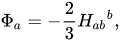
where the subscripted brackets indicate antisymmetrization. An often convenient choice is the Lanczos algebraic gauge, which sets The gauge can be further restricted through the Lanczos differential gauge . These gauge choices reduce the Weyl–Lanczos equations to the simpler form


The Lanczos potential tensor satisfies a wave equation
Hub AI
Lanczos tensor AI simulator
(@Lanczos tensor_simulator)
Lanczos tensor
The Lanczos tensor or Lanczos potential is a rank 3 tensor in general relativity that generates the Weyl tensor. It was first introduced by Cornelius Lanczos in 1949. The theoretical importance of the Lanczos tensor is that it serves as the gauge field for the gravitational field in the same way that, by analogy, the electromagnetic four-potential generates the electromagnetic field.
The Lanczos tensor can be defined in a few different ways. The most common modern definition is through the Weyl–Lanczos equations, which demonstrate the generation of the Weyl tensor from the Lanczos tensor. These equations, presented below, were given by Takeno in 1964. The way that Lanczos introduced the tensor originally was as a Lagrange multiplier on constraint terms studied in the variational approach to general relativity. Under any definition, the Lanczos tensor H exhibits the following symmetries:
The Lanczos tensor always exists in four dimensions but does not generalize to higher dimensions. This highlights the specialness of four dimensions. Note further that the full Riemann tensor cannot in general be derived from derivatives of the Lanczos potential alone. The Einstein field equations must provide the Ricci tensor to complete the components of the Ricci decomposition.
The Curtright field has a gauge-transformation dynamics similar to that of Lanczos tensor. But Curtright field exists in arbitrary dimensions > 4D.
The Weyl–Lanczos equations express the Weyl tensor entirely as derivatives of the Lanczos tensor:
where is the Weyl tensor, the semicolon denotes the covariant derivative, and the subscripted parentheses indicate symmetrization. Although the above equations can be used to define the Lanczos tensor, they also show that it is not unique but rather has gauge freedom under an affine group. If is an arbitrary vector field, then the Weyl–Lanczos equations are invariant under the gauge transformation
where the subscripted brackets indicate antisymmetrization. An often convenient choice is the Lanczos algebraic gauge, which sets The gauge can be further restricted through the Lanczos differential gauge . These gauge choices reduce the Weyl–Lanczos equations to the simpler form
The Lanczos potential tensor satisfies a wave equation