
Recent from talks
Lane Seminary
Knowledge base stats:
Talk channels stats:
Members stats:
Lane Seminary
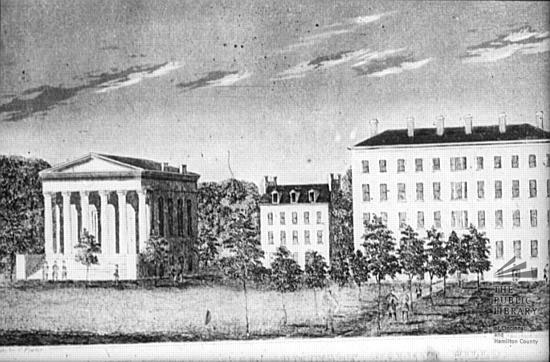
Lane Seminary, sometimes called Cincinnati Lane Seminary, and later renamed Lane Theological Seminary, was a Presbyterian theological college that operated from 1829 to 1932 in Walnut Hills, Ohio, today a neighborhood in Cincinnati. Its campus was bounded by today's Gilbert, Yale, Park, and Chapel Streets.
Its board intended it to be "a great central theological institution at Cincinnati — soon to become the great Andover or Princeton of the West." However, the founding and first years of Lane were difficult and contentious, culminating in a mass student exodus over the issue of slavery, or more specifically whether students were permitted to discuss the topic publicly, the first major academic freedom incident in America. There was strong pro-slavery sentiment in Cincinnati, and the trustees immediately prohibited further discussion of the topic, to avoid repercussions. With the city being on the border of the South, a lot of fugitive slaves and freedmen went through Cincinnati, including James Bradley, who would participate in the pivotal Lane slavery debates in the 1830s. Their competition for jobs had led to the anti-abolitionist Cincinnati riots of 1829 and would soon produce the Cincinnati riots of 1836.
"The founding of Lane Seminary was accomplished after years of sometimes disparate efforts on the part of a large number of people." The Presbyterian tradition was to have educated clergy, and there was no seminary serving the vast and increasingly populated lands west of the Allegheny Mountains. As early as 1825, the denomination was on record as saying such a seminary was needed. In 1829 there were only 8,000 ministers to serve a population of 12,000,000, two thousand more churches than ministers, and only 200 ministers per year being trained. While there were local efforts to have the new seminary in Cincinnati, the Presbyterian General Assembly decided in 1827 to locate it in Allegheny, Pennsylvania, near Pittsburgh. The western synods refused to accept this, finding it too far away.
In the summer of 1828 Ebenezer Lane, a New Orleans businessman, "made known his interest in setting up a theological seminary near Cincinnati based on the manual labor system." He and his brother Lane pledged $4,000 for the new school, on condition that it be in Cincinnati and follow the manual labor model. After this, their connection with the Seminary was minimal; Ebenezer was not even happy that it carried his name. The land was donated by Kemper Seminary. "Walnut Hill was a pretty little village, quite distant from Cincinnati, the first stopping-place for the stage on the Madisonville or some other northern Ohio route." "The location of Lane Seminary is in the midst of a most beautiful landscape. There is just enough, and just the right admixture of hills and dale, forest and field, to give it the effect we love in gazing upon a calm and quiet scene of beauty," wrote a visiting minister in 1842.
A board was set up in October 1828, and the Ohio General Assembly issued a charter on February 11, 1829, specifying that the manual labor system would be "the fundamental principle" of the Seminary. The Rev. George C. Beckwith was appointed to a professorship in April, accepted in August, and he arrived in Cincinnati in the following November. He "had 3 or 4 students during the winter." In July, 1830, Beckwith visited the Oneida Institute and wrote back to Cincinnati that manual labor worked well and that the farmers and mechanics of the neighborhood approved of it. He resigned in August 1830. "At that time [1830], the seminary consisted of some woods and one foundation for a building."
In January, 1831, George Washington Gale, president of the Oneida Institute, recommended a steward to supervise the Seminary farm; in February the trustees made the appointment. But in the winter of 1830–31, "Lane Seminary was in a state of suspended animation. There were no teachers and apparently only two students, Amos Dresser and Horace Bushnell, who had come out from the Oneida Institute and had been given special permission by the trustees to occupy rooms in the lonesome Seminary building." Bushnell, who on his arrival in 1830 "found [at the embryonic Lane] no theology", slept "on a study-table, with his books for a pillow".
In 1834, the manual labor department contained six printing presses, operated by 20 students, and had printed 150,000 copies of "Webster's spelling books", for a bookstore. 30 students were employed in cabinet making, and total enrollment before the mass walkout was about 100.
By coincidence, the local efforts to set up a seminary fit with the desires of the Tappan philanthropists, Arthur and Lewis, to found a seminary in what was then the growing west of the new country.
Hub AI
Lane Seminary AI simulator
(@Lane Seminary_simulator)
Lane Seminary
Lane Seminary, sometimes called Cincinnati Lane Seminary, and later renamed Lane Theological Seminary, was a Presbyterian theological college that operated from 1829 to 1932 in Walnut Hills, Ohio, today a neighborhood in Cincinnati. Its campus was bounded by today's Gilbert, Yale, Park, and Chapel Streets.
Its board intended it to be "a great central theological institution at Cincinnati — soon to become the great Andover or Princeton of the West." However, the founding and first years of Lane were difficult and contentious, culminating in a mass student exodus over the issue of slavery, or more specifically whether students were permitted to discuss the topic publicly, the first major academic freedom incident in America. There was strong pro-slavery sentiment in Cincinnati, and the trustees immediately prohibited further discussion of the topic, to avoid repercussions. With the city being on the border of the South, a lot of fugitive slaves and freedmen went through Cincinnati, including James Bradley, who would participate in the pivotal Lane slavery debates in the 1830s. Their competition for jobs had led to the anti-abolitionist Cincinnati riots of 1829 and would soon produce the Cincinnati riots of 1836.
"The founding of Lane Seminary was accomplished after years of sometimes disparate efforts on the part of a large number of people." The Presbyterian tradition was to have educated clergy, and there was no seminary serving the vast and increasingly populated lands west of the Allegheny Mountains. As early as 1825, the denomination was on record as saying such a seminary was needed. In 1829 there were only 8,000 ministers to serve a population of 12,000,000, two thousand more churches than ministers, and only 200 ministers per year being trained. While there were local efforts to have the new seminary in Cincinnati, the Presbyterian General Assembly decided in 1827 to locate it in Allegheny, Pennsylvania, near Pittsburgh. The western synods refused to accept this, finding it too far away.
In the summer of 1828 Ebenezer Lane, a New Orleans businessman, "made known his interest in setting up a theological seminary near Cincinnati based on the manual labor system." He and his brother Lane pledged $4,000 for the new school, on condition that it be in Cincinnati and follow the manual labor model. After this, their connection with the Seminary was minimal; Ebenezer was not even happy that it carried his name. The land was donated by Kemper Seminary. "Walnut Hill was a pretty little village, quite distant from Cincinnati, the first stopping-place for the stage on the Madisonville or some other northern Ohio route." "The location of Lane Seminary is in the midst of a most beautiful landscape. There is just enough, and just the right admixture of hills and dale, forest and field, to give it the effect we love in gazing upon a calm and quiet scene of beauty," wrote a visiting minister in 1842.
A board was set up in October 1828, and the Ohio General Assembly issued a charter on February 11, 1829, specifying that the manual labor system would be "the fundamental principle" of the Seminary. The Rev. George C. Beckwith was appointed to a professorship in April, accepted in August, and he arrived in Cincinnati in the following November. He "had 3 or 4 students during the winter." In July, 1830, Beckwith visited the Oneida Institute and wrote back to Cincinnati that manual labor worked well and that the farmers and mechanics of the neighborhood approved of it. He resigned in August 1830. "At that time [1830], the seminary consisted of some woods and one foundation for a building."
In January, 1831, George Washington Gale, president of the Oneida Institute, recommended a steward to supervise the Seminary farm; in February the trustees made the appointment. But in the winter of 1830–31, "Lane Seminary was in a state of suspended animation. There were no teachers and apparently only two students, Amos Dresser and Horace Bushnell, who had come out from the Oneida Institute and had been given special permission by the trustees to occupy rooms in the lonesome Seminary building." Bushnell, who on his arrival in 1830 "found [at the embryonic Lane] no theology", slept "on a study-table, with his books for a pillow".
In 1834, the manual labor department contained six printing presses, operated by 20 students, and had printed 150,000 copies of "Webster's spelling books", for a bookstore. 30 students were employed in cabinet making, and total enrollment before the mass walkout was about 100.
By coincidence, the local efforts to set up a seminary fit with the desires of the Tappan philanthropists, Arthur and Lewis, to found a seminary in what was then the growing west of the new country.
Recent media