Hubbry Logo
Larry SteeleLarry SteeleMain
Open search
Larry Steele
Community hub
Larry Steele
logo
8 pages, 0 posts
0 subscribers
Be the first to start a discussion here.
Larry Steele
Larry Steele
from Wikipedia

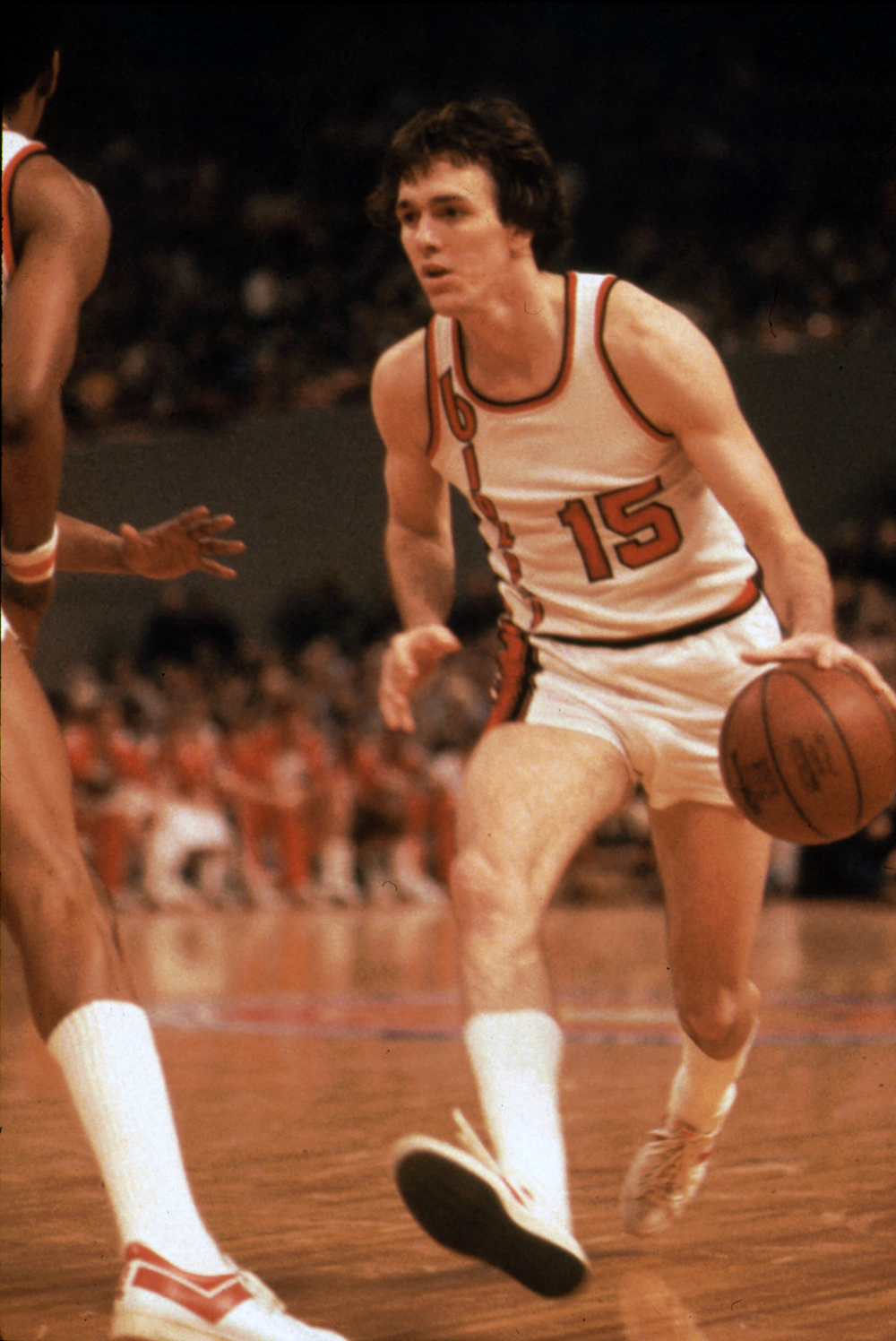
Larry Nelson Steele (born May 5, 1949) is an American former professional basketball player, best known for being on the Portland Trail Blazers team that won the 1977 NBA Finals.

Key Information

Early life

[edit]

Born in Greencastle, Indiana, Steele grew up in Bainbridge, Indiana, and played collegiately at the University of Kentucky under coach Adolph Rupp. As a junior at Bainbridge High School, he had a high game of 46 points and 38 points as a high game during senior year. He scored a total of 1,646 high school points. His senior year he was selected All-County, All-Sectional, All-Regional, All- Semi-State, Indianapolis News 1st Team All-State, and a member of the Indiana All-Star Team. In 2003, he was inducted into the Indiana Basketball Hall of Fame.[1]

College career

[edit]

At the University of Kentucky, he was a three-year starter, averaging 13.1 points, 6.7 rebounds, and 3.9 assists per game. He was selected 1st Team All-SEC twice, Co-captain, MVP, Leadership Award, Hustle Award, led the UK team in assists and free throws. In 2003, he was inducted into the Indiana Basketball Hall of Fame.[2] As a junior in 1970, Steele earned 3rd team UPI/Coaches All-SEC honors and in 1971 as a senior 2nd team AP and 3rd team UPI/Coaches All-SEC honors.[3]

NBA playing career

[edit]

Portland Trail Blazers

[edit]

He was drafted by the Trail Blazers in 1971, with the 2nd pick in the 3rd round (37th overall) and by the Kentucky Colonels in the 1971 American Basketball Association draft. In 1974 he was drafted again by the Kentucky Colonels in the 5th round of the ABA draft of NBA players.[4] He joined the Trail Blazers at the start of the Blazers' second season and became a roster mainstay for nine years before knee injuries forced him into retirement at the end of the 1979–80 season.[5]

Steele played his entire NBA career for the team (retiring from basketball at the end of the 1979–80 season). Steele led the NBA in steals in the 1973–74 NBA season—the first year steals were recorded by the league with 2.68 swipes per game. He played 20.7 MPG on the 1977 championship team (starting nine games) averaging a career high 10.3 points per game. During his nine-year NBA career, all with the Trail Blazers, he averaged 8.2 points, 2.9 assists, 1.39 steals and 24.2 minutes while starting 337 games. The Trail Blazers retired his jersey (15) on October 11, 1981.

Personal life

[edit]

After his playing days, he worked in the Blazers front office in marketing and served as a commentator with broadcaster Bill Schonely.[6] Steele later worked as a broadcaster for the NBA on CBS and as a head coach at the University of Portland from 1987 to 1994. He currently runs a basketball camp in Vernonia, Oregon.[7]

NBA career statistics

[edit]
Steele on the cover of a Portland Trail Blazers program in 1971.
Legend
  GP Games played   GS  Games started  MPG  Minutes per game
 FG%  Field goal percentage  3P%  3-point field goal percentage  FT%  Free throw percentage
 RPG  Rebounds per game  APG  Assists per game  SPG  Steals per game
 BPG  Blocks per game  PPG  Points per game  Bold  Career high
 †  Won an NBA championship  *  Led the league

Regular season

[edit]
Year Team GP GS MPG FG% 3P% FT% RPG APG SPG BPG PPG
1971–72 Portland 72 - 18.2 .481 - .722 3.9 2.2 - - 5.1
1972–73 Portland 66 - 19.7 .483 - .798 2.3 2.4 - - 5.9
1973–74 Portland 81 - 32.7 .478 - .789 3.8 4.0 2.7* 0.4 9.7
1974–75 Portland 76 - 31.4 .548 - .836 3.0 3.8 2.4 0.2 8.6
1975–76 Portland 81 - 29.4 .495 - .759 3.6 4.0 2.1 0.2 9.9
1976–77 Portland 81 - 20.7 .500 - .806 2.3 2.1 1.5 0.2 10.3
1977–78 Portland 65 - 17.4 .470 - .820 1.7 1.3 0.9 0.1 8.0
1978–79 Portland 72 - 20.7 .420 - .824 2.4 2.0 1.0 0.1 7.2
1979–80 Portland 16 - 27.9 .425 - .815 2.8 4.2 1.6 0.1 9.1
Career 610 - 24.2 .483 - .796 2.9 2.8 1.8 0.2 8.2

Playoffs

[edit]
Year Team GP GS MPG FG% 3P% FT% RPG APG SPG BPG PPG
1977 Portland 18 - 14.5 .371 - .750 1.5 1.0 0.5 0.0 4.2
1978 Portland 6 - 31.8 .417 - .905 4.3 2.3 1.2 0.3 11.5
1979 Portland 3 - 24.3 .571 - .889 3.7 2.3 3.3 0.0 13.3
Career 27 - 19.4 .424 - .823 2.4 1.4 1.0 0.1 6.9

Head coaching record

[edit]
Statistics overview
Season Team Overall Conference Standing Postseason
Portland (West Coast Conference) (1987–1993)
1987–88 Portland 6-22 1-13 8th
1988–89 Portland 2-26 2-12 T-7th
1989–90 Portland 11-17 7-7 4th
1990–91 Portland 5-23 3-11 8th
1991–92 Portland 10-18 3-11 8th
1992–93 Portland 9-18 3-11 7th
1993–94 Portland 13-17 6-8 T-5th
Portland: 56-141 25-73
Total: 56-141

      National champion         Postseason invitational champion  
      Conference regular season champion         Conference regular season and conference tournament champion
      Division regular season champion       Division regular season and conference tournament champion
      Conference tournament champion

See also

[edit]

References

[edit]
[edit]
Revisions and contributorsEdit on WikipediaRead on Wikipedia
from Grokipedia
Larry Nelson Steele (born May 5, 1949) is an American former professional player best known for his nine-season tenure as a guard with the , during which he contributed to the team's 1977 NBA championship victory and led the league in steals per game in the 1973–74 season. Standing at 6 feet 5 inches (1.96 m) and weighing 180 pounds (82 kg), Steele played in 610 regular-season games, averaging 8.2 points, 2.9 rebounds, and 2.8 assists per game across his career. His defensive prowess, including a career-high 10 steals in a single game, earned him recognition as one of the NBA's early standout steal specialists. Born in , Steele developed his skills at Bainbridge High School, where he became a standout player, amassing 1,648 points and earning first-team All-State honors as a senior while also being selected to the Indiana All-Star Team. At the from 1967 to 1971, he was a three-year starter under coach , averaging 13.1 points, 6.7 rebounds, and 3.9 assists per game, and receiving accolades such as first-team All-SEC, team MVP, and co-captain. Drafted in the third round (37th overall) by the in the , Steele transitioned seamlessly to the professional level, becoming a vital role player known for his perimeter defense and versatility as a shooting guard and . During his time with the Trail Blazers, Steele's contributions were instrumental in the franchise's first and only NBA title in 1977, appearing in 18 playoff games that postseason with averages of 4.2 points and 1.0 assists. His No. 15 jersey was retired by the team in 1981, honoring his loyalty and impact on the organization. Steele's induction into the Indiana Basketball Hall of Fame in 1992 further cemented his legacy, recognizing both his prep and collegiate achievements alongside his professional success. After retiring as a player in 1980, Steele remained deeply involved in and his adopted hometown of , where he has resided since joining the Trail Blazers in 1971. He served as a radio analyst and marketing manager for the team before taking on the role of at the from 1987 to 1994. Steele founded and continues to operate the Larry Steele Basketball Camp in , which has run annually since 1986 and emphasizes skill development for youth players. A dedicated community figure, he attends most Trail Blazers home games, supports local sports initiatives, and pursues personal interests like , while raising three children in the Portland area.

Early life and college career

Early life and high school

Larry Steele was born on May 5, 1949, in , and raised in the small town of Bainbridge, where held a central place in community life during the . Growing up in this environment, Steele developed a passion for the sport amid strong local support, including community parades to send the high school team to tournaments. At Bainbridge High School, Steele excelled in under coach Pat Rady, whose fast-paced, pressing defensive style significantly influenced his development and playing philosophy. As a junior, he scored a career-high 46 points in a game, and as a senior, he notched 38 points in his top performance, contributing to the team's back-to-back regional titles and semi-state appearances in 1966 and 1967. Over his high school career, Steele amassed 1,648 points. In his senior year, Steele earned widespread recognition, including All-County, All-Sectional, All-Regional, and All-Semi-State honors, as well as selection to the News first-team All-State and membership on the All-Star Team. Following high school, he transitioned to at the .

College career

Larry Steele joined the basketball program in 1967 and emerged as a three-year starter from the 1968–69 season through the 1970–71 season, playing under head coach during the final years of the legendary coach's tenure. As a 6-foot-5 guard, Steele contributed significantly to the Wildcats' success, helping the team capture the (SEC) regular-season championship in each of his three varsity seasons. His development under Rupp emphasized versatile playmaking, defensive tenacity, and leadership, transitioning from a surprise starter as a to a co-captain and key offensive facilitator by his senior year. Over his college career, Steele appeared in 75 games, totaling 781 points, 499 rebounds, and 216 assists. In his senior season of 1970–71, he averaged career highs of 13.1 points, 6.7 rebounds, and 3.9 assists per game, leading the team in assists. He also led the team in assists as a junior, while setting a school record for free-throw percentage at 91.8% (45-of-49) in 1969–70. In his senior campaign, Steele earned team honors as co-captain, MVP, and recipient of the Leadership and Hustle Awards. Steele's recognition included All-SEC honors: third-team in 1970 (UPI) and first-team (coaches) and second-team (AP) in 1971. His role extended beyond statistics, as he provided steady leadership on squads that posted strong records, including 23–5 in 1968–69 and 26–2 in 1969–70, and advanced to the NCAA Tournament regionals each year, though falling short of the due to regional competition.

NBA playing career

Portland Trail Blazers

Larry Steele was selected by the in the third round (37th overall) of the out of the . He signed with the team shortly after and made his NBA debut on October 15, 1971. In his rookie season of 1971–72, Steele adjusted to professional play as a versatile guard-forward off the bench for a young Trail Blazers franchise in its second year of existence, averaging 5.1 points, 3.9 rebounds, and 2.2 assists per game while shooting 48.1% from the field in 72 appearances. His role emphasized hustle and perimeter defense, helping him earn consistent minutes despite the team's 29–53 record. From the 1972–73 to 1976–77 seasons, Steele evolved into a defensive specialist for Portland, solidifying his reputation as a steals threat and contributing to the team's gradual improvement. In 1973–74, he led the NBA in steals per game with 2.7, a franchise first, while averaging 9.7 points, 3.8 rebounds, and 4.0 assists. His defensive prowess continued in subsequent years, with career averages of 1.8 steals per game, as he anchored the backcourt alongside emerging stars like Bill Walton. One standout performance came during the 1974–75 season, when he recorded 12 points, 11 rebounds, 10 steals, and 9 assists against the Los Angeles Lakers. The Trail Blazers reached the playoffs for the first time in franchise history in 1976–77, where Steele appeared in 18 postseason games, averaging 4.2 points in 14.4 minutes while providing key bench energy during their run to the NBA Finals. In the Finals against the Philadelphia 76ers, he played limited but impactful minutes across five games, averaging 3.8 points and 1.4 rebounds in 10.0 minutes per game, often tasked with guarding perimeter players like George McGinnis to support Portland's championship effort. The Blazers won the series 4–2, securing their lone NBA title to date, with Steele's defensive versatility praised as a stabilizing factor for the squad. Steele's final seasons from 1977–78 to 1979–80 were hampered by accumulating injuries, which reduced his production and availability. He averaged 8.0 points in 1977–78 and helped Portland to another playoff appearance, but issues limited him to 72 games in 1978–79 at 7.2 . In his last year, 1979–80, Steele appeared in only 16 games, averaging 9.1 points, before retiring at age 31 due to chronic problems that ended his nine-year career entirely with the Trail Blazers.

Career achievements

One of Larry Steele's standout achievements came during the 1973–74 NBA season, when he led the league in steals per game with an average of 2.68, totaling 217 steals over 81 games played for the . This marked the first year the NBA officially tracked steals, highlighting Steele's prowess as a defensive standout nicknamed "Man of Steal." His ability to disrupt opponents' offenses established him as a key perimeter defender early in his career. Steele played a vital supporting role in the Portland Trail Blazers' 1977 NBA Championship victory, appearing in all 18 playoff games and providing crucial defensive stability off the bench. Averaging 14.5 minutes per game, he focused on containing opposing guards, contributing to the team's balanced defensive effort that limited the in the Finals. His tenure with the championship squad underscored his reliability in high-stakes situations. Over nine seasons exclusively with the Trail Blazers from 1971–72 to 1979–80, Steele solidified his reputation as a defensive specialist and team stabilizer, amassing 846 career steals while playing in 610 games. In recognition of his loyalty and contributions to the franchise, the Trail Blazers retired his No. 15 jersey on October 11, 1981.

Post-playing career

career

In 1987, Larry Steele was hired as head basketball coach at the , drawing on his nine seasons of professional playing experience with the to transition into coaching. He served in the role for seven seasons, from 1987 to 1994. During his tenure, Steele compiled an overall record of 56 wins and 141 losses, yielding a .284 , with a conference mark of 25 wins and 73 losses (.255) in the (formerly the West Coast Athletic Conference in his first two seasons). The Pilots struggled consistently, posting losing records in all seven seasons, including particularly challenging campaigns such as 2–26 overall (2–12 conference) in 1988–89 and 6–22 (1–13) in 1987–88. The team's best performance came in 1993–94, with a 13–17 overall finish (6–8 conference), but the program never achieved a winning season or qualified for postseason play, such as the NCAA Tournament or . Portland achieved its best conference finish of fourth place in the 1989–90 season. In the other seasons through 1992–93, they finished no higher than seventh, reaching that position in 1992–93. Steele's coaching approach emphasized fundamentals and defensive principles honed during his NBA career, though the team faced ongoing challenges with recruiting and competitiveness in a tough conference. He resigned from the position in 1994, paving the way for his successor, Rob Chavez.

Front office, broadcasting, and basketball camp

After retiring from playing in 1980 due to knee injuries, Larry Steele joined the ' front office, where he served as marketing manager under general manager for several years, contributing to the organization's promotional and administrative efforts. His role involved supporting the team's community engagement and business operations during a transitional period following the 1977 championship. In broadcasting, Steele worked as a color commentator alongside Bill Schonely on Trail Blazers radio and television broadcasts for multiple seasons in the early 1980s. He later contributed as an analyst for the NBA on CBS during the 1980s, providing insights on national telecasts of league games. Steele established the Larry Steele Basketball Camp in 1986 at Camp Cedar Ridge in , motivated by his experiences as a key contributor to the Trail Blazers' 1977 NBA championship team. The camp, now in its 40th year as of 2025, operates as a five-day, four-night sleepover program for boys and girls ages 9–18 of all skill levels, with separate sessions typically held in June for girls and July for boys. Held in a scenic outdoor setting amid woods along a creek, the camp emphasizes fundamental skill development—including shooting, passing, dribbling, rebounding, defense, and teamwork—through daily drills, competitions, guest lectures, and games, while fostering and resilience in a supportive environment. Steele personally leads clinics and demonstrations, drawing on his nine-year NBA career to guide participants.

Personal life

Family

Steele has three children with Britt: Ryan, Kari, and Kyle Steele. The family relocated to following his NBA career, where the children grew up in Lake Oswego and attended . Steele has six grandchildren, five girls and one boy. His granddaughter Ally Schimel, the daughter of Kari and her husband Bill Schimel, is a player who enrolled at as a freshman walk-on in 2024, earned a during her freshman year in which she appeared in all 35 games averaging 3.4 points and 19.5 minutes per game, and is continuing as a sophomore as of 2025. In high school at Corbett, she earned 3A Player of the Year and state tournament MVP honors as a senior, including a record 42 points with eight three-pointers in the state championship game victory. The Steele family shares deep ties to , exemplified by Kari and Bill co-directing the Larry Steele Basketball Camp, and has provided steadfast support during Steele's various career transitions.

Residence and interests

Steele resides in , with his partner, Autumn Rose, having established deep roots in the Portland area following his arrival in 1971. In his personal time, Steele has developed a strong enthusiasm for , a sport he plays predominantly in doubles format at least four days a week at Life Time Fitness in Beaverton. He has also attended major events, including the Professional Pickleball Association finals in . Steele has often reflected on how Portland quickly became his home upon his 1971 arrival, citing the region's natural beauty—including its and mountains—as well as the supportive community that has fostered his long-term integration into the area.

Legacy

Honors and awards

Larry Steele was inducted into the Indiana Basketball Hall of Fame in 2003, honoring his standout high school career at Bainbridge High School where he scored 1,648 points and earned All-State recognition, as well as his college achievements at the as a three-year starter averaging 13.1 points, 6.7 rebounds, and 3.9 assists per game. During his professional tenure with the , Steele contributed to the team's 1977 NBA Championship victory, appearing in 18 playoff games with averages of 4.2 points and 1.0 assists while providing defensive support as a key reserve. Steele led the NBA in steals during the 1973–74 season, recording 217 steals at a league-high 2.7 per game across 81 appearances, earning him the nickname "Man of Steal." At the , Steele received multiple All-SEC honors, including third-team selection in 1970 by UPI and first-team by coaches, second-team by AP, and third-team by UPI in 1971. In recognition of his contributions to the franchise, the retired Steele's number 15 jersey in 1981.

Community impact

Larry Steele has been a steadfast presence in the Portland community since arriving in 1971 as a rookie with the Trail Blazers, establishing long-term residency and contributing to local culture over more than five decades. He raised his family in Lake Oswego and later settled in Beaverton, remaining actively involved in the region's sports scene through various roles that extended his influence beyond the court. A cornerstone of Steele's community work is the Larry Steele Basketball Camp, which he has operated for 39 years in rural , at Camp Cedar Ridge. The five-day, four-night program for ages 9 to 18 emphasizes basketball fundamentals like , passing, , rebounding, and defense, alongside and , in an immersive outdoor setting that promotes personal growth and character development. With a low staff-to-camper ratio of 8:1 and instruction from experienced coaches, the camp fosters and hustle among participants from diverse backgrounds, particularly benefiting youth in underserved rural areas by providing accessible skill-building opportunities. Steele's mentorship extends through his post-playing roles in the Trail Blazers organization, including as a radio analyst alongside and as marketing manager under , where he helped shape the team's community engagement and operational culture. As a long-serving ambassador and alumni figure, he has drawn on his reputation as an NBA steals leader and defensive specialist to inspire younger generations, emphasizing hustle, loyalty, and tenacious playstyles during broadcasts and front-office interactions. Steele's legacy in continues through his family, notably his granddaughter Ally Schimel, a sophomore guard at who walked on to the Beavers' team after a standout high school career, including a 3A state playoff record of 42 points. During her freshman year in 2024–25, she earned a and appeared in all 35 games, averaging 3.4 points and 19.5 minutes per game. As the daughter of Steele's daughter Kari—a former All-State player at and starter at San Jose State—Schimel's collegiate success represents an extension of the family's multigenerational commitment to the sport, mirroring Steele's own path from to the NBA.

NBA career statistics

Regular season

Larry Steele played all 610 of his regular-season games with the from 1971 to 1980, posting career totals of 5,009 points, 1,781 rebounds, 1,719 assists, and 846 steals while averaging 8.2 points, 2.9 rebounds, 2.8 assists, 1.8 steals, 24.2 minutes per game, and a .483 .
SeasonGMPFGFGAFG%FTFTAFT%RebAstStlPts
1971–727218.22.14.3.4811.01.3.7223.92.25.1
1972–736619.72.45.0.4831.11.3.7982.32.45.9
1973–748132.74.08.4.4781.72.1.7893.84.02.79.7
1974–757631.43.56.4.5481.61.9.8363.03.82.48.6
1975–768129.44.08.0.4951.92.5.7593.64.02.19.9
1976–778120.74.08.0.5002.32.8.8062.32.11.510.3
1977–786517.43.26.9.4701.51.9.8201.71.30.98.0
1978–797220.72.86.7.4201.61.9.8242.42.01.07.2
1979–801627.93.99.1.4251.41.7.8152.84.21.69.1
Career61024.23.36.9.4831.62.0.7982.92.81.88.2
Notes: Statistics are per game unless otherwise noted; steals were not officially recorded prior to the 1973–74 season. Career totals include 2,020 field goals made out of 4,180 attempts and 969 free throws made out of 1,218 attempts.

Playoffs

Steele participated in 27 NBA playoff games during his career with the , contributing to their 1977 championship season. His career playoff averages were 6.9 points, 2.4 rebounds, 1.4 assists, 1.0 steals, and 19.4 minutes per game, with a of .424.

Career Playoff Totals and Per-Game Averages

StatisticTotalsPer Game
Games Played (G)2727
Minutes Played (MP)52519.4
Points (PTS)1856.9
Rebounds (TRB)642.4
Assists (AST)391.4
Steals (STL)261.0
Field Goals Made (FG)672.5
Field Goals Attempted (FGA)1585.9
Field Goal % (FG%).424.424
Free Throws Made (FT)511.9
Free Throws Attempted (FTA)622.3
Free Throw % (FT%).823.823

Year-by-Year Playoff Statistics

Steele's playoff appearances spanned the 1976–77, 1977–78, and 1978–79 seasons. The following tables provide totals and per-game averages for key statistics.

Totals

SeasonGMPFGFGAFG%FTFTAFT%TRBASTSTLPTS
1976–77182612670.3712432.7502718976
1977–7861912560.4171921.9052614769
1978–793731628.57189.8891171040

Per Game

SeasonGMPFGFGAFG%FTFTAFT%TRBASTSTLPTS
1976–771814.51.43.9.3711.31.8.7501.51.00.54.2
1977–78631.84.210.0.4173.23.5.9054.32.31.211.5
1978–79324.35.39.3.5712.73.0.8893.72.33.313.3

1977 NBA Finals Contributions

In the against the , which Portland won 4–2, Steele appeared in 5 of the 6 games.

Totals

StatisticValue
Games Played (G)5
Minutes Played (MP)50
7
Field Goals Attempted (FGA)22
Field Goal % (FG%).318
5
Free Throws Attempted (FTA)6
Free Throw % (FT%).833
Rebounds (TRB)7
Assists (AST)5
Steals (STL)0
Points (PTS)19

Per Game

StatisticValue
Minutes Played (MP)10.0
1.4
Field Goals Attempted (FGA)4.4
Field Goal % (FG%).318
1.0
Free Throws Attempted (FTA)1.2
Free Throw % (FT%).833
Rebounds (TRB)1.4
Assists (AST)1.0
Steals (STL)0.0
Points (PTS)3.8

References

Add your contribution
Related Hubs
User Avatar
No comments yet.