



Community hub
Recent from talks
Knowledge base stats:
Talk channels stats:
Members stats:
Laser Interferometer Space Antenna
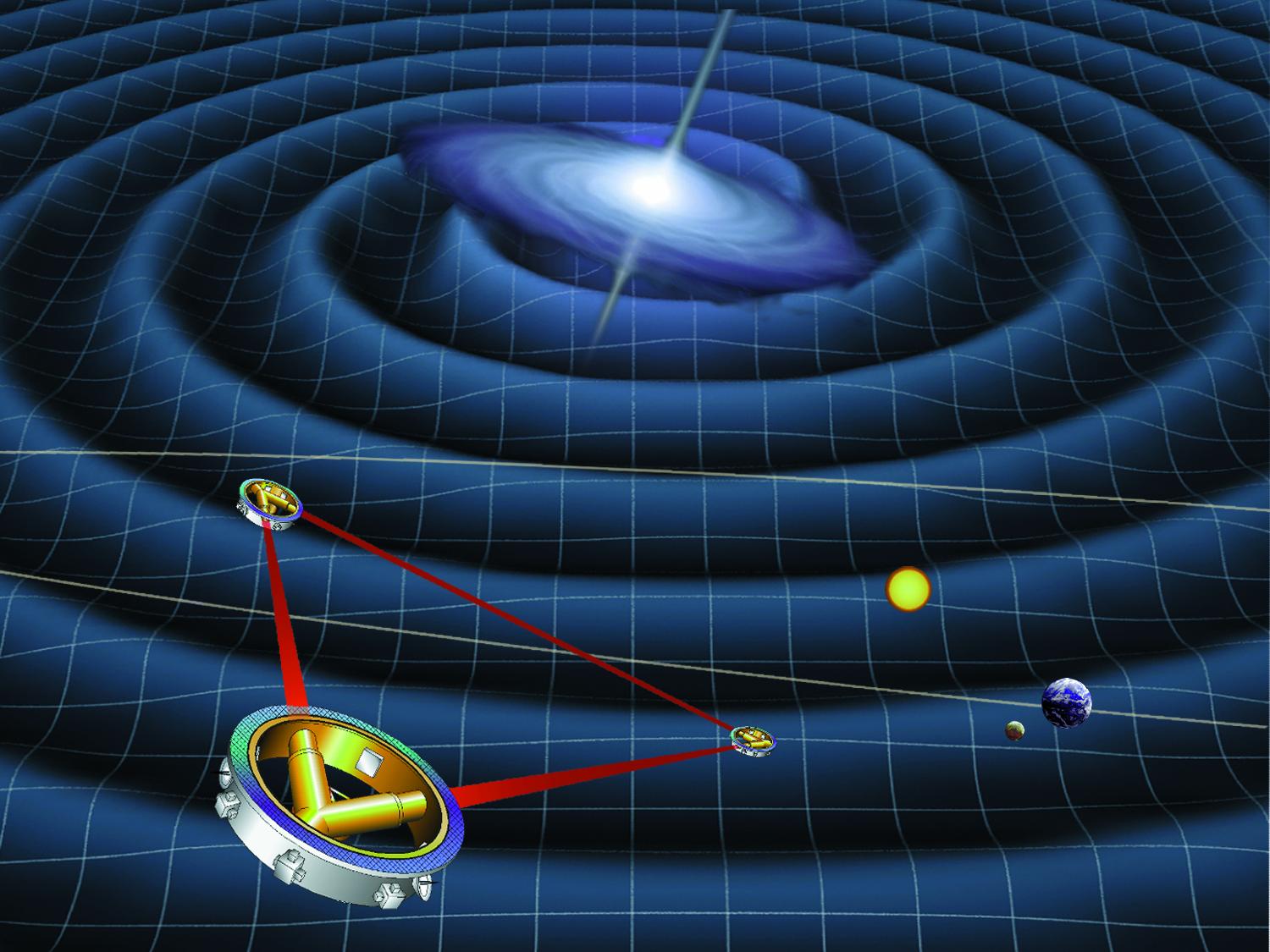
The Laser Interferometer Space Antenna (LISA) is a planned European space mission to detect and measure gravitational waves—slight ripples in the fabric of spacetime—from astronomical sources. LISA will be the first dedicated space-based gravitational-wave observatory. It aims to measure gravitational waves directly by using laser interferometry. The LISA concept features three spacecraft arranged in an equilateral triangle with each side 2.5 million kilometers long, flying in an Earth-like heliocentric orbit. The relative acceleration between the satellites is precisely monitored to detect a passing gravitational wave, which are distortions of spacetime traveling at the speed of light.
Potential sources for signals are merging massive black holes at the centre of galaxies, massive black holes orbited by small compact objects, known as extreme mass ratio inspirals, binaries of compact stars, substellar objects orbiting such binaries, and possibly other sources of cosmological origin, such as a cosmological phase transition shortly after the Big Bang, and speculative astrophysical objects like cosmic strings and domain boundaries.
The LISA mission's primary objective is to detect and measure gravitational waves produced by compact binary systems and mergers of supermassive black holes. LISA will observe gravitational waves by measuring differential changes in the length of its arms, as sensed by laser interferometry. Each of the three LISA spacecraft contains two telescopes, two lasers and two test masses (each a 46 mm, roughly 2 kg, gold-coated cube of gold/platinum), arranged in two optical assemblies pointed at the other two spacecraft. These form Michelson-like interferometers, each centred on one of the spacecraft, with the test masses defining the ends of the arms. The entire arrangement, which is ten times larger than the orbit of the Moon, will be placed in solar orbit at the same distance from the Sun as the Earth, but trailing the Earth by 20 degrees, and with the orbital planes of the three spacecraft inclined relative to the ecliptic by about 0.33 degree, which results in the plane of the triangular spacecraft formation being tilted 60 degrees from the plane of the ecliptic. The mean linear distance between the formation and the Earth will be 50 million kilometres.
To eliminate non-gravitational forces such as light pressure and solar wind on the test masses, each spacecraft is constructed as a zero-drag satellite. The test mass floats free inside, effectively in free-fall, while the spacecraft around it absorbs all these local non-gravitational forces. Then, using capacitive sensing to determine the spacecraft's position relative to the mass, very precise thrusters adjust the spacecraft so that it follows, keeping itself centered around the mass.
The longer the arms, the more sensitive the detector is to long-period gravitational waves, but its sensitivity to wavelengths shorter than the arms is reduced (2,500,000 km is 8.3 lightseconds, or 0.12 Hz; compare to LIGO's peak sensitivity around 500 Hz). As the satellites are free-flying, the spacing is easily adjusted before launch, with upper bounds being imposed by the sizes of the telescopes required at each end of the interferometer (which are constrained by the size of the launch vehicle's payload fairing) and the stability of the constellation orbit (larger constellations are more sensitive to the gravitational effects of other planets, limiting the mission lifetime). Another length-dependent factor which must be compensated for is the "point-ahead angle" between the incoming and outgoing laser beams; the telescope must receive its incoming beam from where its partner was a few seconds ago, but send its outgoing beam to where its partner will be a few seconds from now.
The original 2008 LISA proposal had arms 5 million kilometres (5 Gm) long. When downscoped to eLISA in 2013, arms of 1 million kilometres were proposed. The approved 2017 LISA proposal has arms 2.5 million kilometres (2.5 Gm) long.
Like most modern gravitational wave-observatories, LISA is based on laser interferometry. Its three satellites form a giant Michelson interferometer in which two "transponder" satellites play the role of reflectors and one "master" satellite the roles of source and observer. When a gravitational wave passes the interferometer, the lengths of the two LISA arms vary due to spacetime distortions caused by the wave. Practically, LISA measures a relative phase shift between one local laser and one distant laser by light interference. Comparison between the observed laser beam frequency (in return beam) and the local laser beam frequency (sent beam) encodes the wave parameters. The principle of laser-interferometric inter-satellite ranging measurements was successfully implemented in the Laser Ranging Interferometer onboard GRACE Follow-On.
Unlike terrestrial gravitational-wave observatories, LISA cannot keep its arms "locked" in position at a fixed length. Instead, the distances between satellites vary significantly over each year's orbit, and the detector must keep track of the constantly changing distance, counting the millions of wavelengths by which the distance changes each second. Then, the signals are separated in the frequency domain: changes with periods of less than a day are signals of interest, while changes with periods of a month or more are irrelevant.
Hub AI
Laser Interferometer Space Antenna AI simulator
(@Laser Interferometer Space Antenna_simulator)
Laser Interferometer Space Antenna
The Laser Interferometer Space Antenna (LISA) is a planned European space mission to detect and measure gravitational waves—slight ripples in the fabric of spacetime—from astronomical sources. LISA will be the first dedicated space-based gravitational-wave observatory. It aims to measure gravitational waves directly by using laser interferometry. The LISA concept features three spacecraft arranged in an equilateral triangle with each side 2.5 million kilometers long, flying in an Earth-like heliocentric orbit. The relative acceleration between the satellites is precisely monitored to detect a passing gravitational wave, which are distortions of spacetime traveling at the speed of light.
Potential sources for signals are merging massive black holes at the centre of galaxies, massive black holes orbited by small compact objects, known as extreme mass ratio inspirals, binaries of compact stars, substellar objects orbiting such binaries, and possibly other sources of cosmological origin, such as a cosmological phase transition shortly after the Big Bang, and speculative astrophysical objects like cosmic strings and domain boundaries.
The LISA mission's primary objective is to detect and measure gravitational waves produced by compact binary systems and mergers of supermassive black holes. LISA will observe gravitational waves by measuring differential changes in the length of its arms, as sensed by laser interferometry. Each of the three LISA spacecraft contains two telescopes, two lasers and two test masses (each a 46 mm, roughly 2 kg, gold-coated cube of gold/platinum), arranged in two optical assemblies pointed at the other two spacecraft. These form Michelson-like interferometers, each centred on one of the spacecraft, with the test masses defining the ends of the arms. The entire arrangement, which is ten times larger than the orbit of the Moon, will be placed in solar orbit at the same distance from the Sun as the Earth, but trailing the Earth by 20 degrees, and with the orbital planes of the three spacecraft inclined relative to the ecliptic by about 0.33 degree, which results in the plane of the triangular spacecraft formation being tilted 60 degrees from the plane of the ecliptic. The mean linear distance between the formation and the Earth will be 50 million kilometres.
To eliminate non-gravitational forces such as light pressure and solar wind on the test masses, each spacecraft is constructed as a zero-drag satellite. The test mass floats free inside, effectively in free-fall, while the spacecraft around it absorbs all these local non-gravitational forces. Then, using capacitive sensing to determine the spacecraft's position relative to the mass, very precise thrusters adjust the spacecraft so that it follows, keeping itself centered around the mass.
The longer the arms, the more sensitive the detector is to long-period gravitational waves, but its sensitivity to wavelengths shorter than the arms is reduced (2,500,000 km is 8.3 lightseconds, or 0.12 Hz; compare to LIGO's peak sensitivity around 500 Hz). As the satellites are free-flying, the spacing is easily adjusted before launch, with upper bounds being imposed by the sizes of the telescopes required at each end of the interferometer (which are constrained by the size of the launch vehicle's payload fairing) and the stability of the constellation orbit (larger constellations are more sensitive to the gravitational effects of other planets, limiting the mission lifetime). Another length-dependent factor which must be compensated for is the "point-ahead angle" between the incoming and outgoing laser beams; the telescope must receive its incoming beam from where its partner was a few seconds ago, but send its outgoing beam to where its partner will be a few seconds from now.
The original 2008 LISA proposal had arms 5 million kilometres (5 Gm) long. When downscoped to eLISA in 2013, arms of 1 million kilometres were proposed. The approved 2017 LISA proposal has arms 2.5 million kilometres (2.5 Gm) long.
Like most modern gravitational wave-observatories, LISA is based on laser interferometry. Its three satellites form a giant Michelson interferometer in which two "transponder" satellites play the role of reflectors and one "master" satellite the roles of source and observer. When a gravitational wave passes the interferometer, the lengths of the two LISA arms vary due to spacetime distortions caused by the wave. Practically, LISA measures a relative phase shift between one local laser and one distant laser by light interference. Comparison between the observed laser beam frequency (in return beam) and the local laser beam frequency (sent beam) encodes the wave parameters. The principle of laser-interferometric inter-satellite ranging measurements was successfully implemented in the Laser Ranging Interferometer onboard GRACE Follow-On.
Unlike terrestrial gravitational-wave observatories, LISA cannot keep its arms "locked" in position at a fixed length. Instead, the distances between satellites vary significantly over each year's orbit, and the detector must keep track of the constantly changing distance, counting the millions of wavelengths by which the distance changes each second. Then, the signals are separated in the frequency domain: changes with periods of less than a day are signals of interest, while changes with periods of a month or more are irrelevant.