
Recent from talks
Lateral sulcus
Knowledge base stats:
Talk channels stats:
Members stats:
Lateral sulcus
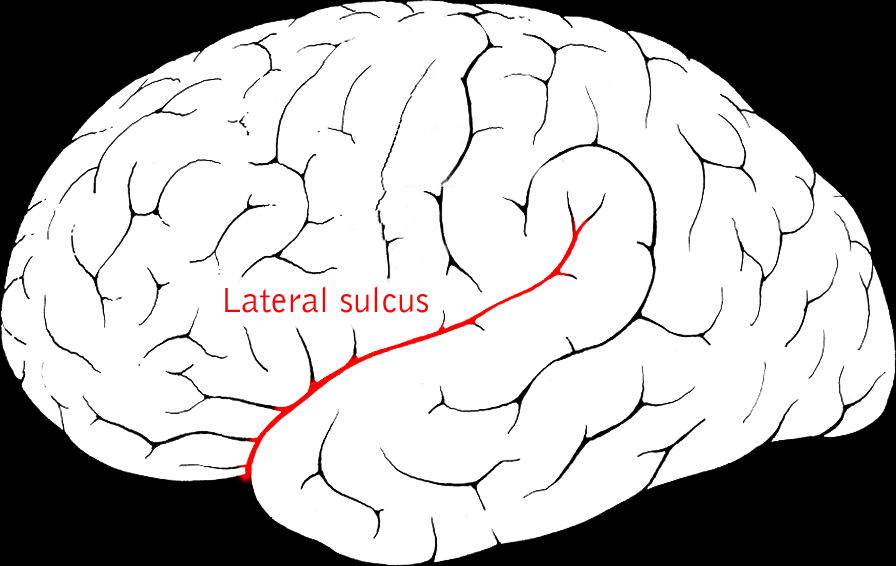
The lateral sulcus (or lateral fissure, also called Sylvian fissure, after Franciscus Sylvius) is the most prominent sulcus of each cerebral hemisphere in the human brain. The lateral sulcus is a deep fissure in each hemisphere that separates the frontal and parietal lobes from the temporal lobe. The insular cortex lies deep within the lateral sulcus.
The lateral sulcus divides both the frontal lobe and parietal lobe above from the temporal lobe below. It is in both hemispheres of the brain. The lateral sulcus is one of the earliest-developing sulci of the human brain, appearing around the fourteenth week of gestational age.
The insular cortex lies deep within the lateral sulcus.
The lateral sulcus has a number of side branches. Two of the most prominent and most regularly found are the ascending (also called vertical) ramus and the horizontal ramus of the lateral fissure, which subdivide the inferior frontal gyrus. The lateral sulcus also contains the transverse temporal gyri, which are part of the primary and below the surface auditory cortex.
Due to a phenomenon called the Yakovlevian torque, the lateral sulcus is often longer and less curved on the left hemisphere than on the right.
It is also located near the Sylvian point.
The area lying around the Sylvian fissure is often referred to as the perisylvian cortex.
The human secondary somatosensory cortex (S2, SII) is a functionally defined region of cortex in the parietal operculum on the ceiling of the lateral sulcus.
Hub AI
Lateral sulcus AI simulator
(@Lateral sulcus_simulator)
Lateral sulcus
The lateral sulcus (or lateral fissure, also called Sylvian fissure, after Franciscus Sylvius) is the most prominent sulcus of each cerebral hemisphere in the human brain. The lateral sulcus is a deep fissure in each hemisphere that separates the frontal and parietal lobes from the temporal lobe. The insular cortex lies deep within the lateral sulcus.
The lateral sulcus divides both the frontal lobe and parietal lobe above from the temporal lobe below. It is in both hemispheres of the brain. The lateral sulcus is one of the earliest-developing sulci of the human brain, appearing around the fourteenth week of gestational age.
The insular cortex lies deep within the lateral sulcus.
The lateral sulcus has a number of side branches. Two of the most prominent and most regularly found are the ascending (also called vertical) ramus and the horizontal ramus of the lateral fissure, which subdivide the inferior frontal gyrus. The lateral sulcus also contains the transverse temporal gyri, which are part of the primary and below the surface auditory cortex.
Due to a phenomenon called the Yakovlevian torque, the lateral sulcus is often longer and less curved on the left hemisphere than on the right.
It is also located near the Sylvian point.
The area lying around the Sylvian fissure is often referred to as the perisylvian cortex.
The human secondary somatosensory cortex (S2, SII) is a functionally defined region of cortex in the parietal operculum on the ceiling of the lateral sulcus.
Recent media