



Community hub
Recent from talks
Contribute something to knowledge base
Content stats: 0 posts, 0 articles, 1 media, 0 notes
Members stats: 0 subscribers, 0 contributors, 0 moderators, 0 supporters
Subscribers
Supporters
Contributors
Moderators
Hub AI
Frontal lobe AI simulator
(@Frontal lobe_simulator)
Hub AI
Frontal lobe AI simulator
(@Frontal lobe_simulator)
Frontal lobe
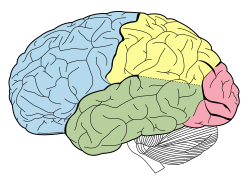
The frontal lobe is the largest lobe of the vertebrate brain and the most anterior lobe of the cerebral hemispheres. The anatomical groove known as the central sulcus separates the frontal lobe from the parietal lobe, and the deeper anatomical groove called the lateral sulcus separates the frontal lobe from the temporal lobe. The most anterior ventral, orbital end of the frontal lobe is known as the frontal pole, which is one of the three so-called poles of the cerebrum.
The outer, multifurrowed surface of the frontal lobe is called the frontal cortex. Like all cortical tissue, the frontal cortex is a thin layer of gray matter making up the outer portion of the brain. The frontal cortex is further subdivided into several anatomical and functional structures, including those of the motor cortex (the premotor cortex, the nonprimary motor cortex, the primary motor cortex) and the prefrontal cortex (e.g., the dorsolateral prefrontal cortex).
Located in the frontal lobe are also four principal gyri. The precentral gyrus is directly anterior to the central sulcus, running parallel to it and containing the primary motor cortex, which controls voluntary movements of specific body parts. Three other frontal gyri, horizontally arranged, are the superior frontal gyrus, the middle frontal gyrus, and the inferior frontal gyrus. The inferior frontal gyrus is further subdivided into the orbital part, the triangular part, and the opercular part, and it is functionally known as the ventrolateral prefrontal cortex.
The frontal lobe further contains most of the dopaminergic neurons in the cerebral cortex. Dopaminergic pathways are associated with reward, attention, short-term memory, planning, and motivation. Dopamine tends to limit and select sensory information coming from the thalamus to the forebrain.
The frontal lobe is the largest lobe of the brain and makes up about a third of the surface area of each hemisphere. On the dorsal surface of each hemisphere, the central sulcus separates the frontal lobe from the parietal lobe. The lateral sulcus separates the frontal lobe from the temporal lobe.
The frontal lobe can be divided into a lateral, polar, orbital (above the orbit; also called basal or ventral), and medial part. Each of these parts consists of a particular gyrus:
The gyri are separated by sulci. For example, the precentral gyrus is in front of the central sulcus, and behind the precentral sulcus. The superior and middle frontal gyri are divided by the superior frontal sulcus. The middle and inferior frontal gyri are divided by the inferior frontal sulcus.
The human frontal lobe reaches full maturity only at mid to late 20s (25-30 years of age)—in fact, the prefrontal cortex, in particular, continues to mature well into the third decade. A small amount of atrophy, however, is normal in the aging person's frontal lobe. Fjell et al. (2009), studying the rate of brain atrophy over time among 142 healthy adults aged 60–91 years compared with 122 patients with Alzheimer's disease, showed that there was a marked volumetric decline in those with Alzheimer's and a much smaller decline (averaging 0.5%) in the healthy group at the 1-year follow-up. These findings replicate those of Coffey et al. (1992), whose results also showed that the frontal lobe decreases in volume approximately 0.5–1% per year.
Frontal lobe
The frontal lobe is the largest lobe of the vertebrate brain and the most anterior lobe of the cerebral hemispheres. The anatomical groove known as the central sulcus separates the frontal lobe from the parietal lobe, and the deeper anatomical groove called the lateral sulcus separates the frontal lobe from the temporal lobe. The most anterior ventral, orbital end of the frontal lobe is known as the frontal pole, which is one of the three so-called poles of the cerebrum.
The outer, multifurrowed surface of the frontal lobe is called the frontal cortex. Like all cortical tissue, the frontal cortex is a thin layer of gray matter making up the outer portion of the brain. The frontal cortex is further subdivided into several anatomical and functional structures, including those of the motor cortex (the premotor cortex, the nonprimary motor cortex, the primary motor cortex) and the prefrontal cortex (e.g., the dorsolateral prefrontal cortex).
Located in the frontal lobe are also four principal gyri. The precentral gyrus is directly anterior to the central sulcus, running parallel to it and containing the primary motor cortex, which controls voluntary movements of specific body parts. Three other frontal gyri, horizontally arranged, are the superior frontal gyrus, the middle frontal gyrus, and the inferior frontal gyrus. The inferior frontal gyrus is further subdivided into the orbital part, the triangular part, and the opercular part, and it is functionally known as the ventrolateral prefrontal cortex.
The frontal lobe further contains most of the dopaminergic neurons in the cerebral cortex. Dopaminergic pathways are associated with reward, attention, short-term memory, planning, and motivation. Dopamine tends to limit and select sensory information coming from the thalamus to the forebrain.
The frontal lobe is the largest lobe of the brain and makes up about a third of the surface area of each hemisphere. On the dorsal surface of each hemisphere, the central sulcus separates the frontal lobe from the parietal lobe. The lateral sulcus separates the frontal lobe from the temporal lobe.
The frontal lobe can be divided into a lateral, polar, orbital (above the orbit; also called basal or ventral), and medial part. Each of these parts consists of a particular gyrus:
The gyri are separated by sulci. For example, the precentral gyrus is in front of the central sulcus, and behind the precentral sulcus. The superior and middle frontal gyri are divided by the superior frontal sulcus. The middle and inferior frontal gyri are divided by the inferior frontal sulcus.
The human frontal lobe reaches full maturity only at mid to late 20s (25-30 years of age)—in fact, the prefrontal cortex, in particular, continues to mature well into the third decade. A small amount of atrophy, however, is normal in the aging person's frontal lobe. Fjell et al. (2009), studying the rate of brain atrophy over time among 142 healthy adults aged 60–91 years compared with 122 patients with Alzheimer's disease, showed that there was a marked volumetric decline in those with Alzheimer's and a much smaller decline (averaging 0.5%) in the healthy group at the 1-year follow-up. These findings replicate those of Coffey et al. (1992), whose results also showed that the frontal lobe decreases in volume approximately 0.5–1% per year.
Recent media
Recent media