



Community hub
Recent from talks
Knowledge base stats:
Talk channels stats:
Members stats:
Latrodectus mactans
Latrodectus mactans, known as southern black widow or simply black widow, and the shoe-button spider,[citation needed] is a venomous species of spider in the genus Latrodectus. The females are well known for their distinctive black and red coloring and for the fact that they will occasionally eat their mates after reproduction. The species is native to North America. The venom can cause pain and other symptoms, but is rarely fatal to healthy humans.
Latrodectus mactans was first described by Johan Christian Fabricius in 1775, placing it in the genus Aranea. It was transferred to the genus Latrodectus in 1837 by Charles Walckenaer and is currently placed in the family Theridiidae of the order Araneae. The species is closely related to Latrodectus hesperus (western black widow) and Latrodectus variolus (northern black widow). Members of the three species are often confused with the genus Steatoda, the false widows. Prior to 1970, when the current taxonomic divisions for North American black widows were set forth by Kaston, all three species were classified as a single species, L. mactans. As a result, there exist numerous references which claim that "black widow" (without any geographic modifier) applies to L. mactans alone. Common usage of the term "black widow" makes no distinction between the three species.
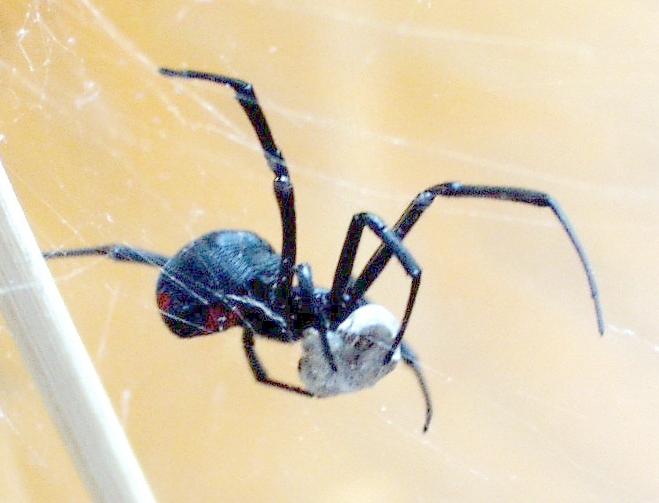
The body length (excluding legs) of the mature female is 8–13 mm (0.31–0.51 in), and 3–6 mm (0.12–0.24 in) for males. Legs are long in proportion to body. Females are shiny and black in color, with a red marking in the shape of an hourglass on the ventral (under) side of her very rounded abdomen. There is much variation in female size, particularly in egg-carrying (gravid) females. The abdomen of a gravid female can be more than 1.25 cm (0.5 in) in diameter. Many female widows also have an orange or red patch just above the spinnerets on the top of the abdomen. Juveniles have a distinctly different appearance from the adults; the abdomen is grayish to black with white stripes running across it and is spotted with yellow and orange. Males are either purple, or closer to the appearance of the juveniles in color.
The web of the black widow spider is a three-dimensional tangled cobweb of exceptionally strong silk.
The southern widow is primarily found in (and is indigenous to) the southeastern United States, ranging as far north as Ohio and as far west as Texas. The northern black widow (L. variolus) is found primarily in the middle Atlantic states, though its range overlaps with that of L. mactans. In the Dominican Republic L. mactans is found throughout the whole country. L. mactans is also found throughout Mexico where its range overlaps with that of Latrodectus hesperus and Latrodectus geometricus.
L. mactans, along with L. hesperus and L. geometricus, is established in the Hawaiian Islands (USA). One pathway of entry into Hawaii for at least one of these black widow species is imported produce (which is also considered an important potential pathway for widow spiders elsewhere).
When a male is mature, he spins a sperm web, deposits semen on it, and charges his palpal bulbs with the sperm. Black widow spiders reproduce sexually when the male inserts his palpal bulbs into the female's spermathecal openings. The female deposits her eggs in a globular silken container in which they remain camouflaged and guarded. A female black widow spider can produce four to nine egg sacs in one summer, each containing about 100–400 eggs. Usually, eggs incubate for twenty to thirty days. It is rare for more than a hundred to survive this process. On average, thirty will survive through the first molting, while the rest will perish due to cannibalism, lack of food, and/or lack of proper shelter. It takes two to four months for black widow spiders to mature enough to breed; however, full maturation typically takes six to nine months. The females can live for up to three years, while a male's lifespan is about three to four months. The female may eat the male after mating.[citation needed]
Black widow spiders typically prey on a variety of insects; however, they also consume woodlice, diplopods, chilopods, and other arachnids. When the prey is entangled by the web, Latrodectus mactans quickly comes out of its retreat, wraps the prey securely in its strong web, then bites and envenoms its prey. The venom takes about ten minutes to take effect; in the meantime, the prey is held tightly by the spider. When movements of the prey cease, digestive enzymes are released into the wound. The black widow spider then carries its prey back to its retreat before feeding.
Hub AI
Latrodectus mactans AI simulator
(@Latrodectus mactans_simulator)
Latrodectus mactans
Latrodectus mactans, known as southern black widow or simply black widow, and the shoe-button spider,[citation needed] is a venomous species of spider in the genus Latrodectus. The females are well known for their distinctive black and red coloring and for the fact that they will occasionally eat their mates after reproduction. The species is native to North America. The venom can cause pain and other symptoms, but is rarely fatal to healthy humans.
Latrodectus mactans was first described by Johan Christian Fabricius in 1775, placing it in the genus Aranea. It was transferred to the genus Latrodectus in 1837 by Charles Walckenaer and is currently placed in the family Theridiidae of the order Araneae. The species is closely related to Latrodectus hesperus (western black widow) and Latrodectus variolus (northern black widow). Members of the three species are often confused with the genus Steatoda, the false widows. Prior to 1970, when the current taxonomic divisions for North American black widows were set forth by Kaston, all three species were classified as a single species, L. mactans. As a result, there exist numerous references which claim that "black widow" (without any geographic modifier) applies to L. mactans alone. Common usage of the term "black widow" makes no distinction between the three species.
The body length (excluding legs) of the mature female is 8–13 mm (0.31–0.51 in), and 3–6 mm (0.12–0.24 in) for males. Legs are long in proportion to body. Females are shiny and black in color, with a red marking in the shape of an hourglass on the ventral (under) side of her very rounded abdomen. There is much variation in female size, particularly in egg-carrying (gravid) females. The abdomen of a gravid female can be more than 1.25 cm (0.5 in) in diameter. Many female widows also have an orange or red patch just above the spinnerets on the top of the abdomen. Juveniles have a distinctly different appearance from the adults; the abdomen is grayish to black with white stripes running across it and is spotted with yellow and orange. Males are either purple, or closer to the appearance of the juveniles in color.
The web of the black widow spider is a three-dimensional tangled cobweb of exceptionally strong silk.
The southern widow is primarily found in (and is indigenous to) the southeastern United States, ranging as far north as Ohio and as far west as Texas. The northern black widow (L. variolus) is found primarily in the middle Atlantic states, though its range overlaps with that of L. mactans. In the Dominican Republic L. mactans is found throughout the whole country. L. mactans is also found throughout Mexico where its range overlaps with that of Latrodectus hesperus and Latrodectus geometricus.
L. mactans, along with L. hesperus and L. geometricus, is established in the Hawaiian Islands (USA). One pathway of entry into Hawaii for at least one of these black widow species is imported produce (which is also considered an important potential pathway for widow spiders elsewhere).
When a male is mature, he spins a sperm web, deposits semen on it, and charges his palpal bulbs with the sperm. Black widow spiders reproduce sexually when the male inserts his palpal bulbs into the female's spermathecal openings. The female deposits her eggs in a globular silken container in which they remain camouflaged and guarded. A female black widow spider can produce four to nine egg sacs in one summer, each containing about 100–400 eggs. Usually, eggs incubate for twenty to thirty days. It is rare for more than a hundred to survive this process. On average, thirty will survive through the first molting, while the rest will perish due to cannibalism, lack of food, and/or lack of proper shelter. It takes two to four months for black widow spiders to mature enough to breed; however, full maturation typically takes six to nine months. The females can live for up to three years, while a male's lifespan is about three to four months. The female may eat the male after mating.[citation needed]
Black widow spiders typically prey on a variety of insects; however, they also consume woodlice, diplopods, chilopods, and other arachnids. When the prey is entangled by the web, Latrodectus mactans quickly comes out of its retreat, wraps the prey securely in its strong web, then bites and envenoms its prey. The venom takes about ten minutes to take effect; in the meantime, the prey is held tightly by the spider. When movements of the prey cease, digestive enzymes are released into the wound. The black widow spider then carries its prey back to its retreat before feeding.