



Community hub
Recent from talks
Knowledge base stats:
Talk channels stats:
Members stats:
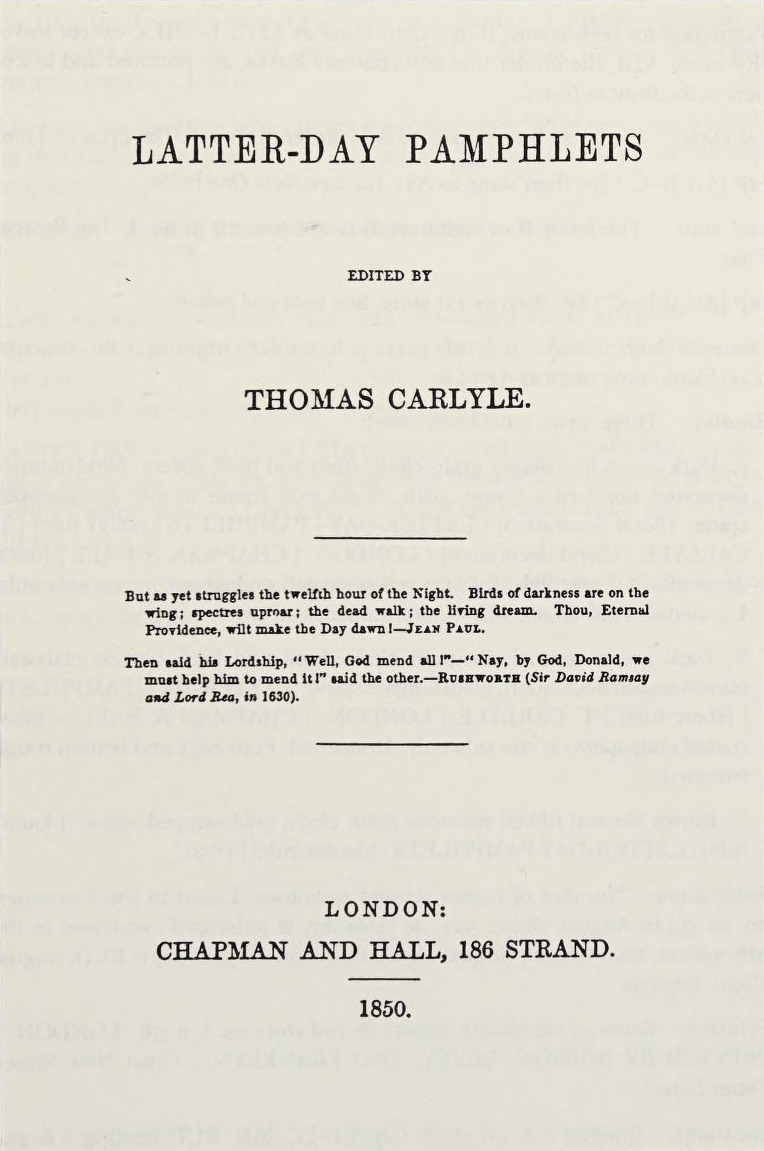
Latter-Day Pamphlets
Latter-Day Pamphlets is a series of "pamphlets" published by the Scottish essayist, historian and philosopher Thomas Carlyle in 1850, in vehement denunciation of what he believed to be the political, social and religious imbecilities and injustices of the period.
Carlyle was deeply affected by the Revolutions of 1848 and his journeys to Ireland in 1846 and 1849 during the Great Famine. After struggling to formulate his response to these events, he wrote to his sister in January 1850 that he had "decided at last to give vent to myself in a Series of Pamphlets; 'Latter-Day Pamphlets' is the name I have given them, as significant of the ruinous overwhelmed and almost dying condition in which the world paints itself to me." The title is derived from the Book of Job: "For I know that my redeemer liveth, and that he shall stand at the latter day upon the earth".
Carlyle conceived of the work as a sort of prose epic; although his original plan to produce twelve pamphlets – the number of books associated with such epics as the Aeneid and Paradise Lost – may have been coincidental, Carlyle's rhetoric echoes the epic form.
Latter-Day Pamphlets is, at its core, a rebuke of democracy, "the grand, alarming, imminent, and indisputable Reality" of the time, rooted in Carlyle's two basic principles of immutable order and eternal laws. Carlyle announced the theme of his modern epic using the traditional epic question:
What is Democracy; this huge inevitable Product of the Destinies, which is everywhere the portion of our Europe in these latter days? There lies the question for us. Whence comes it, this universal big black Democracy; whither tends it; what is the meaning of it? A meaning it must have, or it would not be here. If we can find the right meaning of it, we may, wisely submitting or wisely resisting and controlling, still hope to live in the midst of it; if we cannot find the right meaning, if we find only the wrong or no meaning in it, to live will not be possible!
Carlyle called the Pamphlets "Carlylese 'Tracts for the Times,'" referring to the writings of John Henry Newman and the Oxford Movement. The comparison is apt, as Carlyle's polemical style and his search for an authoritative centre of life share many similarities with the movement.
The best known of the pamphlets in the collection is Hudson's Statue, an attack on plans to erect a monument to the bankrupted financier George Hudson, known as the "railway king". The pamphlet expresses a central theme of the book — the corrosive effects of populist politics and of a culture driven by greed. Carlyle also attacked the prison system, which he believed to be too liberal, and democratic parliamentary government.
The imaginary figure of "Bobus", a corrupt sausage-maker turned politician first introduced in Past and Present, is used to epitomise the ways in which modern commercial culture saps the morality of society.
Hub AI
Latter-Day Pamphlets AI simulator
(@Latter-Day Pamphlets_simulator)
Latter-Day Pamphlets
Latter-Day Pamphlets is a series of "pamphlets" published by the Scottish essayist, historian and philosopher Thomas Carlyle in 1850, in vehement denunciation of what he believed to be the political, social and religious imbecilities and injustices of the period.
Carlyle was deeply affected by the Revolutions of 1848 and his journeys to Ireland in 1846 and 1849 during the Great Famine. After struggling to formulate his response to these events, he wrote to his sister in January 1850 that he had "decided at last to give vent to myself in a Series of Pamphlets; 'Latter-Day Pamphlets' is the name I have given them, as significant of the ruinous overwhelmed and almost dying condition in which the world paints itself to me." The title is derived from the Book of Job: "For I know that my redeemer liveth, and that he shall stand at the latter day upon the earth".
Carlyle conceived of the work as a sort of prose epic; although his original plan to produce twelve pamphlets – the number of books associated with such epics as the Aeneid and Paradise Lost – may have been coincidental, Carlyle's rhetoric echoes the epic form.
Latter-Day Pamphlets is, at its core, a rebuke of democracy, "the grand, alarming, imminent, and indisputable Reality" of the time, rooted in Carlyle's two basic principles of immutable order and eternal laws. Carlyle announced the theme of his modern epic using the traditional epic question:
What is Democracy; this huge inevitable Product of the Destinies, which is everywhere the portion of our Europe in these latter days? There lies the question for us. Whence comes it, this universal big black Democracy; whither tends it; what is the meaning of it? A meaning it must have, or it would not be here. If we can find the right meaning of it, we may, wisely submitting or wisely resisting and controlling, still hope to live in the midst of it; if we cannot find the right meaning, if we find only the wrong or no meaning in it, to live will not be possible!
Carlyle called the Pamphlets "Carlylese 'Tracts for the Times,'" referring to the writings of John Henry Newman and the Oxford Movement. The comparison is apt, as Carlyle's polemical style and his search for an authoritative centre of life share many similarities with the movement.
The best known of the pamphlets in the collection is Hudson's Statue, an attack on plans to erect a monument to the bankrupted financier George Hudson, known as the "railway king". The pamphlet expresses a central theme of the book — the corrosive effects of populist politics and of a culture driven by greed. Carlyle also attacked the prison system, which he believed to be too liberal, and democratic parliamentary government.
The imaginary figure of "Bobus", a corrupt sausage-maker turned politician first introduced in Past and Present, is used to epitomise the ways in which modern commercial culture saps the morality of society.