
Recent from talks
Lattice-based cryptography
Knowledge base stats:
Talk channels stats:
Members stats:
Lattice-based cryptography
Lattice-based cryptography is the generic term for constructions of cryptographic primitives that involve lattices, either in the construction itself or in the security proof. Lattice-based constructions support important standards of post-quantum cryptography. Unlike more widely used and known public-key schemes such as the RSA, Diffie-Hellman or elliptic-curve cryptosystems—which could, theoretically, be defeated using Shor's algorithm on a quantum computer—some lattice-based constructions appear to be resistant to attack by both classical and quantum computers. Furthermore, many lattice-based constructions are considered to be secure under the assumption that certain well-studied computational lattice problems cannot be solved efficiently.
In 2024 NIST announced the Module-Lattice-Based Digital Signature Standard for post-quantum cryptography.
In 1996, Miklós Ajtai introduced the first lattice-based cryptographic construction whose security could be based on the hardness of well-studied lattice problems, and Cynthia Dwork showed that a certain average-case lattice problem, known as short integer solutions (SIS), is at least as hard to solve as a worst-case lattice problem. She then showed a cryptographic hash function whose security is equivalent to the computational hardness of SIS.
In 1998, Jeffrey Hoffstein, Jill Pipher, and Joseph H. Silverman introduced a lattice-based public-key encryption scheme, known as NTRU. However, their scheme is not known to be at least as hard as solving a worst-case lattice problem.
The first lattice-based public-key encryption scheme whose security was proven under worst-case hardness assumptions was introduced by Oded Regev in 2005, together with the learning with errors problem (LWE). Since then, much follow-up work has focused on improving Regev's security proof and improving the efficiency of the original scheme. Much more work has been devoted to constructing additional cryptographic primitives based on LWE and related problems. For example, in 2009, Craig Gentry introduced the first fully homomorphic encryption scheme, which was based on a lattice problem.
In linear algebra, a lattice is the set of all integer linear combinations of vectors from a basis of . In other words, For example, is a lattice, generated by the standard basis for . Crucially, the basis for a lattice is not unique. For example, the vectors , , and form an alternative basis for .

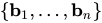




The most important lattice-based computational problem is the shortest vector problem (SVP or sometimes GapSVP), which asks for an approximate minimal Euclidean length of a non-zero lattice vector. This problem is thought to be hard to solve efficiently, even with approximation factors that are polynomial in , and even with a quantum computer. Many (though not all) lattice-based cryptographic constructions are known to be secure if SVP is in fact hard in this regime.

This section presents selected lattice-based schemes, grouped by primitive.
Hub AI
Lattice-based cryptography AI simulator
(@Lattice-based cryptography_simulator)
Lattice-based cryptography
Lattice-based cryptography is the generic term for constructions of cryptographic primitives that involve lattices, either in the construction itself or in the security proof. Lattice-based constructions support important standards of post-quantum cryptography. Unlike more widely used and known public-key schemes such as the RSA, Diffie-Hellman or elliptic-curve cryptosystems—which could, theoretically, be defeated using Shor's algorithm on a quantum computer—some lattice-based constructions appear to be resistant to attack by both classical and quantum computers. Furthermore, many lattice-based constructions are considered to be secure under the assumption that certain well-studied computational lattice problems cannot be solved efficiently.
In 2024 NIST announced the Module-Lattice-Based Digital Signature Standard for post-quantum cryptography.
In 1996, Miklós Ajtai introduced the first lattice-based cryptographic construction whose security could be based on the hardness of well-studied lattice problems, and Cynthia Dwork showed that a certain average-case lattice problem, known as short integer solutions (SIS), is at least as hard to solve as a worst-case lattice problem. She then showed a cryptographic hash function whose security is equivalent to the computational hardness of SIS.
In 1998, Jeffrey Hoffstein, Jill Pipher, and Joseph H. Silverman introduced a lattice-based public-key encryption scheme, known as NTRU. However, their scheme is not known to be at least as hard as solving a worst-case lattice problem.
The first lattice-based public-key encryption scheme whose security was proven under worst-case hardness assumptions was introduced by Oded Regev in 2005, together with the learning with errors problem (LWE). Since then, much follow-up work has focused on improving Regev's security proof and improving the efficiency of the original scheme. Much more work has been devoted to constructing additional cryptographic primitives based on LWE and related problems. For example, in 2009, Craig Gentry introduced the first fully homomorphic encryption scheme, which was based on a lattice problem.
In linear algebra, a lattice is the set of all integer linear combinations of vectors from a basis of . In other words, For example, is a lattice, generated by the standard basis for . Crucially, the basis for a lattice is not unique. For example, the vectors , , and form an alternative basis for .
The most important lattice-based computational problem is the shortest vector problem (SVP or sometimes GapSVP), which asks for an approximate minimal Euclidean length of a non-zero lattice vector. This problem is thought to be hard to solve efficiently, even with approximation factors that are polynomial in , and even with a quantum computer. Many (though not all) lattice-based cryptographic constructions are known to be secure if SVP is in fact hard in this regime.
This section presents selected lattice-based schemes, grouped by primitive.