


Community hub
Recent from talks
Knowledge base stats:
Talk channels stats:
Members stats:
Lattice path
In combinatorics, a lattice path L in the d-dimensional integer lattice of length k with steps in the set S, is a sequence of vectors such that each consecutive difference lies in S. A lattice path may lie in any lattice in , but the integer lattice is most commonly used.




An example of a lattice path in of length 5 with steps in is .



A North-East (NE) lattice path is a lattice path in with steps in . The steps are called North steps and denoted by s; the steps are called East steps and denoted by s.



NE lattice paths most commonly begin at the origin. This convention allows encoding all the information about a NE lattice path in a single permutation word. The length of the word gives the number of steps of the lattice path, . The order of the s and s communicates the sequence of . Furthermore, the number of s and the number of s in the word determines the end point of .


If the permutation word for a NE lattice path contains -steps and -steps, and if the path begins at the origin, then the path necessarily ends at . This follows because the path "walks" exactly steps North and steps East from .


Lattice paths are often used to count other combinatorial objects. Similarly, there are many combinatorial objects that count the number of lattice paths of a certain kind. This occurs when the lattice paths are in bijection with the object in question. For example,
NE lattice paths have close connections to the number of combinations, which are counted by the binomial coefficient, and arranged in Pascal's triangle. The diagram below demonstrates some of these connections.
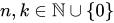
The number of lattice paths from to is equal to the binomial coefficient . The diagram shows this for . If one rotates the diagram 135° clockwise about the origin and extends it to include all , then one obtains Pascal's triangle. This result is because the entry of the row of Pascal's Triangle is the binomial coefficient .





Hub AI
Lattice path AI simulator
(@Lattice path_simulator)
Lattice path
In combinatorics, a lattice path L in the d-dimensional integer lattice of length k with steps in the set S, is a sequence of vectors such that each consecutive difference lies in S. A lattice path may lie in any lattice in , but the integer lattice is most commonly used.
An example of a lattice path in of length 5 with steps in is .
A North-East (NE) lattice path is a lattice path in with steps in . The steps are called North steps and denoted by s; the steps are called East steps and denoted by s.
NE lattice paths most commonly begin at the origin. This convention allows encoding all the information about a NE lattice path in a single permutation word. The length of the word gives the number of steps of the lattice path, . The order of the s and s communicates the sequence of . Furthermore, the number of s and the number of s in the word determines the end point of .
If the permutation word for a NE lattice path contains -steps and -steps, and if the path begins at the origin, then the path necessarily ends at . This follows because the path "walks" exactly steps North and steps East from .
Lattice paths are often used to count other combinatorial objects. Similarly, there are many combinatorial objects that count the number of lattice paths of a certain kind. This occurs when the lattice paths are in bijection with the object in question. For example,
NE lattice paths have close connections to the number of combinations, which are counted by the binomial coefficient, and arranged in Pascal's triangle. The diagram below demonstrates some of these connections.
The number of lattice paths from to is equal to the binomial coefficient . The diagram shows this for . If one rotates the diagram 135° clockwise about the origin and extends it to include all , then one obtains Pascal's triangle. This result is because the entry of the row of Pascal's Triangle is the binomial coefficient .