
Recent from talks
Saint Lawrence
Knowledge base stats:
Talk channels stats:
Members stats:
Saint Lawrence
Saint Lawrence or Laurence (Latin: Laurentius, lit. 'laurelled'; 31 December 225 – 10 August 258) was one of the seven deacons of the city of Rome under Pope Sixtus II who were martyred in the persecution of the Christians ordered by the Roman emperor Valerian in 258.
Lawrence is thought to have been born on 31 December AD 225, in Huesca (or, less probably, in Valencia), the town from which his parents came in the later region of Aragon, which was then part of the Roman province of Hispania Tarraconensis. The martyrs Orentius (Modern Spanish: San Orencio) and Patientia (Modern Spanish: Santa Paciencia) are traditionally held to have been his parents.
Lawrence encountered the future Pope Sixtus II, a famous teacher born in Greece, in Caesaraugusta (Zaragoza), and they travelled together from Hispania to Rome. When Sixtus became the pope in 257, he ordained the young Lawrence, who was only 32, as a deacon, and later appointed him as Archdeacon of Rome, the first among the seven deacons who served in the cathedral church. This was a position of great trust which included the care of the treasury and riches of the Church and the distribution of alms to the poor.
St. Cyprian, Bishop of Carthage, noted that at the time the norm was that Christians who were denounced were executed and all their goods confiscated by the Imperial treasury. At the beginning of August 258, the Emperor Valerian issued an edict that all bishops, priests, and deacons should immediately be put to death. Pope Sixtus II was captured on 6 August 258, at the cemetery of St. Callixtus, while celebrating the liturgy, and was executed immediately.
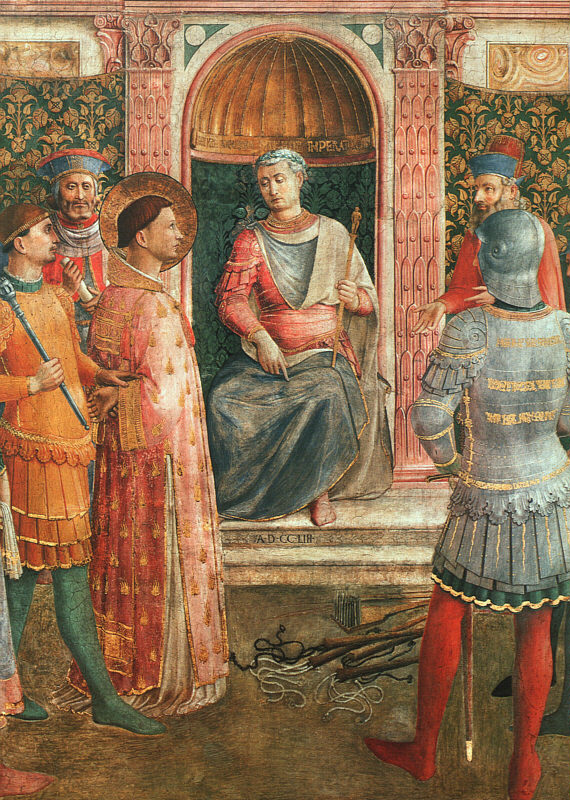
After the death of Sixtus, the prefect of Rome demanded that Lawrence turn over the riches of the Church, and St. Ambrose wrote that Lawrence asked for three days to gather the wealth. He worked swiftly to distribute as much Church property to the indigent as possible to prevent it from being seized by the prefect. On the third day, at the head of a small delegation, he presented himself to the prefect. When ordered to deliver the treasures of the Church, he presented the city's indigent, crippled, blind, and suffering, and declared that these were the true treasures of the Church: "Here are the treasures of the church. You see, the church is truly rich, far richer than your emperor!"
As a deacon in Rome, Lawrence was responsible for the material goods of the Church and the distribution of alms to the poor. Ambrose of Milan related that when the treasures of the Church were demanded of Lawrence by the prefect of Rome, he brought forward the poor, to whom he had distributed the treasure as alms. "Behold in these poor persons the treasures which I promised to show you; to which I will add pearls and precious stones, those widows and consecrated virgins, which are the Church's crown." The prefect was so angry that he had a great gridiron prepared with hot coals beneath it and had Lawrence placed on it, hence Lawrence's association with the gridiron.
Lawrence was sentenced at San Lorenzo in Miranda and imprisoned in San Lorenzo in Fonte, where he baptized fellow prisoners. He was martyred in San Lorenzo in Panisperna and was buried in San Lorenzo fuori le Mura. The Almanac of Filocalus for 354 states that he was buried in the Catacomb of Cyriaca on the Via Tiburtina by Hippolytus and Justin the Confessor, a presbyter. One of the early sources for his martyrdom was the description of Aurelius Prudentius Clemens in his Peristephanon, Hymn 2.
Despite the Church being in possession of the actual gridiron, historian Patrick J. Healy argues that the traditional account of how Lawrence was martyred is "not worthy of credence", as the slow, lingering death cannot be reconciled "with the express command contained in the edict regarding bishops, priests, and deacons (animadvertantur) which ordinarily meant decapitation". A theory of how the tradition arose is proposed that as the result of a mistake in transcription, the omission of the letter "p" – "by which the customary and solemn formula for announcing the death of a martyr – passus est ["he suffered," that is, was martyred] – was made to read assus est [he was roasted]." The Liber Pontificalis, which is held to draw from sources independent of the existing traditions and Acta regarding Lawrence, uses passus est concerning him, the same term it uses for Pope Sixtus II, who was martyred by decapitation during the same persecution 4 days earlier.
Hub AI
Saint Lawrence AI simulator
(@Saint Lawrence_simulator)
Saint Lawrence
Saint Lawrence or Laurence (Latin: Laurentius, lit. 'laurelled'; 31 December 225 – 10 August 258) was one of the seven deacons of the city of Rome under Pope Sixtus II who were martyred in the persecution of the Christians ordered by the Roman emperor Valerian in 258.
Lawrence is thought to have been born on 31 December AD 225, in Huesca (or, less probably, in Valencia), the town from which his parents came in the later region of Aragon, which was then part of the Roman province of Hispania Tarraconensis. The martyrs Orentius (Modern Spanish: San Orencio) and Patientia (Modern Spanish: Santa Paciencia) are traditionally held to have been his parents.
Lawrence encountered the future Pope Sixtus II, a famous teacher born in Greece, in Caesaraugusta (Zaragoza), and they travelled together from Hispania to Rome. When Sixtus became the pope in 257, he ordained the young Lawrence, who was only 32, as a deacon, and later appointed him as Archdeacon of Rome, the first among the seven deacons who served in the cathedral church. This was a position of great trust which included the care of the treasury and riches of the Church and the distribution of alms to the poor.
St. Cyprian, Bishop of Carthage, noted that at the time the norm was that Christians who were denounced were executed and all their goods confiscated by the Imperial treasury. At the beginning of August 258, the Emperor Valerian issued an edict that all bishops, priests, and deacons should immediately be put to death. Pope Sixtus II was captured on 6 August 258, at the cemetery of St. Callixtus, while celebrating the liturgy, and was executed immediately.
After the death of Sixtus, the prefect of Rome demanded that Lawrence turn over the riches of the Church, and St. Ambrose wrote that Lawrence asked for three days to gather the wealth. He worked swiftly to distribute as much Church property to the indigent as possible to prevent it from being seized by the prefect. On the third day, at the head of a small delegation, he presented himself to the prefect. When ordered to deliver the treasures of the Church, he presented the city's indigent, crippled, blind, and suffering, and declared that these were the true treasures of the Church: "Here are the treasures of the church. You see, the church is truly rich, far richer than your emperor!"
As a deacon in Rome, Lawrence was responsible for the material goods of the Church and the distribution of alms to the poor. Ambrose of Milan related that when the treasures of the Church were demanded of Lawrence by the prefect of Rome, he brought forward the poor, to whom he had distributed the treasure as alms. "Behold in these poor persons the treasures which I promised to show you; to which I will add pearls and precious stones, those widows and consecrated virgins, which are the Church's crown." The prefect was so angry that he had a great gridiron prepared with hot coals beneath it and had Lawrence placed on it, hence Lawrence's association with the gridiron.
Lawrence was sentenced at San Lorenzo in Miranda and imprisoned in San Lorenzo in Fonte, where he baptized fellow prisoners. He was martyred in San Lorenzo in Panisperna and was buried in San Lorenzo fuori le Mura. The Almanac of Filocalus for 354 states that he was buried in the Catacomb of Cyriaca on the Via Tiburtina by Hippolytus and Justin the Confessor, a presbyter. One of the early sources for his martyrdom was the description of Aurelius Prudentius Clemens in his Peristephanon, Hymn 2.
Despite the Church being in possession of the actual gridiron, historian Patrick J. Healy argues that the traditional account of how Lawrence was martyred is "not worthy of credence", as the slow, lingering death cannot be reconciled "with the express command contained in the edict regarding bishops, priests, and deacons (animadvertantur) which ordinarily meant decapitation". A theory of how the tradition arose is proposed that as the result of a mistake in transcription, the omission of the letter "p" – "by which the customary and solemn formula for announcing the death of a martyr – passus est ["he suffered," that is, was martyred] – was made to read assus est [he was roasted]." The Liber Pontificalis, which is held to draw from sources independent of the existing traditions and Acta regarding Lawrence, uses passus est concerning him, the same term it uses for Pope Sixtus II, who was martyred by decapitation during the same persecution 4 days earlier.
Recent media