Hubbry Logo
Catacomb of CallixtusCatacomb of CallixtusMain
Open search
Catacomb of Callixtus
Community hub
Catacomb of Callixtus
logo
8 pages, 0 posts
0 subscribers
Be the first to start a discussion here.
Contribute something
Catacomb of Callixtus
from Wikipedia
Entrance to the areal of the Catacomb of Callixtus.
Grave niches in the Catacomb of Callixtus

The Catacomb(s) of Callixtus (also known as the Cemetery of Callixtus) is one of the Catacombs of Rome on the Appian Way, notable for containing the Crypt of the Popes (Italian: Cappella dei Papi), which once contained the tombs of several popes from the 2nd to 4th centuries.[1][2]

History

[edit]

The Catacomb is believed to have been created by future Pope Callixtus I, then a deacon of Rome, under the direction of Pope Zephyrinus, enlarging pre-existing early Christian hypogea. Callixtus himself was entombed in the Catacomb of Calepodius on the Aurelian Way. The crypt fell into disuse and decay as the relics it contained were translated from the catacombs to the various churches of Rome; the final wave of translations from the crypt occurred under Pope Sergius II in the 9th century, primarily to San Silvestro in Capite, which unlike the Catacomb was within the Aurelian Walls.[1] The Catacomb and Crypt were rediscovered in 1854 by the pioneering Italian archaeologist Giovanni Battista de Rossi.[1]

Description

[edit]
Christians celebrating Liturgy in the catacombs.

The catacomb forms part of an ancient funerary complex, the Complesso Callistiano, that occupies thirty hectares. The boundaries of this are taken as being the Via Appia Antica, the Via Ardeatina and the Vicolo delle Sette Chiese. The area of the catacomb proper is about fifteen hectares, and it goes down for five levels.[3] A rough estimate puts the length of passageways at about twenty kilometres, and the occupancy at about half a million bodies.[4]

This catacomb's most ancient parts are the crypt of Lucina, the region of the Popes and the region of Saint Cecilia, where some of the most sacred memories of the place are preserved (including the crypt of the Popes, the crypt of Saint Cecilia, and the crypt of the Sacraments); the other regions are named the region of Saint Gaius and the region of Saint Eusebius (end of the 3rd century), West region (built in the first half of the 4th century) and the Liberian region (second half of the 4th century), all showing grandiose underground architecture. A modern staircase, on the site of an ancient one, was built by Pope Damasus I, giving access to the region of the Popes, in which is to be found the Crypt of the Popes, where nine pontiffs and, perhaps, eight representatives of the ecclesiastical hierarchy had been buried – along its walls are the original Greek inscriptions for the pontiffs Pontian, Anterus, Fabian, Lucius I and Eutychian. In the far wall Pope Sixtus II was also buried, after he was killed during the persecution of Valerian; in front of his tomb Pope Damasus had carved an inscription in poetic metre in characters thought up by the calligrapher Furius Dionysius Filocalus.

In the adjoining crypt is the grave of Saint Cecilia, whose relics were removed by Pope Paschal I in 821: the early 9th-century frescoes on the walls represent Saint Cecilia praying, the bust of the Redeemer and Pope Urban I. A short distance away, an arcade dating to the end of the 2nd century gives access to the cubicula of the sacraments, with their frescoes from the first half of the 3rd century hinting at baptism, the Eucharist and the resurrection of the flesh; in the region of Saint Militiades next door, a child's sarcophagus has a front sculpted with biblical episodes. In the region of Saints Gaius and Eusebius are some crypts set apart, opposite each other, with the tombs of Pope Gaius (with an inscription) and Pope Eusebius, who died in Sicily where he had been exiled by Maxentius and whose body was translated to Rome during the pontificate of Militiades; on a marble copy of the end of the 4th century (of which fragments may be seen on the opposite wall) may be read of an inscription by Damasus which highlights Eusebius' role in the resolution of schism in the early church, particularly as it related to the acceptance of apostates.

Grave of St. Cecilia, March, 2018.

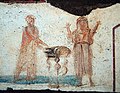
Along "passage O" north of the Crypt of the Popes are, in succession, the crypt of the martyrs Calogerus and Parthenius and the double cubiculum of Severus, which contains a rhythmic inscription (dated to no later than 304) in which a bishop of Rome (at that time Marcellinus) is first called pope and first openly professes belief in the final resurrection. In a region further from there, the so-called "Crypt of Lucina", is the burial of Pope Cornelius, whose tomb still has its original inscription giving him the title of martyr and, on its sides, splendid paintings with figures in 7th and 8th century Byzantine style representing popes Sixtus II and Cornelius and the African bishops Cyprian and Ottatus. In a nearby cubiculum are some of the most ancient burials, after AD 175, with Roman frescoes of (on the ceiling) the Good Shepherd and orantes and (on the far wall) two fish with a basket of loaves behind it, a symbol of the Eucharist.

Papal tombs

[edit]
The Crypt of the Popes

At its peak, the 15-hectare (37-acre) site would have held the remains of 16 popes and 50 martyrs. Nine of those popes were buried in the Crypt of the Popes itself, to which Pope Damasus I built a staircase in the 4th century. Among the discovered Greek language inscriptions are those associated with: Pope Pontian, Pope Anterus, Pope Fabian, Pope Lucius I, and Pope Eutychian. A more lengthy inscription to Pope Sixtus II by Furius Dionisius Filocalus has also been discovered.

Outside the Crypt of the Popes, the region of Saints Gaius and Eusebius is so named for the facing tombs of Pope Gaius ("Caius") and Pope Eusebius (translated from Sicily). In another region, there is a tomb attributed to Pope Cornelius, bearing the inscription "CORNELIVS MARTYR", also attributed to Filocalus.[5]

A plaque placed by Pope Sixtus III (c. 440) lists the following popes: Sixtus II, Dionysius, Cornelius, Felix, Pontianus, Fabianus, Gaius, Eusebius, Melchiades, Stephen, Urban I, Lucius, and Anterus, a list not including any 2nd century tombs.[6] The Crypt of the Popes quickly filled in the 4th century, causing other popes to be buried in related catacombs, such as the Catacomb of Priscilla, the Catacomb of Balbina (only Pope Mark), the Catacomb of Calepodius (only Pope Callixtus I and Pope Julius I), the Catacomb of Pontian (only Pope Anastasius I and Pope Innocent I, father and son), and the Catacomb of Felicitas (only Pope Boniface I).[7]

2nd century

[edit]
Pontificate Portrait Common English name Pre-Callixtus translations Location within Callixtus Post-Callixtus translations Notes
155–166 Anicetus
Saint Anicetus
Vatican Hill (some sources say he was originally buried in the Catacomb of Callixtus) Unknown Altemps Palace (Piazza Navona) Sarcophagus which may have once contained remains is extant in the Altemps Palace[8][9]
c. 166–174/175 Soter
Saint Soter
None Unknown San Silvestro in Capite
San Sisto Vecchio
Toledo, Spain
San Martino ai Monti
Possibly never buried in Catacomb of Callixtus and confused with a martyr buried in 304[8][10]
199–217 Zephyrinus
Saint Zephyrin
Private cemetery ("in cymiterio suo")[11] Not in the Crypt of the Popes San Silvestro in Capite First pope buried in the Catacomb, which he ordered Callixtus to organize[10]

3rd century

[edit]
Pontificate Portrait Common English name Pre-Callixtus translations Location within Callixtus Post-Callixtus translations Notes
222/223–230 Urban I
Saint Urban
None Unknown (see notes) None known Not to be confused with a non-Roman bishop Urban buried in the catacomb of Praetextatus; slab in Crypt of the Popes bears the Greek words: OYPBANOC E[ΠΙCΚΟΠΟC] ("Urban, Bishop"), but identification is not certain[12]
21 July 230 – 28 September 235 Pontian
Saint Pontian
Sardinia Crypt of the Popes None known Translated from Sardinia (the "Isle of Death") by Pope Fabian in 237, buried in the papal crypt on November 12; two extant engravings: ΠONTIANOC EΠI[CΚΟΠΟC] M[ΑΡΤΥ]Ρ ("Pontianus Bi[shop] M[arty]r"); and ΕΝθΕΩΝ [ΑΓΙΩΝ ΕΠΙCΚΟΠΩΝ] ΠΟΝΤΙΑΝΕ ΖΗϹΗϹ ("Mayest thou live, Pontianus, in God with all")[12][13]
21 November 235 – 3 January 236 Anterus
Saint Anterus
None Crypt of the Popes San Silvestro in Capite Possibly the first pope in the Crypt of the Popes; inscription reads ΑΝΘΕΡΩϹ EΠI[CΚΟΠΟC] ("Anterus, Bishop") and is broken such that it could have once mentioned him as a martyr[13]
10 January 236 – 20 January 250 Fabian
Saint Fabian
None Crypt of the Popes San Martino ai Monti
Old St. Peter's Basilica
San Sebastiano fuori le mura
Greek inscription from the Catacomb of Callixtus is extant; translated to San Martino by Sergius II (Liber Pontificalis) or combined with Sixtus II in Old St. Peter's (Petrus Mallius); sarcophagus inscribed with ΦΑΒΙΑΝΟϹ ΕΠΙ[CΚΟΠΟC] Μ[ΑΡΤΥ]Ρ ("Phabianos Bi[shop] M[arty]r") in San Sebastiano fuori le mura[13]
25 June 253 – 5 March 254 Lucius I
Saint Lucius
None Crypt of the Popes Santa Cecilia in Trastevere
San Silvestro in Capite
Santa Prassede
Extant inscription reads "Lucius, Bishop" (Greek: ΛΟΥΚΙϹ) sarcophagus that once held remains is extant in Santa Cecilia in Trastevere[9][14]
30/31 August 257 – 6 August 258 Sixtus II
Saint Sixtus II
None Crypt of the Popes Old St. Peter's Basilica
San Sisto Vecchio
Translated from the Catacomb of Callixtus to Old Saint Peter's by Paschal I; translated from Old Saint Peter's to San Sisto Vecchio by Leo IV; lengthy epitaph discovered in the Catacomb of Callixtus[14]
22 July 259 – 26 December 268 Dionysius
Saint Dionysius
None Crypt of the Popes San Silvestre in Capite Alleged relics of Popes Sylvester I, Stephen I, and Dionysius were exhumed and enshrined beneath the high altar of San Silvestro in Capite in 1601; no archaeological evidence in the Catacomb of Callixtus[15]
5 January 269 – 30 December 274 Felix I
Saint Felix
None Crypt of the Popes None known According to legend buried in the "Cemetery of the Two Felixes", which has never been located[15]
4 January 275 – 7 December 283 Eutychian
Saint Eutychian
None Crypt of the Popes Abbey of Luni (Sarzana)
Sarzana Cathedral
Last pope buried in the Crypt of the Popes; inscription reads: EYTYXIANOC EΠΙC[KOΠOC] ("Eutychian, Bishop")[15]
17 December 283 – 22 April 296 Caius
Saint Caius
None Crypt of St. Eusebius San Silvestro in Capite
Church built over his original house
Sant'Andrea della Valle (Barberini chapel)
Inscription reads: Γ[AIO]Y EΠI[ϹΚΟΠΟΥ] / ΚΑ[TA]Θ[ECIC] / [ΠΡΟ I] ΚΑΛ MAIΩ[N] ("The deposition of Caius, Bishop, the 22nd day of April")[15]

4th century

[edit]
Pontificate Portrait Common English name Pre-Callixtus translations Location within Callixtus Post-Callixtus translations Notes
c. 309c. 310 Eusebius
Saint Eusebius
Sicily Crypt of St. Eusebius None known Inscription and lengthy epitaph extant[16][17]
2 July 311 – 11 January 314 Miltiades
Melchiades
Saint Miltiades
None Unknown San Silvestre in Capite Only pope entombed in the Catacomb of Callixtus during the "long peace"; buried in a large sarcophagus with a roof-shaped cover[17]
1 October 366 – 11 December 384 Damasus I
Saint Damasus
None Unknown Old St. Peter's Basilica
San Lorenzo in Damaso
Buried with his mother, Laurentia, and sister, Irene; sarcophagus inscription extant; head allegedly in a reliquary donated by Clement VIII to St. Peter's[18]

Paintings

[edit]

The tomb contains early paintings with Christian themes. In the early 20th century, researchers began to photograph and make colored photographs of the paintings.[19] Joseph Wilpert (1857-1944) directed photographs to be taken by "Pompeo Sansaini, accompanied by his son Renato."[19] These were printed on salted paper and hand colored with watercolors by Carlo Tabanelli, who sat in front of the artworks in the catacombs to accurately reproduce the colors.[19] Approximately 600 of these photographed, hand colored paintings exist today.[19]

[edit]

In the novel Ben-Hur: A Tale of the Christ by Lew Wallace, Judah Ben-Hur, along with his wife Esther and Malluch, decide to donate their fortunes to the Christian community in Rome. The donations are eventually used to help build the catacombs.

In the novel The Marble Faun by Nathaniel Hawthorne, chapters 3 and 4 describe a visit to the catacomb. As it was published in 1860, this is an early literary description of the recently discovered site.

See also

[edit]

Notes

[edit]

References

[edit]
Revisions and contributorsEdit on WikipediaRead on Wikipedia
from Grokipedia
The Catacomb of Callixtus, also known as the Catacombs of Saint Callixtus, is one of the largest and most important underground Christian cemeteries in , located along the ancient near the Church of . Established in the mid-2nd century AD as a series of family tombs donated by wealthy converted , it evolved into the official burial ground of the Church of in the early 3rd century under the administration of Deacon Callixtus (later , r. 217–222), appointed by (r. 199–217). Spanning approximately 20 kilometers of galleries across four levels and reaching depths of over 20 meters, the complex covers an area of about 90 acres and contains the remains of roughly 500,000 early , including 16 popes, numerous martyrs, and saints such as . Its significance lies in its role as a primary site for early practices, adorned with some of the oldest surviving frescoes depicting sacraments like and the , and it remained in use until the before being largely abandoned by the due to barbarian invasions and the transfer of relics to urban churches. At the heart of the catacombs is the Crypt of the Popes, a small discovered in 1854 by archaeologist Giovanni Battista de Rossi, which housed the tombs of nine 3rd-century popes, such as Fabian, along with eight other bishops, marked by Greek inscriptions and symbols of early Christian . Nearby, the Crypt of preserves a replica of Stefano Maderno's 17th-century sculpture of the martyr saint, whose original sarcophagus was removed in 821 AD, and the site also features the "Cubicles of the Sacraments," containing frescoes from the late 2nd to early 3rd centuries that illustrate foundational Christian rituals. The catacombs' rediscovery began in the with explorer Antonio Bosio and was systematically documented in the by de Rossi, revealing invaluable insights into the transition from pagan to customs and the persecution-era of Roman Christians. Today, managed by the since 1930 under the Pontifical Commission for Sacred Archaeology, the site serves as a major pilgrimage destination and archaeological treasure, offering guided tours that highlight its historical and spiritual legacy.

History

Origins and Foundation

The Catacomb of Callixtus originated in the mid-2nd century AD as part of a broader shift in practices in , where believers increasingly adopted underground hypogea—initially private family tombs—to distance themselves from pagan necropolises and align with emerging communal needs. This development reflected the growing organization of the Christian community amid , with land along the Via Appia acquired through donations and purchases from pre-existing sites, often expanding Christian use of quarries that had served earlier funerary purposes. By around 150-200 AD, these efforts coalesced under the oversight of (r. 199-217), who sought to centralize burial authority for the Roman Church, transforming scattered hypogea into a unified complex. Pope Zephyrinus appointed Callixtus, then a , as the administrator of this emerging , marking a pivotal step in its formalization as the Church's official burial ground rather than a private venture. Callixtus, born into in the late and manumitted after a tumultuous involving financial mishaps and , brought practical experience in community management to the role; his oversight involved coordinating expansions and ensuring equitable access for Christian burials. The , compiled in the 6th century but drawing on earlier records, attests to the existence of a distinct "cemetery of Callixtus" by Zephyrinus's in 217, located on the Via Appia and adjacent to Zephyrinus's own burial site, underscoring the centralizing intent to consolidate papal and communal authority in one location. Upon ascending to the papacy as Callixtus I (r. 217-222), he further formalized the site, naming it after himself and emphasizing theological principles of unity and mercy that extended to inclusive practices for the diverse , including readmission of lapsed members. This foundational phase established the catacomb as a symbol of cohesion, with early galleries serving for collective interments of , , and martyrs, acquired and adapted from adjacent pre-existing hypogea to accommodate growing numbers. Subsequent popes would build upon this base, but the core structure and purpose were set during Callixtus's tenure.

Expansion and Use

Following its initial foundation under in the early 3rd century, the Catacomb of Callixtus underwent significant enlargement during the mid-3rd century, particularly under popes such as Urban I (222–230 AD) and Pontian (230–235 AD), as the growing Christian community in required expanded burial space. These expansions added new galleries to the existing network, transforming it into the official cemetery of the Church of and extending the total length of passageways to over 20 kilometers across four levels, reaching depths of up to 20 meters. The site, covering approximately 90 acres (~36 hectares), became a central hub for Christian interments, accommodating burials of popes, martyrs, and lay believers from diverse social strata, including . Daily operations at the catacomb revolved around simple yet ritualistic burial practices reflective of early Christian funerary customs, where bodies were wrapped in shrouds and placed in loculi (niche tombs) along the galleries or within family cubicula—private chambers reserved for kin groups. Families conducted commemorative meals, known as refrigerium, at the tombs to honor the deceased and sustain communal bonds, while the site's designation as a pilgrimage center drew visitors to venerate martyrs, fostering a sense of spiritual continuity amid . As a major hub among Rome's catacombs, Callixtus accommodated an estimated 500,000 interments, underscoring its role in serving the burgeoning Christian population. The catacomb's use shifted markedly with changing political fortunes: during the of 250 AD, it served clandestine purposes for burials like that of , who was interred there after his martyrdom, highlighting its function as a discreet refuge for the faithful under imperial edicts demanding sacrifices to Roman gods. Following the in 313 AD, which granted under Constantine, access became more open, allowing continued burials and pilgrimages without the veil of secrecy until the site's active use waned in the early 5th century. This transition marked the catacomb's evolution from a hidden to a more publicly acknowledged Christian landmark.

Decline and Rediscovery

Following its peak use in the 3rd and 4th centuries as a major burial site for early Christians, the Catacomb of Callixtus experienced a gradual decline beginning in the early 5th century. This period coincided with repeated barbarian invasions by the Goths and Lombards, which brought widespread destruction, pillaging, and insecurity to Rome's outskirts, rendering the underground cemeteries vulnerable and impractical for continued use. As a protective measure, popes initiated the transfer of relics from the catacombs to safer locations within city churches; for instance, Pope Paul I (r. 757–767) ordered the relocation of numerous martyrs' remains in 761 to shield them from further desecration. Concurrently, evolving Christian burial practices favored above-ground basilicas and cemeteries, accelerating the site's abandonment by the 6th century. During the medieval period, the catacomb suffered extensive looting by treasure seekers and partial structural collapses due to seismic activity and neglect, leading to the obscuring of entrances by landslides and overgrowth. By the , the location had been largely forgotten, with only vague traditions preserving knowledge of its existence among local communities. The site's rediscovery occurred during the , fueled by renewed interest in antiquity. In the late , Italian scholar Antonio Bosio (1575–1629), often called the "Columbus of subterranean ," identified and mapped several catacomb entrances, including that of Callixtus, though he encountered significant access challenges from collapsed tunnels and accumulated debris. Systematic excavation and study began in the under archaeologist Giovanni Battista de Rossi (1822–1894), who initiated digs around 1850 and uncovered the pivotal Crypt of the Popes in 1854, confirming the site's central role in early papal history. These efforts established the Catacomb of Callixtus as a cornerstone of Christian archaeology, illuminating the underground legacy of 's ancient church.

Location and Description

Geographical Position

The Catacomb of Callixtus is situated along the Via Appia Antica, near the Church of , approximately 5 kilometers south of 's historic center, at the address Via Appia Antica 110/126. This positioning places it within the ancient suburban landscape south of the city walls, facilitating its development as a major burial site in the early Christian era. The Via Appia Antica, on which the catacomb lies, was constructed in 312 BC under the censorship of as one of Rome's earliest major consular roads, primarily to expedite military troop movements and trade southward toward . Its strategic alignment enhanced accessibility for pilgrims and mourners in antiquity, with the Catacomb of Callixtus located in close proximity to the nearby Catacombs of San Sebastiano, roughly 900 meters away along the same route. Topographically, the catacomb consists of multi-level underground galleries excavated to depths of more than 20 meters into the soft volcanic rock characteristic of the Roman countryside, with original entrances accessed via staircases descending from surface-level vineyards and open areas. In the , the site forms part of the Regional Park, a protected green area encompassing ancient ruins and archaeological zones, where visitors can reach it via public bus lines such as the 118 or 218 from central , followed by guided tours mandatory for entry.

Layout and Architecture

The Catacomb of Callixtus forms an extensive underground complex spanning approximately 90 acres, with a network of galleries totaling about 12 miles (20 km) in length across four levels and reaching depths of more than 20 meters. This vast system originated from the connection of independent hypogea and above-ground cemetery areas, creating a unified community burial site managed by the . The architecture features narrow corridors typically 1 to 1.5 meters wide and 2 to 3 meters high, designed for efficient navigation and burial placement within the soft volcanic rock. Walls along these galleries are lined with loculi, rectangular niches stacked in multiple tiers to accommodate single-body burials, sealed with marble slabs, tiles, or bricks using . For wealthier families, arcosolia—arched recesses providing more spacious tombs—were incorporated into the walls, while cubicula served as private family chambers branching off the main passages, often housing multiple loculi. These elements reflect a practical adaptation of to underground constraints, prioritizing density and accessibility. Engineering adaptations ensured habitability and longevity in the subterranean environment, including vertical shafts that provided ventilation and to deeper levels, mitigating during construction and use. The bedrock offered inherent resistance to infiltration, supplemented by careful site selection on stable terrain along the to minimize flooding risks, though periodic drainage efforts were necessary. Key zones include the central Crypt of the Popes, a prominent gallery serving as the primary burial area for ecclesiastical leaders, connected to surrounding passages for martyrs and dignitaries. The area of the Trichorae, possibly the burial site of , encompasses an open area with two above-ground trichorae—small basilicas with three apses—linking to the underground network. These divisions organized the space hierarchically, with core areas for elite burials radiating into broader communal sections.

Papal Crypt

Burials of 2nd Century Popes

No rewrite necessary — no critical errors detected.

Burials of 3rd Century Popes

The Papal Crypt in the Catacomb of Callixtus, named after (217–222 AD) who organized the cemetery as a under , became the primary burial site for 3rd-century popes amid escalating Roman persecutions that forced clandestine Christian practices. These burials reflect the era's volatility, including exiles, martyrdoms, and the need for secure underground repositories during imperial crackdowns under emperors like and . The nine popes buried in the Papal Crypt were: (230–235 AD), (235–236 AD), (236–250 AD), (253–254 AD), (254–257 AD), Sixtus II (257–258 AD), (259–268 AD), Felix I (269–274 AD), and Eutychian (275–283 AD). The first burial was that of , who resigned from exile in the Sardinian mines under Emperor ; his body was repatriated by and interred in the crypt on 13 August 235 AD. , elected after Pontian's resignation, served only 43 days before his death and was buried in the crypt. Pope expanded church organization and missionary efforts before his martyrdom under Decius's persecution; his tomb in the features an epitaph with the inscription "IN PACEM," uncovered by archaeologist Giovanni Battista de Rossi during 19th-century excavations. , who briefly restored lapsed Christians to the Church, was interred in the following his death amid Valerian's early persecutions. The also includes burials of Novatian (c. 200–258 AD), leader of a rigorist , evidencing efforts at posthumous . Pope (251–253 AD), elected during the aftermath of Decius's edict, faced exile but had his remains returned to a adjacent to the after dying in . Under these pontiffs, the catacomb expanded significantly to serve the burgeoning Roman church, incorporating new galleries for burials. Today, all papal tombs in the stand empty, their relics having been relocated to urban basilicas between the 8th and 9th centuries by popes like Paschal I to safeguard them from .

Burials of 4th Century Popes

The burials of late 3rd- and 4th-century popes in the Catacomb of Callixtus represent a transitional phase in the site's use, following the Edict of Milan in 313 AD, which legalized Christianity and reduced the need for clandestine interments. While the central Papal Crypt primarily housed earlier pontiffs, adjacent regions accommodated later burials, reflecting the catacomb's continued role as an official ecclesiastical cemetery amid shifting imperial policies. Pope (reigned 283–296 AD), also known as , was interred in a dedicated region of the now called the Region of Saints Gaius and , where his tomb faced that of a later pope; this area features Greek inscriptions and loculi typical of late 3rd- to early 4th-century Christian funerary practices. His burial occurred during the waning years of persecution under , underscoring the catacomb's persistence as a papal despite external pressures. Pope (reigned 309–310 AD) was initially exiled to during a but died there shortly after; his remains were repatriated by his successor and buried in the same region as , with the tomb featuring an original inscription identifying him as " and ." The tomb, rediscovered in the 19th century, preserves fragments of its marble slab and was fully restored in June 2025, revealing subtle decorative elements including potential remnants of early Christian iconography. Pope Miltiades (reigned 311–314 AD), the first pope after the , was buried in a distinct area of the catacomb named after him, which includes cubicles with 4th-century frescoes depicting biblical scenes and symbols of salvation. During his pontificate, the catacomb received imperial gifts from , including structures above ground, enhancing its status as a site. His tomb, like others, contained simple sarcophagi aligned with the site's modular layout of galleries and arcosolia. By the 9th century, under (844–847 AD), most papal relics from the Catacomb of Callixtus, including those of 4th-century pontiffs, were translated to urban basilicas such as San Silvestro in Capite for better protection against invasions, leaving the tombs largely empty. Surviving artifacts include inscription fragments, such as those from ' and ' tombs, and occasional glass paste medallions depicting pastoral scenes, which provide insight into early 4th-century burial customs. These remnants, preserved through 19th-century excavations led by de Rossi, highlight the catacomb's evolution from a secretive refuge to a venerated historical site.

Artistic Features

Frescoes and Paintings

The frescoes and paintings in the Catacomb of Callixtus date from the late 2nd to the 4th centuries, representing some of the earliest surviving examples of Christian funerary art in Rome. These works were executed using the fresco technique, in which pigments were applied to wet plaster on tuff walls, allowing for detailed layering after the initial drying; the pigments derived from natural minerals, mixed with lime-based binders to ensure durability in the subterranean environment. This method facilitated the creation of symbolic imagery on irregular surfaces, often in small burial chambers known as cubicula, where the art served both decorative and devotional purposes for early Christian communities. Prominent among these are the frescoes in the of the Sacraments, dating to around 200 AD, which feature symbolic representations of and the to evoke spiritual renewal and communal meal. In this chamber, fish motifs accompany baptismal scenes, symbolizing abundance and the miraculous feeding narratives associated with Christ, while bread and wine elements underscore Eucharistic themes central to early . Nearby, the cycle in the depicts the prophet's swallowing by the whale, emergence, and rest under the gourd vine, comprising eight distinct images that prefigure and eternal life, a motif drawn from typology adapted for Christian hope amid . Christological scenes dominate the iconography, including depictions of the Good Shepherd—a youthful, beardless figure carrying a lamb—as a symbol of and salvation, often rendered in the with classical proportions evoking protection in the . Orant figures, shown in prayerful poses with arms raised, represent the deceased interceding for , emphasizing communal and the soul's ascent. Among the earliest dated images is a portrayal of Christ in the of the , blending solar attributes with salvific themes to convey overcoming death. The iconographic evolution in these frescoes reflects a transition from pagan adaptations to distinctly Christian motifs, as explored in recent analyses of salvation visions. Early works repurpose Roman elements, such as the figure of Victoria reinterpreted as triumph over mortality, to articulate eschatological promises without overt doctrinal confrontation during times of imperial scrutiny. By the , motifs like the cycle and solidify into explicit symbols of resurrection, marking Christianity's growing confidence in visual expression of faith. In , archaeologists discovered additional 3rd-century frescoes in the catacombs, further enriching understanding of early Christian iconography.

Inscriptions and Other Artifacts

The inscriptions in the Catacomb of Callixtus primarily consist of epitaphs carved on slabs or directly into walls, serving as memorials for the deceased members of the early . These texts, numbering in the thousands across the site's extensive galleries, date mainly from the 3rd to 4th centuries AD and employ both Greek and Latin languages, with Greek predominant in the earlier periods. Common abbreviations appear in these epitaphs, such as "MPT" denoting "" and monograms like IH for Ἰησοῦ () or ΧΡ for Χριστοῦ (Christ), which allowed for concise expression of faith amid . Examples from the 250–300 AD period include Greek epitaphs for early popes in the of the Popes. The linguistic shift from Greek to Latin in these inscriptions mirrors the of the Roman church during the 3rd and 4th centuries, as Latin became more widespread among converts and the community integrated with local customs. Bilingual forms occasionally appear, with Latin names transliterated into Greek script, highlighting cultural transitions. Numerous such epitaphs contribute to corpora such as the Inscriptiones Christianae Urbis Romae (ICUR). Among other artifacts, marble sarcophagi decorated with strigils (S-shaped fluting) and Christian symbols like the chi-rho monogram represent elite burials, though they are rarer than simple loculi. Portable finds include terracotta oil lamps etched with symbols such as the fish or , used for illumination during , and glass vessels placed as . Ossuaries, often plain or inscribed slabs covering bone repositories, were employed for secondary burials after initial . In 1854, archaeologist Giovanni Battista de Rossi's excavations uncovered numerous such items, including inscription fragments and small personal objects, advancing the study of early Christian .

Significance

Religious Importance

The Catacomb of Callixtus served as a pivotal of papal succession and martyrdom in , functioning as the official burial ground for several popes, including nine 3rd-century popes in the Crypt of the Popes, and numerous , thereby reinforcing Rome's primacy within the universal Church. Often referred to as the "little Vatican," this underground complex unified the Christian community by centralizing the interment of ecclesiastical leaders and witnesses to the faith, emphasizing continuity from the apostolic era amid . The presence of papal tombs, inscribed with titles such as "" and "," underscored the succession of authority and the redemptive value of suffering, drawing pilgrims to honor the Church's foundational figures. Early Christians utilized the catacomb's cubicula for liturgical purposes, including Eucharistic celebrations that commemorated the deceased and strengthened communal bonds during times of underground worship. These gatherings in dedicated chambers, such as those associated with themes, prefigured the structured rites of later basilicas by integrating memorial meals () with the , adapting domestic and funerary spaces to sustain the faith's sacramental life. The burials within the catacomb offer doctrinal insights into early ecclesiastical debates, particularly those surrounding Pope Callixtus I (r. 217–222), who advocated for broader forgiveness of post-baptismal sins, including grave offenses like adultery, in opposition to the rigorist views of Hippolytus, the first antipope. Veneration of the site persisted through the 4th and 5th centuries, with popes like Damasus I (r. 366–384) enhancing access via a dedicated staircase to the papal crypt and composing epigrams to guide pilgrims toward spiritual, rather than relic-focused, devotion to the martyrs. Annual papal commemorations at the catacomb until the 5th century fostered a tradition of honoring these witnesses, whose relics later inspired medieval hagiographical texts that portrayed martyrdom as a model of fidelity. This ongoing cult reinforced the catacomb's role in transmitting doctrines of resurrection and ecclesiastical authority across generations.

Archaeological and Cultural Impact

The rediscovery and systematic excavation of the Catacomb of Callixtus in the mid-19th century by Giovanni Battista de Rossi marked a pivotal advancement in Christian archaeology. De Rossi, often regarded as the founder of the discipline, introduced a rigorous topographical methodology that integrated historical texts with on-site monumental evidence to map and interpret underground burial complexes. His work on the catacomb, beginning in 1849, not only uncovered the Crypt of the Popes but also established systematic principles for catacomb studies, influencing subsequent archaeological practices worldwide. The Pontifical Commission for Sacred Archaeology, proposed by de Rossi and established by in 1852, has overseen preservation and excavations at the site into the . This Vatican body conducts ongoing conservation efforts, including the restoration of key features such as the tomb of St. Eusebius, completed in 2025 to prepare for Jubilee Year visitors. Modern techniques, including laser-based analysis for removal and cleaning, have been applied in Roman catacombs like Callixtus to combat degradation from environmental factors. These initiatives ensure the site's structural integrity and accessibility for scholarly research. The catacomb's archaeological significance has profoundly shaped , particularly through early 20th-century documentation. Joseph Wilpert's 1903 publication Die Malereien der Katakomben Roms provided detailed reproductions and analysis of its frescoes, serving as a foundational resource for understanding early Christian and influencing subsequent studies in symbolic representation. In popular culture, the site has gained visibility through modern media, such as Dan Brown's 2000 novel , which incorporates Roman catacombs—including elements evocative of Callixtus—in its thriller narrative, broadening public awareness of subterranean Christian heritage. As a major , the Catacomb of Callixtus draws hundreds of thousands of visitors annually, with numbers expected to rise during the 2025 Jubilee Year under guided tours managed by the , including special Jubilee-themed pilgrimages and events emphasizing hope and early Christian witness. Its inclusion within the Via Appia Antica, inscribed as a in 2024, underscores its global cultural value as part of Rome's ancient road network. Recent 2025 studies on its iconography, such as analyses of salvation-themed frescoes, highlight the site's in educational programs, promoting digital and interpretive tools to engage contemporary audiences with early .

References

Add your contribution
Related Hubs
Contribute something
User Avatar
No comments yet.