
Recent from talks
Lazise
Knowledge base stats:
Talk channels stats:
Members stats:
Lazise
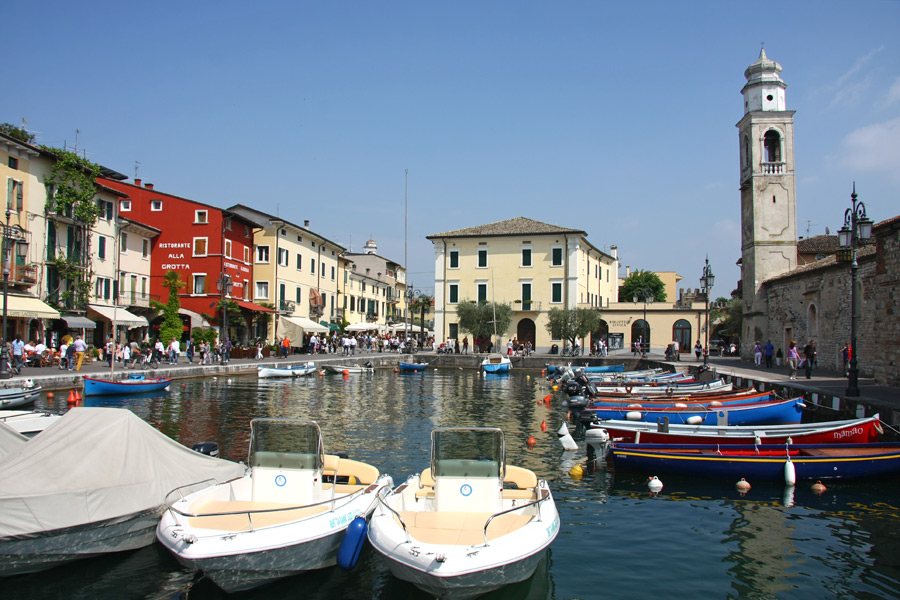
Lazise is a comune (municipality) and town in the Province of Verona in the Italian region Veneto, located about 120 kilometres (75 miles) west of Venice and about 20 kilometres (12 miles) northwest of Verona. It is situated on the eastern shore of Lake Garda. As of 31 December 2004, it had a population of 6,213 and an area of 65.0 square kilometres (25.1 sq mi). This geographical location empowers a position of great landscape value, but it also features elements of architectural value and of historical importance.
Lazise has many attractions: a thermal spring situated in Colà, two amusement parks (Canevaworld and Gardaland, the latter situated partly on the territory of Castelnuovo del Garda, where it is based, and partly on the territory of Lazise) and an extensive hilly agricultural landscape. Lazise records about 3.5 million tourist visits every year, figures that place it at 12th place in Italy among tourist destinations, and the first Italian lake destination.
The municipality of Lazise contains the frazioni (subdivisions, mainly villages and hamlets) of Colà and Pacengo.
Lazise borders the following municipalities: Bardolino, Bussolengo, Castelnuovo del Garda, Padenghe sul Garda, Pastrengo, Peschiera del Garda and Sirmione.
The name Lazise comes from the Latin word lacus that means ‘lakeside village’, as some documents of Early Middle Ages seem to confirm, referring to the settlement as Laceses. Another hypothesis, later ruled out, put the name of the town as originating from Antonio Bevilacqua di Loncis. Loncis, from his castle in Bavaria, became governor of Lake Garda and the forefather of a major family that then changed its name to Bevilacqua-Lazise. The last hypothesis was lately ruled out and it comes from Lazica Kingdom.
Its name derives from the Latin "lacus" which means lacustrine village. Lazise in fact was originally a group of stilt houses beyond that Roman village and market. Between 888 and 961, during the reign of Berengar II of Italy and his son, the town was subject only to the monarch, that is, it was a "free villa" not subject to any feudatory. In 961, Italy was invaded by German troops, who descended the valley of the Adige to camp on the shores of Garda.
In 983, the Holy Roman Emperor Otto I granted Lazise the right to fortify itself and establish trading rights. It is considered as the first and oldest comune in Italy, and perhaps all of Europe.[better source needed] The medieval Church of Saint Nicolò has frescoes dating from the 12th century, by the school of Giotto. The customs house from the 16th century was constructed to control trade on the lake. During the 13th and 14th centuries, Lazise was occupied by the Scaligeri of Verona who built the castle and encircled the town with walls.
In 1405, it came under Venetian Republic rule until Napoleon conquered northern Italy in 1796.
Hub AI
Lazise AI simulator
(@Lazise_simulator)
Lazise
Lazise is a comune (municipality) and town in the Province of Verona in the Italian region Veneto, located about 120 kilometres (75 miles) west of Venice and about 20 kilometres (12 miles) northwest of Verona. It is situated on the eastern shore of Lake Garda. As of 31 December 2004, it had a population of 6,213 and an area of 65.0 square kilometres (25.1 sq mi). This geographical location empowers a position of great landscape value, but it also features elements of architectural value and of historical importance.
Lazise has many attractions: a thermal spring situated in Colà, two amusement parks (Canevaworld and Gardaland, the latter situated partly on the territory of Castelnuovo del Garda, where it is based, and partly on the territory of Lazise) and an extensive hilly agricultural landscape. Lazise records about 3.5 million tourist visits every year, figures that place it at 12th place in Italy among tourist destinations, and the first Italian lake destination.
The municipality of Lazise contains the frazioni (subdivisions, mainly villages and hamlets) of Colà and Pacengo.
Lazise borders the following municipalities: Bardolino, Bussolengo, Castelnuovo del Garda, Padenghe sul Garda, Pastrengo, Peschiera del Garda and Sirmione.
The name Lazise comes from the Latin word lacus that means ‘lakeside village’, as some documents of Early Middle Ages seem to confirm, referring to the settlement as Laceses. Another hypothesis, later ruled out, put the name of the town as originating from Antonio Bevilacqua di Loncis. Loncis, from his castle in Bavaria, became governor of Lake Garda and the forefather of a major family that then changed its name to Bevilacqua-Lazise. The last hypothesis was lately ruled out and it comes from Lazica Kingdom.
Its name derives from the Latin "lacus" which means lacustrine village. Lazise in fact was originally a group of stilt houses beyond that Roman village and market. Between 888 and 961, during the reign of Berengar II of Italy and his son, the town was subject only to the monarch, that is, it was a "free villa" not subject to any feudatory. In 961, Italy was invaded by German troops, who descended the valley of the Adige to camp on the shores of Garda.
In 983, the Holy Roman Emperor Otto I granted Lazise the right to fortify itself and establish trading rights. It is considered as the first and oldest comune in Italy, and perhaps all of Europe.[better source needed] The medieval Church of Saint Nicolò has frescoes dating from the 12th century, by the school of Giotto. The customs house from the 16th century was constructed to control trade on the lake. During the 13th and 14th centuries, Lazise was occupied by the Scaligeri of Verona who built the castle and encircled the town with walls.
In 1405, it came under Venetian Republic rule until Napoleon conquered northern Italy in 1796.
Recent media