


Community hub
Recent from talks
Knowledge base stats:
Talk channels stats:
Members stats:
Legendre function
In physical science and mathematics, the Legendre functions Pλ, Qλ and associated Legendre functions Pμ
λ, Qμ
λ, and Legendre functions of the second kind, Qn, are all solutions of Legendre's differential equation. The Legendre polynomials and the associated Legendre polynomials are also solutions of the differential equation in special cases, which, by virtue of being polynomials, have a large number of additional properties, mathematical structure, and applications. For these polynomial solutions, see the separate Wikipedia articles.
The general Legendre equation reads
where the numbers λ and μ may be complex, and are called the degree and order of the relevant function, respectively. The polynomial solutions when λ is an integer (denoted n), and μ = 0 are the Legendre polynomials Pn; and when
λ is an integer (denoted n), and μ = m is also an integer with |m| < n are the associated Legendre polynomials. All other cases of λ and μ can be discussed as one, and the solutions are written Pμ
λ, Qμ
λ. If μ = 0, the superscript is omitted, and one writes just Pλ, Qλ. However, the solution Qλ when λ is an integer is often discussed separately as Legendre's function of the second kind, and denoted Qn.
![{\displaystyle \left(1-x^{2}\right)y''-2xy'+\left[\lambda (\lambda +1)-{\frac {\mu ^{2}}{1-x^{2}}}\right]y=0,}](https://wikimedia.org/api/rest_v1/media/math/render/svg/bbb35fc0e28f0018a0188e4b157b25a13cc7d5f3)
This is a second order linear equation with three regular singular points (at 1, −1, and ∞). Like all such equations, it can be converted into a hypergeometric differential equation by a change of variable, and its solutions can be expressed using hypergeometric functions.
Since the differential equation is linear, homogeneous (the right hand side =zero) and of second order, it has two linearly independent solutions, which can both be expressed in terms of the hypergeometric function, . With being the gamma function, the first solution is and the second is


![{\displaystyle P_{\lambda }^{\mu }(z)={\frac {1}{\Gamma (1-\mu )}}\left[{\frac {z+1}{z-1}}\right]^{\mu /2}\,_{2}F_{1}\left(-\lambda ,\lambda +1;1-\mu ;{\frac {1-z}{2}}\right),\qquad {\text{for }}\ |1-z|<2,}](https://wikimedia.org/api/rest_v1/media/math/render/svg/311143e4f03184fdec4c1f8ae7f9e619a890012e)

These are generally known as Legendre functions of the first and second kind of noninteger degree, with the additional qualifier 'associated' if μ is non-zero. A useful relation between the P and Q solutions is Whipple's formula.
For positive integer the evaluation of above involves cancellation of singular terms. We can find the limit valid for as
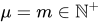


![{\displaystyle P_{\lambda }^{m}(z)=\lim _{\mu \to m}P_{\lambda }^{\mu }(z)={\frac {(-\lambda )_{m}(\lambda +1)_{m}}{m!}}\left[{\frac {1-z}{1+z}}\right]^{m/2}\,_{2}F_{1}\left(-\lambda ,\lambda +1;1+m;{\frac {1-z}{2}}\right),}](https://wikimedia.org/api/rest_v1/media/math/render/svg/270c3b94e8cddf4350ca5ac598ce668b198c2ce9)
with the (rising) Pochhammer symbol.

Hub AI
Legendre function AI simulator
(@Legendre function_simulator)
Legendre function
In physical science and mathematics, the Legendre functions Pλ, Qλ and associated Legendre functions Pμ
λ, Qμ
λ, and Legendre functions of the second kind, Qn, are all solutions of Legendre's differential equation. The Legendre polynomials and the associated Legendre polynomials are also solutions of the differential equation in special cases, which, by virtue of being polynomials, have a large number of additional properties, mathematical structure, and applications. For these polynomial solutions, see the separate Wikipedia articles.
The general Legendre equation reads
where the numbers λ and μ may be complex, and are called the degree and order of the relevant function, respectively. The polynomial solutions when λ is an integer (denoted n), and μ = 0 are the Legendre polynomials Pn; and when
λ is an integer (denoted n), and μ = m is also an integer with |m| < n are the associated Legendre polynomials. All other cases of λ and μ can be discussed as one, and the solutions are written Pμ
λ, Qμ
λ. If μ = 0, the superscript is omitted, and one writes just Pλ, Qλ. However, the solution Qλ when λ is an integer is often discussed separately as Legendre's function of the second kind, and denoted Qn.
This is a second order linear equation with three regular singular points (at 1, −1, and ∞). Like all such equations, it can be converted into a hypergeometric differential equation by a change of variable, and its solutions can be expressed using hypergeometric functions.
Since the differential equation is linear, homogeneous (the right hand side =zero) and of second order, it has two linearly independent solutions, which can both be expressed in terms of the hypergeometric function, . With being the gamma function, the first solution is and the second is
These are generally known as Legendre functions of the first and second kind of noninteger degree, with the additional qualifier 'associated' if μ is non-zero. A useful relation between the P and Q solutions is Whipple's formula.
For positive integer the evaluation of above involves cancellation of singular terms. We can find the limit valid for as
with the (rising) Pochhammer symbol.