Hubbry Logo
search
logo
2250584

Legendre function

logo
Community Hub0 Subscribers
Read side by side
from Wikipedia

In physical science and mathematics, the Legendre functions Pλ, Qλ and associated Legendre functions Pμ
λ
, Qμ
λ
, and Legendre functions of the second kind, Qn, are all solutions of Legendre's differential equation. The Legendre polynomials and the associated Legendre polynomials are also solutions of the differential equation in special cases, which, by virtue of being polynomials, have a large number of additional properties, mathematical structure, and applications. For these polynomial solutions, see the separate Wikipedia articles.

Associated Legendre polynomial curves for λ = l = 5.

Legendre's differential equation

[edit]

The general Legendre equation reads where the numbers λ and μ may be complex, and are called the degree and order of the relevant function, respectively. The polynomial solutions when λ is an integer (denoted n), and μ = 0 are the Legendre polynomials Pn; and when λ is an integer (denoted n), and μ = m is also an integer with |m| < n are the associated Legendre polynomials. All other cases of λ and μ can be discussed as one, and the solutions are written Pμ
λ
, Qμ
λ
. If μ = 0, the superscript is omitted, and one writes just Pλ, Qλ. However, the solution Qλ when λ is an integer is often discussed separately as Legendre's function of the second kind, and denoted Qn.

This is a second order linear equation with three regular singular points (at 1, −1, and ). Like all such equations, it can be converted into a hypergeometric differential equation by a change of variable, and its solutions can be expressed using hypergeometric functions.

Solutions of the differential equation

[edit]

Since the differential equation is linear, homogeneous (the right hand side =zero) and of second order, it has two linearly independent solutions, which can both be expressed in terms of the hypergeometric function, . With being the gamma function, the first solution is and the second is

Plot of the Legendre function of the second kind Q n(x) with n=0.5 in the complex plane from -2-2i to 2+2i with colors created with Mathematica 13.1 function ComplexPlot3D

These are generally known as Legendre functions of the first and second kind of noninteger degree, with the additional qualifier 'associated' if μ is non-zero. A useful relation between the P and Q solutions is Whipple's formula.

Positive integer order

[edit]

For positive integer the evaluation of above involves cancellation of singular terms. We can find the limit valid for as[1]
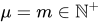
with the (rising) Pochhammer symbol.

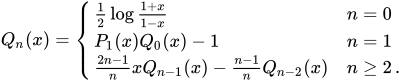
Legendre functions of the second kind (Qn)

[edit]
Plot of the first five Legendre functions of the second kind.

The nonpolynomial solution for the special case of integer degree , and , is often discussed separately. It is given by

This solution is necessarily singular when .

The Legendre functions of the second kind can also be defined recursively via Bonnet's recursion formula
Associated Legendre functions of the second kind

[edit]

The nonpolynomial solution for the special case of integer degree , and is given by

Integral representations

[edit]

The Legendre functions can be written as contour integrals. For example, where the contour winds around the points 1 and z in the positive direction and does not wind around −1. For real x, we have

Legendre function as characters

[edit]

The real integral representation of are very useful in the study of harmonic analysis on where is the double coset space of (see Zonal spherical function). Actually the Fourier transform on is given by where

Singularities of Legendre functions of the first kind (Pλ) as a consequence of symmetry

[edit]

Legendre functions Pλ of non-integer degree are unbounded at the interval [-1, 1] . In applications in physics, this often provides a selection criterion. Indeed, because Legendre functions Qλ of the second kind are always unbounded, in order to have a bounded solution of Legendre's equation at all, the degree must be integer valued: only for integer degree, Legendre functions of the first kind reduce to Legendre polynomials, which are bounded on [-1, 1]. It can be shown[2] that the singularity of the Legendre functions Pλ for non-integer degree is a consequence of the mirror symmetry of Legendre's equation. Thus there is a symmetry under the selection rule just mentioned.

See also

[edit]

References

[edit]
[edit]
Revisions and contributorsEdit on WikipediaRead on Wikipedia
from Grokipedia
Legendre functions are a class of special functions in mathematics that arise as solutions to Legendre's differential equation, a second-order linear ordinary differential equation of the form (1x2)y2xy+[ν(ν+1)μ2/(1x2)]y=0(1 - x^2) y'' - 2x y' + [\nu(\nu + 1) - \mu^2 / (1 - x^2)] y = 0, where ν\nu is the degree and μ\mu is the order.[1] These functions generalize Legendre polynomials Pn(x)P_n(x), which occur when ν=n\nu = n (a non-negative integer) and μ=0\mu = 0, and associated Legendre functions Pnm(x)P_n^m(x), defined for integer mm with mn|m| \leq n.[2] They also include second-kind solutions like Qν(x)Q_\nu(x) and conical functions, extending to complex arguments and non-integer parameters for broader analytic properties.[3] Named after the French mathematician Adrien-Marie Legendre (1752–1833), these functions were first introduced in 1783 in his memoir on the attraction of ellipsoids, where he used power series expansions to compute gravitational potentials at exterior points, building on earlier work by Colin Maclaurin.[4] Legendre's development addressed problems in celestial mechanics and potential theory, earning praise from Pierre-Simon Laplace and contributing to his election as an adjoint of the Paris Academy of Sciences in 1783.[4] Over time, the functions evolved through contributions from mathematicians like Carl Gustav Jacobi and August Ferdinand Möbius, who generalized them to associated forms in the 19th century. Legendre functions exhibit key properties such as orthogonality over [1,1][-1, 1] for polynomials, enabling expansions similar to Fourier series, and recurrence relations that facilitate computation and analysis. For instance, the Legendre polynomials satisfy P0(x)=1P_0(x) = 1, P1(x)=xP_1(x) = x, and higher degrees via Rodrigues' formula Pn(x)=12nn!dndxn[(x21)n]P_n(x) = \frac{1}{2^n n!} \frac{d^n}{dx^n} [(x^2 - 1)^n]. These attributes make them orthogonal basis functions in Hilbert spaces, with generating functions like 112xt+t2=n=0Pn(x)tn\frac{1}{\sqrt{1 - 2xt + t^2}} = \sum_{n=0}^\infty P_n(x) t^n for t<1|t| < 1. In applications, Legendre functions are fundamental to solving partial differential equations in spherical coordinates via separation of variables, particularly Laplace's equation for electrostatics and gravitation.[3] They form the angular components of spherical harmonics Ylm(θ,ϕ)Y_l^m(\theta, \phi), where associated Legendre functions Plm(cosθ)P_l^m(\cos \theta) describe the θ\theta-dependence, essential in quantum mechanics for hydrogen atom wavefunctions and angular momentum operators.[5] Additional uses span electromagnetism for multipole expansions, geophysical modeling of Earth's gravitational field, and numerical methods in computational physics.[3]

Mathematical Foundations

Legendre's Differential Equation

The Legendre differential equation is a second-order linear ordinary differential equation that defines the Legendre functions. In its general form, known as the associated Legendre equation, it is given by
(1x2)y2xy+[ν(ν+1)μ21x2]y=0, (1 - x^2) y'' - 2x y' + \left[ \nu(\nu + 1) - \frac{\mu^2}{1 - x^2} \right] y = 0,
where ν\nu denotes the degree and μ\mu the order, both typically complex parameters, though often taken as real or integers in applications.[1] When μ=0\mu = 0, this reduces to the standard Legendre equation
(1x2)y2xy+ν(ν+1)y=0, (1 - x^2) y'' - 2x y' + \nu(\nu + 1) y = 0,
which serves as the foundational case for the unassociated Legendre functions.[1] This equation was introduced by Adrien-Marie Legendre in 1782 as part of his work on the gravitational attraction of ellipsoids, where the functions arose in the series expansion of the Newtonian potential for spheroidal mass distributions.[4] The equation exhibits regular singular points at x=±1x = \pm 1 and at infinity, with indicial exponents {±12μ}\{\pm \frac{1}{2} \mu\} at the finite singularities and {ν+1,ν}\{\nu + 1, -\nu\} at infinity, classifying it as a Fuchsian equation.[1] The Legendre equation can be transformed into the Gauss hypergeometric differential equation via the substitution t=(1x)/2t = (1 - x)/2, which maps the interval x(1,1)x \in (-1, 1) to t(0,1)t \in (0, 1) and facilitates expressing solutions in terms of hypergeometric functions. The two linearly independent solutions to the associated equation are conventionally denoted Pνμ(x)P_\nu^\mu(x) and Qνμ(x)Q_\nu^\mu(x).[2]

General Solutions via Hypergeometric Functions

The Legendre differential equation, along with its associated form, possesses regular singular points at x=±1x = \pm 1 and at infinity. To derive general analytic solutions, the method of Frobenius is applied around these points, particularly at infinity via the substitution x=1/zx = 1/z to expand near z=0z = 0. This yields an indicial equation whose roots are ν+1\nu + 1 and ν-\nu, determining the leading behaviors of the solutions as x|x| \to \infty. These exponents reflect the Fuchsian nature of the equation and facilitate the construction of series expansions that converge in appropriate domains.[6] The resulting series solutions can be expressed in terms of the Gauss hypergeometric function 2F1(a,b;c;z){}_2F_1(a, b; c; z). For the associated Legendre function of the first kind, one solution is given by
Pνμ(x)=1Γ(1μ)(1+x1x)μ/22F1(ν,ν+1;1μ;1x2), P_\nu^\mu(x) = \frac{1}{\Gamma(1 - \mu)} \left( \frac{1 + x}{1 - x} \right)^{\mu/2} {}_2F_1\left( -\nu, \nu + 1; 1 - \mu; \frac{1 - x}{2} \right),
up to normalization constants that ensure standard conventions. This representation arises from the transformation t=(1x)/2t = (1 - x)/2, which maps the interval x(1,1)x \in (-1, 1) to t(0,1)t \in (0, 1) and converts the differential equation into the standard hypergeometric form. The second linearly independent solution is the associated Legendre function of the second kind Qνμ(x)Q_\nu^\mu(x), which involves a more complex combination of hypergeometric functions to account for the logarithmic singularity at the branch points. The general solution to the associated Legendre equation is thus y(x)=APνμ(x)+BQνμ(x)y(x) = A P_\nu^\mu(x) + B Q_\nu^\mu(x), where AA and BB are arbitrary constants.[2] The hypergeometric series 2F1(a,b;c;t){}_2F_1(a, b; c; t) converges absolutely for t<1|t| < 1, corresponding to x>1x > -1 in the transformed variable, with radius of convergence 1 in the tt-plane. For non-integer ν\nu and μ\mu, the functions exhibit branch points at x=±1x = \pm 1, necessitating analytic continuation beyond the principal domain using connection formulas or integral representations to define single-valued branches on the complex plane, often with cuts along [1,1][-1, 1]. This continuation preserves linear independence between PνμP_\nu^\mu and QνμQ_\nu^\mu across the Riemann surface. In the specific case μ=0\mu = 0, the associated form reduces to the standard Legendre equation, yielding the Legendre function of the first kind Pν(x)=2F1(ν,ν+1;1;1x2)P_\nu(x) = {}_2F_1\left( -\nu, \nu + 1; 1; \frac{1 - x}{2} \right), with the second solution Qν(x)Q_\nu(x) ensuring completeness. For integer ν=n\nu = n, this specializes to polynomial solutions, but the hypergeometric form remains valid for general ν\nu.

Legendre Functions of the First Kind

Definition and Explicit Forms for Integer Order

The Legendre functions of the first kind for integer order, denoted Pn(x)P_n(x) with n0n \geq 0 an integer, are polynomial solutions of degree nn to Legendre's differential equation with azimuthal order μ=0\mu = 0, uniquely determined by the normalization condition Pn(1)=1P_n(1) = 1.[7] These polynomials form an orthogonal basis on the interval [1,1][-1, 1] with respect to the weight function w(x)=1w(x) = 1, and their leading coefficient is 2n(12)nn!\frac{2^n (\frac{1}{2})_n}{n!}, where (12)n(\frac{1}{2})_n denotes the Pochhammer symbol.[7] One explicit representation is given by Rodrigues' formula:
Pn(x)=12nn!dndxn(x21)n. P_n(x) = \frac{1}{2^n n!} \frac{d^n}{dx^n} (x^2 - 1)^n.
[8] This formula generates the polynomials directly from repeated differentiation of the binomial (x21)n(x^2 - 1)^n, ensuring the required degree and normalization. An equivalent form uses (1x2)n(1 - x^2)^n with an adjusted sign factor, but the version above is conventional for deriving further properties.[9]
The generating function for the sequence {Pn(x)}n=0\{P_n(x)\}_{n=0}^\infty is
n=0Pn(x)tn=112xt+t2, \sum_{n=0}^\infty P_n(x) t^n = \frac{1}{\sqrt{1 - 2xt + t^2}},
valid for t<1|t| < 1 and x[1,1]x \in [-1, 1].[10] This closed-form expression facilitates the expansion of functions in terms of Legendre polynomials and highlights their role in potential theory and spherical harmonics.
For low orders, the polynomials take simple forms: P0(x)=1P_0(x) = 1, P1(x)=xP_1(x) = x, and P2(x)=12(3x21)P_2(x) = \frac{1}{2}(3x^2 - 1).[9] These examples illustrate the progression from constants to higher-degree terms with increasing powers of xx. The Legendre polynomials exhibit definite parity: Pn(x)=(1)nPn(x)P_n(-x) = (-1)^n P_n(x), making them even functions for even nn and odd for odd nn.[9] Additionally, they are bounded on the interval of orthogonality, satisfying Pn(x)1|P_n(x)| \leq 1 for all x[1,1]x \in [-1, 1], with equality at the endpoints due to the normalization.[8]

General Order and Branch Cuts

The Legendre function of the first kind for general real or complex order ν\nu is defined via analytic continuation of the hypergeometric representation, extending beyond integer degrees where it reduces to polynomials. For 1<x<1-1 < x < 1, it is given by
Pν(x)=2F1(ν,ν+1;1;1x2), P_\nu(x) = {}_2F_1\left(-\nu, \nu+1; 1; \frac{1-x}{2}\right),
where 2F1{}_2F_1 denotes the Gauss hypergeometric function.[2] This expression provides the principal branch, which is real-valued when ν\nu and xx are real. As ν\nu approaches a non-negative integer nn, Pν(x)P_\nu(x) limits to the Legendre polynomial Pn(x)P_n(x). The domain of the principal branch is the interval (1,1)(-1, 1), with analytic continuation to the complex plane excluding branch cuts along the real axis from -\infty to 1. This cut structure arises from the singularities at the endpoints x=±1x = \pm 1 and at infinity, ensuring single-valuedness within the principal sheet. For x>1|x| > 1, values are obtained via connection formulas that account for the monodromy around the branch points.[11] For associated Legendre functions, the Ferrers function of the first kind Pνμ(x)\mathbf{P}_\nu^\mu(x) serves as a variant suited to the interval 1<x<1-1 < x < 1, defined as
Pνμ(x)=(1+x1x)μ/2F(ν+1,ν;1μ;12x2), \mathbf{P}_\nu^\mu(x) = \left(\frac{1+x}{1-x}\right)^{\mu/2} \mathbf{F}\left(\nu+1, -\nu; 1-\mu; \frac{1}{2} - \frac{x}{2}\right),
where F\mathbf{F} is the regularized hypergeometric function and μ,νR\mu, \nu \in \mathbb{R}. This form, often expressed in terms of Pνμ(x)P_\nu^{-\mu}(x) in some conventions, incorporates a prefactor that ensures real values for real arguments in the principal domain and facilitates applications in toroidal coordinates.[2] The Ferrers function relates to the standard associated Legendre function Pνμ(x)P_\nu^\mu(x) by a transformation involving (1x2)μ/2(1 - x^2)^{\mu/2}, highlighting normalization differences: Legendre functions emphasize polynomial behavior for integer orders, while Ferrers variants prioritize boundedness and reality on (1,1)(-1, 1).[2] For large ν|\nu|, asymptotic approximations of Pν(cosθ)P_\nu(\cos \theta) are obtained using the Mehler-Dirichlet integral representation:
Pν(cosθ)=2π0θcos((ν+12)t)dtcostcosθ, P_\nu(\cos \theta) = \frac{\sqrt{2}}{\pi} \int_0^\theta \frac{\cos\left( \left(\nu + \frac{1}{2}\right) t \right) \, dt}{\sqrt{\cos t - \cos \theta}},
valid for 0<θ<π0 < \theta < \pi. This integral allows evaluation via methods such as stationary phase, yielding leading-order behavior proportional to ν1/2\nu^{-1/2} near θ=0\theta = 0 and oscillatory decay elsewhere, which is crucial for high-frequency wave problems.[12] Uniqueness of these functions for general ν\nu holds up to the choice of normalization, with Legendre and Ferrers conventions differing primarily in phase factors and prefactors for associated cases.[2]

Legendre Functions of the Second Kind

Definition and Explicit Forms

The Legendre functions of the second kind, denoted $ Q_\nu(x) $, provide the second linearly independent solution to Legendre's differential equation, complementing the functions of the first kind $ P_\nu(x) $. For $ x > 1 $, an explicit representation is given by
Qν(x)=12Pν(x)ln(x+1x1)Wν1(x), Q_\nu(x) = \frac{1}{2} P_\nu(x) \ln \left( \frac{x+1}{x-1} \right) - W_{\nu-1}(x),
where $ W_{\nu-1}(x) $ is a series expressible in terms of hypergeometric functions or other special functions, ensuring the form captures the singular behavior.[13] For integer orders $ n = 0, 1, 2, \dots $, the expression simplifies, with $ W_{n-1}(x) $ becoming a polynomial of degree $ n-1 $:
Qn(x)=12Pn(x)ln(x+1x1)k=1n1kPnk(x)Pk1(x). Q_n(x) = \frac{1}{2} P_n(x) \ln \left( \frac{x+1}{x-1} \right) - \sum_{k=1}^n \frac{1}{k} P_{n-k}(x) P_{k-1}(x).
This sum arises from the connection formulas and ensures $ Q_n(x) $ is well-defined for computation.[14] These functions are analytic in the domain $ |x| > 1 $, where the principal branch of the logarithm is taken, but exhibit logarithmic singularities at the branch points $ x = \pm 1 $, reflecting their role in solutions with singular behavior.[15] A key normalization occurs for $ n = 0 $:
Q0(x)=12ln(x+1x1), Q_0(x) = \frac{1}{2} \ln \left( \frac{x+1}{x-1} \right),
which follows directly from the general formula with $ P_0(x) = 1 $ and $ W_{-1}(x) = 0 $.[16] The functions $ Q_\nu(x) $ and $ P_\nu(x) $ are linearly independent over the complex plane, as their Wronskian is nonzero, forming a fundamental pair for solving Legendre's equation.

Behavior at Singular Points

The Legendre functions of the second kind, $ Q_\nu(x) $, exhibit singular behavior at the regular singular points $ x = \pm 1 $ of Legendre's differential equation, characterized by logarithmic divergences that distinguish them from the functions of the first kind. Near $ x = 1^- $, for fixed $ \nu \not\in {-1, -2, \dots} $, the leading asymptotic behavior is $ Q_\nu(x) \sim -\frac{1}{2} \ln(1 - x) $, with higher-order terms involving constants such as Euler's constant $ \gamma $ and the digamma function $ \psi(\nu + 1) $. This logarithmic singularity arises from the integral representation or hypergeometric series expansion of $ Q_\nu(x) $, ensuring the function is unbounded as the argument approaches the endpoint of the interval $ (-1, 1) $. A similar logarithmic divergence occurs near $ x = -1^+ $, where the coefficient depends on $ \nu $ through connection formulas relating values across the branch cut, typically yielding $ Q_\nu(x) \sim \frac{1}{2} P_\nu(-1) \ln(1 + x) + $ subleading terms, with $ P_\nu(-1) = \cos(\pi \nu) $ providing the parity adjustment for integer orders. This behavior reflects the symmetric placement of singular points in the differential equation, with the precise coefficient incorporating $ \nu $ to maintain consistency with recurrence relations. At infinity, for large $ |x| $ with $ x > 1 $, $ Q_\nu(x) $ decays algebraically as $ Q_\nu(x) \sim \frac{\sqrt{\pi}}{\Gamma(\nu + 3/2) (2x)^{\nu+1}} $, providing the dominant term in the expansion that ensures convergence in applications requiring solutions at large distances. This asymptotic form highlights the polynomial-like decay modulated by $ \nu $. The singular behaviors at $ x = \pm 1 $ are linked to the monodromy of solutions around these branch points, as described by the Riemann P-symbol for Legendre's equation, which encodes the local exponents $ 0, 0 $ at each finite singular point and the branching structure for non-integer $ \nu $.[17] This monodromy analysis reveals how encircling the points $ \pm 1 $ induces logarithmic phase shifts in $ Q_\nu(x) $, contrasting with the single-valued nature of $ P_\nu(x) $ near these points. In comparison, the Legendre functions of the first kind $ P_\nu(x) $ remain finite at $ x = \pm 1 $ for all $ \nu $, with $ P_\nu(1) = 1 $ and $ P_\nu(-1) = \cos(\pi \nu) $, thus completing an independent basis of solutions without singularities in the physical domain $ [-1, 1] $ for integer orders.

Associated Legendre Functions

Definitions for First and Second Kind

The associated Legendre functions generalize the Legendre functions of the first and second kinds by introducing a non-zero order parameter μ\mu, which arises naturally in problems with azimuthal dependence, such as those in spherical coordinates. These functions satisfy the associated Legendre differential equation,
(1x2)d2wdx22xdwdx+[ν(ν+1)μ21x2]w=0, (1 - x^2) \frac{d^2 w}{dx^2} - 2x \frac{d w}{dx} + \left[ \nu(\nu + 1) - \frac{\mu^2}{1 - x^2} \right] w = 0,
where ν\nu is the degree and μ\mu is the order, typically taken as integers in many applications.[1] For integer μ0\mu \geq 0, the associated Legendre function of the first kind is defined as
Pνμ(x)=(1)μ(1x2)μ/2dμdxμPν(x), P_\nu^\mu(x) = (-1)^\mu (1 - x^2)^{\mu/2} \frac{d^\mu}{dx^\mu} P_\nu(x),
where Pν(x)P_\nu(x) is the Legendre function of the first kind. This definition ensures the function is regular at x=±1x = \pm 1 for appropriate ν\nu and μ\mu, and it reduces to the standard Legendre function when μ=0\mu = 0. For integer degree nn and order mm with mn|m| \leq n, Pnm(x)P_n^m(x) becomes a polynomial of degree nmn - m, often referred to as an associated Legendre polynomial. A representative example is P11(x)=(1x2)1/2P_1^1(x) = -(1 - x^2)^{1/2}.[18][19] The associated Legendre function of the second kind, for integer μ0\mu \geq 0, is similarly defined as
Qνμ(x)=(1)μ(1x2)μ/2dμdxμQν(x), Q_\nu^\mu(x) = (-1)^\mu (1 - x^2)^{\mu/2} \frac{d^\mu}{dx^\mu} Q_\nu(x),
where Qν(x)Q_\nu(x) is the Legendre function of the second kind. This function exhibits logarithmic singularities at x=±1x = \pm 1 and is used to form the complete set of solutions to the associated Legendre equation. An illustrative example is Q01(x)=(1x2)1/2/(x21)Q_0^1(x) = (1 - x^2)^{1/2} / (x^2 - 1).[13] In spherical coordinates, the associated Legendre functions of the first kind are integral to the definition of spherical harmonics, where Ylm(θ,ϕ)Plm(cosθ)eimϕY_l^m(\theta, \phi) \propto P_l^{|m|}(\cos \theta) e^{i m \phi}, providing the θ\theta-dependent part of the angular solutions to Laplace's equation in three dimensions.[20]

Normalization and Symmetry Properties

The normalization of associated Legendre functions of the first kind, Pνμ(x)P_\nu^\mu(x), often incorporates the Condon-Shortley phase in physics contexts to ensure orthonormality when combined with azimuthal factors in spherical harmonics. Specifically, for integer orders nn and m0m \geq 0, the convention is Pnm(x)=(1)m(1x2)m/2dmdxmPn(x)P_n^m(x) = (-1)^m (1 - x^2)^{m/2} \frac{d^m}{dx^m} P_n(x), where Pn(x)P_n(x) is the Legendre polynomial of degree nn. This phase factor (1)m(-1)^m simplifies matrix elements in angular momentum calculations and aligns with the unit normalization of spherical harmonics over the unit sphere, Ylm(θ,ϕ)Ylm(θ,ϕ)dΩ=δllδmm\int Y_l^{m*}(\theta, \phi) Y_l^{m'}(\theta, \phi) \, d\Omega = \delta_{ll'} \delta_{mm'}. Symmetry properties of these functions include parity relations that facilitate their use in even-odd decompositions. For nonnegative integers nn and mm with mnm \leq n, Pnm(x)=(1)n+mPnm(x)P_n^m(-x) = (-1)^{n+m} P_n^m(x). The relation to negative order is given by Pνμ(x)=(1)μΓ(νμ+1)Γ(ν+μ+1)Pνμ(x)P_\nu^{-\mu}(x) = (-1)^\mu \frac{\Gamma(\nu - \mu + 1)}{\Gamma(\nu + \mu + 1)} P_\nu^\mu(x), ensuring consistency across positive and negative μ\mu. Alternative normalizations appear in specialized fields, such as geophysics, where Ferrers functions Pnm(x)P_n^m(x) are defined without the Condon-Shortley phase as Pnm(x)=(1x2)m/2dmdxmPn(x)P_n^m(x) = (1 - x^2)^{m/2} \frac{d^m}{dx^m} P_n(x) for x<1|x| < 1, often paired with Schmidt quasi-normalization for surface spherical harmonics to handle real-valued geomagnetic data efficiently.[21] For imaginary orders μ=iτ\mu = i \tau (τ\tau real), Ferrers functions extend to toroidal coordinates, aiding in geophysical modeling of Earth's magnetic field. A key reflection formula connects functions of degree ν\nu and ν1-\nu - 1: Pνμ(x)=Pν1μ(x)P_\nu^\mu(x) = P_{-\nu-1}^\mu(x), which is essential for analytic continuation and reciprocity in potential theory.[22] In quantum applications, half-integer orders arise in contexts like the Dirac equation for relativistic particles, where functions such as Pl+1/2μ(x)P_{l + 1/2}^\mu(x) exhibit behaviors tied to hypergeometric representations, maintaining orthogonality under specific boundary conditions while preserving the overall symmetry structure.

Representations and Expansions

Series Expansions

The Legendre functions of the first kind Pν(x)P_\nu(x) possess a series expansion expressible through the Gauss hypergeometric function, facilitating numerical computation within appropriate domains. Specifically,
P_\nu(x) = \, _2F_1\left(-\nu, \nu+1; 1; \frac{1-x}{2}\right),
where the hypergeometric function expands as the power series
2F1(a,b;c;z)=k=0(a)k(b)k(c)kk!zk, _2F_1(a,b;c;z) = \sum_{k=0}^\infty \frac{(a)_k (b)_k}{(c)_k k!} z^k,
with Pochhammer symbols (a)k=a(a+1)(a+k1)(a)_k = a(a+1)\cdots(a+k-1) and (a)0=1(a)_0 = 1. Substituting the parameters yields
Pν(x)=k=0(ν)k(ν+1)kk!2(1x2)k. P_\nu(x) = \sum_{k=0}^\infty \frac{(-\nu)_k (\nu+1)_k}{k!^2} \left( \frac{1-x}{2} \right)^k.
This series converges for 1x2<1\left| \frac{1-x}{2} \right| < 1, equivalent to Re(x)>0\operatorname{Re}(x) > 0, and extends analytically to the complex plane excluding the branch cut (,1](-\infty, 1]. For integer orders ν=n0\nu = n \geq 0, the series terminates at k=nk = n due to the vanishing Pochhammer symbol (ν)k=0(-\nu)_k = 0 for k>nk > n, reducing Pn(x)P_n(x) to a polynomial of degree nn. For the Legendre functions of the second kind Qν(x)Q_\nu(x), the expansion incorporates a logarithmic singularity reflecting the branch point at x=±1x = \pm 1. For x>1x > 1,
Q_\nu(x) = \frac{\sqrt{\pi} \, \Gamma(\nu+1)}{2^{\nu+1} \Gamma\left(\nu + \frac{3}{2}\right)} x^{-\nu-1} \, _2F_1\left( \frac{\nu+1}{2}, \frac{\nu+2}{2}; \nu + \frac{3}{2}; \frac{1}{x^2} \right),
which provides a power series in 1/x21/x^2 converging for x>1x > 1. For integer orders n0n \geq 0 and x>1x > 1,
Qn(x)=12Pn(x)ln(x+1x1)k=1n1kPk1(x)Pnk(x), Q_n(x) = \frac{1}{2} P_n(x) \ln \left( \frac{x+1}{x-1} \right) - \sum_{k=1}^n \frac{1}{k} P_{k-1}(x) P_{n-k}(x),
where the finite sum involves polynomials of lower degree, enabling efficient evaluation. This form arises from the limiting case of the general hypergeometric representation and highlights the non-polynomial nature of Qn(x)Q_n(x), diverging logarithmically as x1+x \to 1^+. For 1<x<1-1 < x < 1, the principal value uses the Ferrers function of the second kind, which includes similar logarithmic and hypergeometric components but requires careful branch handling. Associated Legendre functions of the first kind Pνμ(x)P_\nu^\mu(x) also admit hypergeometric series expansions. For integer orders nn and mm with mn|m| \leq n,
P_n^m(x) = (-1)^m \left(1 - x^2\right)^{m/2} \frac{(n+m)!}{2^m m! (n-m)!} \, _2F_1\left(-n+m, n+m+1; m+1; \frac{1-x}{2}\right),
converging under the same condition Re(x)>0\operatorname{Re}(x) > 0. For general ν,μ\nu, \mu, the form generalizes accordingly, with termination occurring when parameters cause Pochhammer symbols to vanish. Similar expansions hold for associated functions of the second kind Qνμ(x)Q_\nu^\mu(x), often combining hypergeometric terms with logarithmic factors.

Integral Representations

Integral representations of Legendre functions trace their origins to the late 18th-century developments in potential theory by Adrien-Marie Legendre and Pierre-Simon Laplace, who employed such forms to expand the gravitational potential of spheroids and ellipsoids in series and integrals for celestial mechanics problems. These early Laplace integrals facilitated the solution of Poisson's equation in spherical coordinates, laying the groundwork for modern analytic expressions that enable evaluation and continuation beyond integer orders. A prominent real integral representation for the Legendre function of the first kind, known as the Mehler-Dirichlet integral, is given by
Pν(cosθ)=2π0θcos((ν+12)ϕ)cosϕcosθdϕ, P_\nu(\cos \theta) = \frac{\sqrt{2}}{\pi} \int_0^\theta \frac{\cos\left((\nu + \frac{1}{2})\phi\right)}{\sqrt{\cos \phi - \cos \theta}} \, d\phi,
valid for 0<θ<π0 < \theta < \pi and complex ν\nu with appropriate convergence conditions. This formula, derived by Dirichlet in 1836 and generalized by Mehler in 1847, proves especially effective for analytic continuation to non-integer ν\nu and for deriving asymptotic behaviors in the complex plane. For general complex arguments, the Schläfli contour integral offers a powerful representation for Pν(z)P_\nu(z):
Pν(z)=12πi(t21)ν2ν(tz)ν+1dt, P_\nu(z) = \frac{1}{2\pi i} \oint \frac{(t^2 - 1)^\nu}{2^\nu (t - z)^{\nu + 1}} \, dt,
where the closed contour encircles the branch cut [1,1][-1, 1] in the positive sense, assuming zz outside the cut and suitable branch choices for the multi-valued functions. Introduced by Ludwig Schläfli in 1850, this integral circumvents singularities and supports analytic continuation across branch cuts, making it ideal for computational purposes in regions away from the real interval [1,1][-1, 1]. The Legendre function of the second kind Qν(z)Q_\nu(z) possesses a real-line integral representation linking it directly to PνP_\nu:
Qν(z)=1211Pν(t)ztdt, Q_\nu(z) = \frac{1}{2} \int_{-1}^1 \frac{P_\nu(t)}{z - t} \, dt,
for z[1,1]z \notin [-1, 1], interpreted as a Cauchy principal value when zz approaches the cut. This form, arising from the theory of singular integrals and orthogonal expansions, facilitates the computation of QνQ_\nu via known values of PνP_\nu and is instrumental in asymptotic expansions for large z|z|. For associated Legendre functions, the Schläfli integral generalizes to
Pνμ(z)=Γ(νμ+1)Γ(ν+1)12νπi(z21)μ/2(t21)ν(tz)ν+μ+1dt, P_\nu^\mu(z) = \frac{\Gamma(\nu - \mu + 1)}{\Gamma(\nu + 1)} \frac{1}{2^\nu \pi i} (z^2 - 1)^{-\mu/2} \oint \frac{(t^2 - 1)^\nu}{(t - z)^{\nu + \mu + 1}} \, dt,
with the contour encircling [1,1][-1, 1] and branches chosen consistently; a similar form holds for negative order Pνμ(z)P_\nu^{-\mu}(z). This representation extends the utility of contour integrals to associated cases, aiding in the study of toroidal and conical functions in potential problems. These integral forms are particularly valuable for deriving asymptotic approximations in high-order or large-argument regimes.

Key Properties

Recurrence Relations and Differentiation Formulas

Legendre functions satisfy a variety of recurrence relations that enable the computation of higher-order functions from lower-order ones, facilitating numerical evaluation and analytical manipulations. For the Legendre polynomials Pn(x)P_n(x) of integer degree nn, the fundamental three-term recurrence relation is
(n+1)Pn+1(x)=(2n+1)xPn(x)nPn1(x), (n+1) P_{n+1}(x) = (2n+1) x P_n(x) - n P_{n-1}(x),
with initial conditions P0(x)=1P_0(x) = 1 and P1(x)=xP_1(x) = x. This relation, derived from the hypergeometric representation or the differential equation, allows recursive generation of the polynomials and holds for x1|x| \leq 1. Differentiation formulas for Pn(x)P_n(x) express the derivative in terms of the polynomials themselves. One such relation is
ddxPn(x)=nx21(xPn(x)Pn1(x)), \frac{d}{dx} P_n(x) = \frac{n}{x^2 - 1} \left( x P_n(x) - P_{n-1}(x) \right),
valid for x21x^2 \neq 1, which follows from combining the recurrence with the Legendre differential equation. An equivalent form is (1x2)Pn(x)=nPn1(x)nxPn(x)(1 - x^2) P_n'(x) = n P_{n-1}(x) - n x P_n(x). For Legendre functions of general (non-integer) degree ν\nu, a key relation involving derivatives is
νPν(x)=xPν(x)Pν1(x). \nu P_\nu(x) = x P_\nu'(x) - P_{\nu-1}'(x).
This identity arises from logarithmic differentiation of the hypergeometric series expansion and is useful in asymptotic analysis and solutions to boundary value problems.[23] The associated Legendre functions Pνμ(x)P_\nu^\mu(x) obey similar recurrences adjusted for the order μ\mu. A prominent differentiation formula is
(1x2)ddxPνμ(x)=νxPνμ(x)(ν+μ)Pν1μ(x), (1 - x^2) \frac{d}{dx} P_\nu^\mu(x) = \nu x P_\nu^\mu(x) - (\nu + \mu) P_{\nu-1}^\mu(x),
which generalizes the integer-degree case and supports derivations in spherical coordinate systems. This can be paired with the recurrence (νμ+2)Pν+2μ(x)(2ν+3)xPν+1μ(x)+(ν+μ+1)Pνμ(x)=0(\nu - \mu + 2) P_{\nu+2}^\mu(x) - (2\nu + 3) x P_{\nu+1}^\mu(x) + (\nu + \mu + 1) P_\nu^\mu(x) = 0 for computational stability. Sums of Legendre functions are connected via the Christoffel-Darboux identity, a summation formula for orthogonal polynomials. For Legendre polynomials, it states
k=0n2k+12Pk(x)Pk(y)=n+12Pn+1(x)Pn(y)Pn(x)Pn+1(y)xy, \sum_{k=0}^n \frac{2k + 1}{2} P_k(x) P_k(y) = \frac{n+1}{2} \frac{P_{n+1}(x) P_n(y) - P_n(x) P_{n+1}(y)}{x - y},
for xyx \neq y, with the confluent form at x=yx = y involving derivatives: k=0n2k+12Pk(x)2=n+12(Pn+1(x)Pn(x)Pn(x)Pn+1(x))\sum_{k=0}^n \frac{2k + 1}{2} P_k(x)^2 = \frac{n+1}{2} (P_{n+1}'(x) P_n(x) - P_n'(x) P_{n+1}(x)). This identity, fundamental for kernel representations and quadrature, extends to associated functions with appropriate weights.

Orthogonality and Completeness for Integer Orders

The Legendre polynomials Pn(x)P_n(x) for nonnegative integers nn form an orthogonal set on the interval [1,1][-1, 1] with respect to the constant weight function 1. Specifically, their orthogonality relation is given by
11Pm(x)Pn(x)dx=22n+1δmn, \int_{-1}^{1} P_m(x) P_n(x) \, dx = \frac{2}{2n + 1} \delta_{mn},
where δmn\delta_{mn} is the Kronecker delta, equal to 1 if m=nm = n and 0 otherwise.[7] This property extends to the associated Legendre functions Plm(x)P_l^m(x) of integer order, where lm0l \geq |m| \geq 0 are integers. For fixed mm, the functions Plm(x)P_l^m(x) are orthogonal on [1,1][-1, 1] with
11Plm(x)Pkm(x)dx=22l+1(l+m)!(lm)!δlk.[](https://dlmf.nist.gov/14.17) \int_{-1}^{1} P_l^m(x) P_k^m(x) \, dx = \frac{2}{2l + 1} \frac{(l + m)!}{(l - m)!} \delta_{lk}.[](https://dlmf.nist.gov/14.17)
The Legendre polynomials constitute a complete orthogonal basis for the Hilbert space L2[1,1]L^2[-1, 1] equipped with the inner product f,g=11f(x)g(x)dx\langle f, g \rangle = \int_{-1}^{1} f(x) g(x) \, dx. Consequently, any function fL2[1,1]f \in L^2[-1, 1] admits a Fourier-Legendre series expansion
f(x)=n=0anPn(x), f(x) = \sum_{n=0}^{\infty} a_n P_n(x),
where the coefficients are an=11f(x)Pn(x)dxa_n = \int_{-1}^{1} f(x) P_n(x) \, dx, and the series converges to ff in the L2L^2 norm.[24] Associated with this completeness is Parseval's identity, which equates the L2L^2 norm of ff to a sum over the squared coefficients: $$ \int_{-1}^{1} |f(x)|^2 , dx = \sum_{n=0}^{\infty} \frac{2n+1}{2} |a_n|^2.[25] In contrast, the Legendre functions of the second kind Qνμ(x)Q_\nu^\mu(x) exhibit logarithmic singularities at the endpoints x=±1x = \pm 1, precluding standard orthogonality relations on [1,1][-1, 1] in the L2L^2 sense.[15]

Applications

Potential Theory and Multipole Expansions

In potential theory, Legendre functions play a fundamental role in describing axisymmetric solutions to Laplace's equation, particularly for problems involving gravitational or electrostatic potentials. Adrien-Marie Legendre introduced these functions in his 1782 memoir on the gravitational attraction of ellipsoids, where he developed methods to compute the potential due to homogeneous ellipsoidal mass distributions at exterior points, laying the groundwork for their use in celestial mechanics and geophysics. A key application arises in the expansion of the reciprocal distance between two points, which represents the fundamental solution to Laplace's equation in three dimensions. For points r\mathbf{r} and r\mathbf{r}' with magnitudes rr and rr', and angle γ\gamma between them, the expansion is given by [ \frac{1}{|\mathbf{r} - \mathbf{r}'|} = \sum_{n=0}^{\infty} \frac{r_<^n}{r_>^{n+1}} P_n(\cos \gamma), $$ where r<=min(r,r)r_< = \min(r, r') and r>=max(r,r)r_> = \max(r, r'), and PnP_n are the Legendre polynomials.[26] This series converges for rrr \neq r' and enables the decomposition of potentials from distributed sources into separable angular and radial components./04:_Series_Solutions/4.05:_Legendre_Polynomials) For axisymmetric boundary value problems, solutions to Laplace's equation 2Φ=0\nabla^2 \Phi = 0 in spherical coordinates (r,θ,ϕ)(r, \theta, \phi) take the form Φ(r,θ)=n=0(Anrn+Bnrn+1)Pn(cosθ)\Phi(r, \theta) = \sum_{n=0}^{\infty} \left( A_n r^n + \frac{B_n}{r^{n+1}} \right) P_n(\cos \theta), assuming azimuthal independence.[27] The terms with positive powers of rr describe interior solutions (regular at the origin), while the inverse powers handle exterior solutions (vanishing at infinity).[28] Coefficients AnA_n and BnB_n are determined by boundary conditions, such as specified potentials on spheres or other surfaces of revolution. In electrostatics, this framework underpins the multipole expansion of the potential due to a localized charge distribution. The leading term for n=0n=0 is the monopole, proportional to the total charge QQ and scaling as 1/r1/r, representing the net Coulomb potential.[29] The n=1n=1 dipole term involves the dipole moment p\mathbf{p} and falls as 1/r21/r^2, capturing the potential asymmetry for neutral distributions with separated charges.[30] Higher-order terms, such as the n=2n=2 quadrupole, describe further deviations and decay as 1/r31/r^3, essential for precise modeling of molecular or planetary fields. Legendre series also facilitate numerical solutions to boundary value problems in potential theory, where the potential on a boundary is expanded as Φ(θ)=n=0CnPn(cosθ)\Phi(\theta) = \sum_{n=0}^{\infty} C_n P_n(\cos \theta), and coefficients are found via orthogonality integrals to approximate the full solution inside or outside the domain. This approach is particularly effective for axisymmetric geometries, reducing the problem to solving for radial coefficients after angular decomposition. For non-axisymmetric cases, associated Legendre functions extend this method to include azimuthal dependence.

Quantum Mechanics and Spherical Harmonics

In quantum mechanics, associated Legendre functions play a central role in describing the angular dependence of wave functions for systems with spherical symmetry, particularly through their incorporation into spherical harmonics. These functions arise as solutions to the angular part of the Schrödinger equation in spherical coordinates, where the separation of variables leads to the associated Legendre equation for the polar angle θ. The spherical harmonics $ Y_l^m(\theta, \phi) $, which form a complete orthonormal basis for functions on the sphere, are defined as
Ylm(θ,ϕ)=(2l+1)(lm)!4π(l+m)!Plm(cosθ)eimϕ, Y_l^m(\theta, \phi) = \sqrt{ \frac{(2l+1)(l - m)!}{4\pi (l + m)!} } \, P_l^m(\cos \theta) \, e^{i m \phi},
where $ P_l^m $ are the associated Legendre functions, $ l $ is the orbital angular momentum quantum number ($ l = 0, 1, 2, \dots $), and $ m $ is the magnetic quantum number ($ -l \leq m \leq l $). This normalization ensures the orthogonality relation $ \int Y_l^{m*}(\theta, \phi) Y_{l'}^{m'}(\theta, \phi) , d\Omega = \delta_{ll'} \delta_{mm'} $, with the integral over the solid angle $ d\Omega = \sin\theta , d\theta , d\phi $.[31] A prime example is the hydrogen atom, where the total wave function $ \psi_{nlm}(r, \theta, \phi) = R_{nl}(r) Y_l^m(\theta, \phi) $ separates into radial and angular parts. The radial function $ R_{nl}(r) $ involves associated Laguerre polynomials, while the angular part relies on the associated Legendre functions via the spherical harmonics to capture the quantum states' dependence on direction. This structure reflects the conservation of angular momentum, with $ L^2 Y_l^m = \hbar^2 l(l+1) Y_l^m $ and $ L_z Y_l^m = \hbar m Y_l^m $, enabling the classification of atomic orbitals (e.g., s, p, d) by $ l $ and $ m .TheassociatedLegendrefunctionsensurethewavefunctionsvanishappropriatelyatthepoles(. The associated Legendre functions ensure the wave functions vanish appropriately at the poles ( \theta = 0, \pi $) for $ m \neq 0 $, maintaining physical boundary conditions.[32][33] The addition theorem for spherical harmonics connects Legendre polynomials to multipole expansions in quantum contexts, such as scattering or perturbation theory:
Pl(cosγ)=4π2l+1m=llYlm(θ,ϕ)Ylm(θ,ϕ), P_l(\cos \gamma) = \frac{4\pi}{2l + 1} \sum_{m=-l}^l Y_l^{m*}(\theta', \phi') Y_l^m(\theta, \phi),
where $ \cos \gamma $ is the angle between directions $ (\theta, \phi) $ and $ (\theta', \phi') $. This relation facilitates the decomposition of rotationally invariant operators and is crucial for calculating matrix elements in angular momentum coupling. The orthogonality of spherical harmonics directly implies selection rules for quantum transitions, such as electric dipole radiation, where $ \Delta l = \pm 1 $ and $ \Delta m = 0, \pm 1 $ arise from the integral $ \int Y_{l'}^{m'*} , \mathbf{r} , Y_l^m , d\Omega $ vanishing unless these conditions hold, governing allowed spectral lines in atomic spectra.[5][34][35]

Advanced Topics

Legendre Functions as Characters in Harmonic Analysis

In the representation theory of the Lie group SL(2,ℝ), Legendre functions arise as zonal spherical functions on the symmetric space SL(2,ℝ)/SO(2), which is isometric to the hyperbolic plane ℍ². Specifically, for the principal series representations parameterized by ν ∈ ℝ, the spherical function φ_ν(g) is given by P_{-1/2 + iν}(cosh t), where t is the hyperbolic distance from the identity coset e·SO(2) to g·SO(2), and P_μ denotes the Legendre function of the first kind. These functions satisfy the spherical function equation derived from the Casimir operator of the group algebra, confirming their role as the Legendre equation solutions in this context.[36] As characters, P_ν(cosh t) traces the irreducible unitary representations induced from the Borel subgroup, providing the radial part of the matrix coefficients in the K-biinvariant functions on the group.[37] In Fourier analysis on SL(2,ℝ)/SO(2), the Legendre transform serves as the Harish-Chandra transform for radial functions, decomposing them into spherical harmonics via integration against P_ν(cosh t). The Plancherel formula for this decomposition states that for a K-biinvariant function f on SL(2,ℝ),
fL22=f^(ν)2νtanh(πν/2)4dν+discrete terms, \|f\|_{L^2}^2 = \int_{-\infty}^{\infty} |\hat{f}(\nu)|^2 \frac{\nu \tanh(\pi \nu / 2)}{4} \, d\nu + \text{discrete terms},
where \hat{f}(ν) is the Legendre transform \hat{f}(ν) = \int_0^{\infty} f(t) P_{-1/2 + iν}(cosh t) \sinh t , dt, and the measure involves |P_ν|^2 implicitly through the inversion.[38] This formula arises from the decomposition of L²(SL(2,ℝ)/SO(2)) into principal series representations, with the continuous spectrum parameterized by ν.[38] The connection to spherical functions on general symmetric spaces follows Harish-Chandra's integral formula, which for rank-one spaces like SL(2,ℝ)/SO(2) specializes to the explicit form involving Legendre functions. Harish-Chandra's c-function c(λ) = Γ(1/2 + iλ) Γ(1/2 - iλ) / [2π Γ(iλ) Γ(-iλ)] appears in the inversion, yielding the density |c(λ)|^{-2} in the Plancherel measure.[39] This framework extends Legendre functions to higher-rank semisimple groups, where they generalize to Jacobi functions, but retain the Legendre form for the SL(2,ℝ) case.[39]

Singularities and Symmetry Considerations

The Legendre functions of the first kind, Pν(x)P_\nu(x), for non-integer degree ν\nu are bounded and real-valued on the interval [1,1][-1, 1], though they exhibit oscillatory behavior and lack the even/odd parity of integer-degree polynomials. This arises from the branch cuts in their analytic continuation outside [1,1][-1, 1], stemming from the hypergeometric representation, with cuts typically along (,1](-\infty, -1] and [1,)[1, \infty). Contrasting with the bounded polynomials for integer ν\nu, these functions are defined via converging series on the closed interval.[2] The mirror symmetry of Legendre's differential equation, which remains invariant under the transformation xxx \to -x, imposes significant constraints on the solutions. For integer ν\nu, this symmetry results in even or odd polynomials that respect the equation's reflection principle, ensuring boundedness. However, for non-integer ν\nu, the solutions do not preserve strict parity, leading to asymmetric behavior. This symmetry consequence manifests in the complex plane through specific pole structures, notably at orders ν=1/2+iτ\nu = -1/2 + i \tau for real τ>0\tau > 0, where the functions develop features tied to the equation's regular singular points at x=±1x = \pm 1.[40] The monodromy group of the Legendre equation, generated by analytic continuations around the branch points at x=±1x = \pm 1 and infinity, is finite for integer ν\nu, reflecting the polynomial nature of the solutions. For non-integer ν\nu, the multi-valuedness introduces a more complex monodromy group, connected to the broader framework of differential Galois theory, where the Galois group of the Picard-Vessiot extension captures the algebraic structure of the solutions and their symmetries. This distinction underscores the algebraic rigidity for integer cases versus the transcendental complexity otherwise.[41] A prominent example of such non-integer order functions is the conical (or Mehler) function P1/2+iτ(x)P_{-1/2 + i \tau}(x), which arises in applications involving axial symmetry, such as toroidal coordinates. These functions feature infinite oscillatory behavior along the branch cuts from -\infty to 1-1 and 11 to \infty in the complex xx-plane, resulting from the imaginary component in the order parameter. For 1<x<1-1 < x < 1, they remain real and suitable for numerical computation.[42] In physical applications, such as potential theory and quantum mechanics, non-integer orders are generally avoided in favor of integer ν\nu to ensure polynomial solutions with orthogonality properties on [1,1][-1, 1], preserving physical interpretability. This selection criterion aligns with the symmetry requirements of the underlying problems, where polynomial Legendre functions provide the necessary regularity.[40]

References

User Avatar
No comments yet.




