
Recent from talks
Lei Cheng Uk Han Tomb Museum
Knowledge base stats:
Talk channels stats:
Members stats:
Lei Cheng Uk Han Tomb Museum
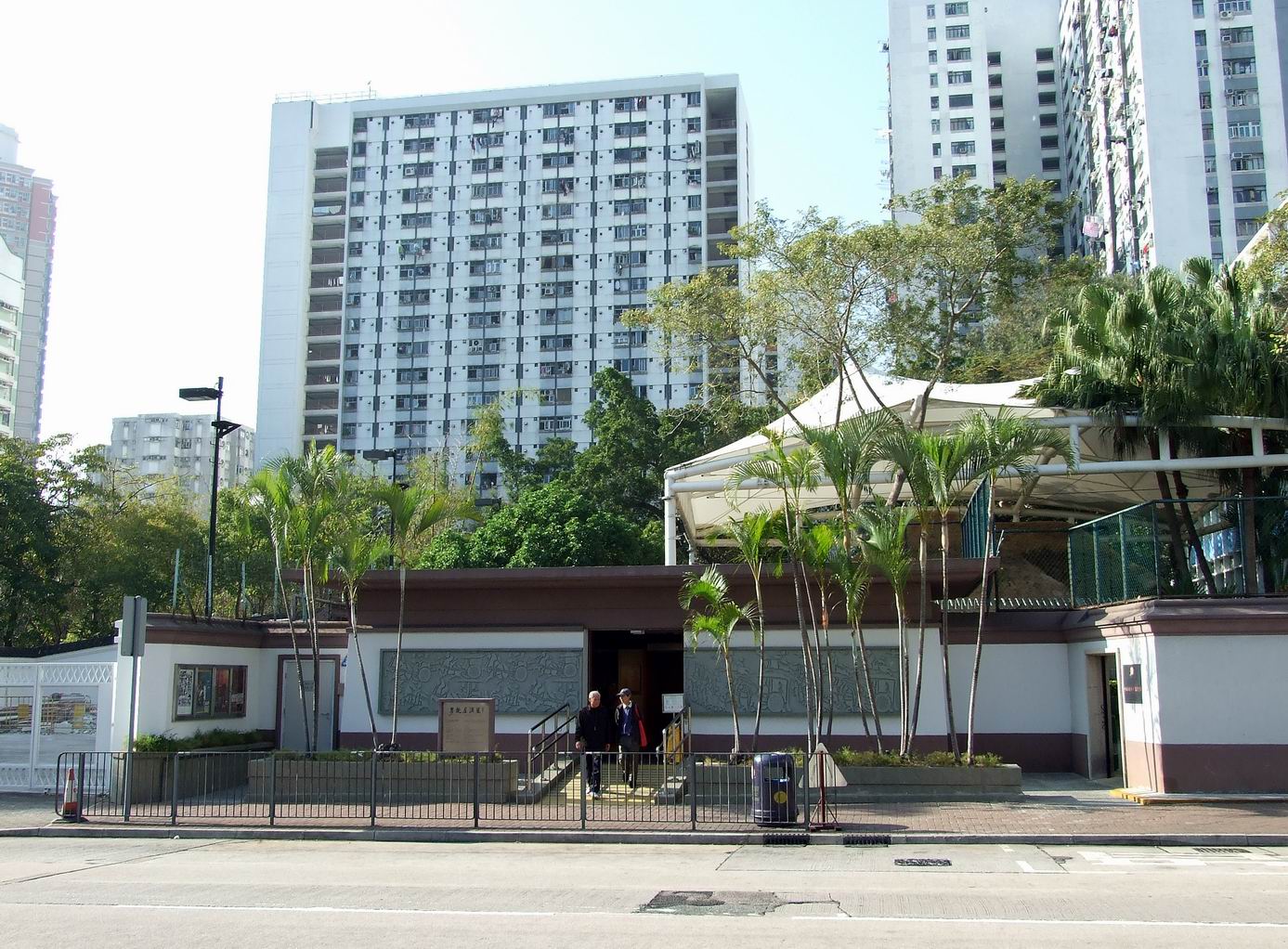
The Lei Cheng Uk Han Tomb Museum is a museum in Hong Kong which houses an ancient Chinese tomb. It is believed to have been built during the Eastern Han dynasty (AD 25–220) for a Chinese officer attached to the local garrison. The museum is located at 41 Tonkin Street, in Cheung Sha Wan, Sham Shui Po District, in the northwestern part of the Kowloon Peninsula of Hong Kong.
According to its structure, inscriptions on the tomb bricks and tomb finds, it is believed that the tomb was built in the Eastern Han dynasty (25–220 AD). Here is the explanation by Museum of History:
The cross-shaped tomb with domed roof was a popular tomb design in Guangdong at the time. The pottery ding tripod, zun wine warmer, kui food container and zhi wine container were common daily utensils and often appeared on pictorial bricks in Han tombs. The set of four pottery models – a house, granary, well and stove – were customary burial objects in the period. The characters Panyu (Chinese: 番禺; Jyutping: pun1 jyu4) in the brick inscription refer to the county in which the Hong Kong region was located in the Han dynasty, and the calligraphic style of the characters Xue Shi was widely used for Eastern Han bronze and stone inscriptions.
Although a number of Han tombs have been discovered in Guangdong province, south of China; the Lei Cheng Uk Han Tomb is the only Han brick tomb unearthed in Hong Kong to date. The tomb is an important site to understand the ancient history of Hong Kong and the early activities of Han people.
The tomb was accidentally discovered in August 1955, when the Hong Kong Government was levelling a hill slope for the construction of resettlement buildings at Lei Cheng Uk Village (present-day Lei Cheng Uk Estate). The tomb was then excavated by members of University of Hong Kong (HKU) and workers of the Public Works Department, under the supervision of Professor Frederick S. Drake, former head of the Chinese Department at HKU. After excavation, the government intended to demolish the tomb, but the tomb was eventually preserved due to high public interest. The tomb and its exhibition hall were formally opened to the public in 1957. In November 1988, the Han Tomb was declared as a gazetted monument by the Hong Kong Government, and is now protected and preserved permanently under the Antiquities and Monuments Ordinance.
Since the mid-1980s, visitors have no longer been allowed inside the tomb due to conservation concerns. It can instead only be viewed through glass panel at the entrance passage. The tomb is sealed in a temperature- and humidity-controlled environment,[citation needed] and is protected by concrete, waterproofing layers, topsoil, and turf. Following rainwater leakage problems, the tomb was renovated in 2005, with the addition of a canopy to cover the tomb.
3D laser scanning technology in the digital recording of the structures was applied to capture 3D images of the structure. An exhibition hall opened in 1988, when the tomb was declared a gazetted monument. The hall was refurbished in 2005. Details on the discovery and characteristics of the tomb, as well as bronze and pottery artefacts found in the tomb are on permanent display in the exhibition hall.
The tomb and gallery came under the management of the former Urban Council in 1969. The museum later became a branch of the Hong Kong Museum of History in 1975. As such, it is presently managed by the Leisure and Cultural Services Department of the Hong Kong government.
Hub AI
Lei Cheng Uk Han Tomb Museum AI simulator
(@Lei Cheng Uk Han Tomb Museum_simulator)
Lei Cheng Uk Han Tomb Museum
The Lei Cheng Uk Han Tomb Museum is a museum in Hong Kong which houses an ancient Chinese tomb. It is believed to have been built during the Eastern Han dynasty (AD 25–220) for a Chinese officer attached to the local garrison. The museum is located at 41 Tonkin Street, in Cheung Sha Wan, Sham Shui Po District, in the northwestern part of the Kowloon Peninsula of Hong Kong.
According to its structure, inscriptions on the tomb bricks and tomb finds, it is believed that the tomb was built in the Eastern Han dynasty (25–220 AD). Here is the explanation by Museum of History:
The cross-shaped tomb with domed roof was a popular tomb design in Guangdong at the time. The pottery ding tripod, zun wine warmer, kui food container and zhi wine container were common daily utensils and often appeared on pictorial bricks in Han tombs. The set of four pottery models – a house, granary, well and stove – were customary burial objects in the period. The characters Panyu (Chinese: 番禺; Jyutping: pun1 jyu4) in the brick inscription refer to the county in which the Hong Kong region was located in the Han dynasty, and the calligraphic style of the characters Xue Shi was widely used for Eastern Han bronze and stone inscriptions.
Although a number of Han tombs have been discovered in Guangdong province, south of China; the Lei Cheng Uk Han Tomb is the only Han brick tomb unearthed in Hong Kong to date. The tomb is an important site to understand the ancient history of Hong Kong and the early activities of Han people.
The tomb was accidentally discovered in August 1955, when the Hong Kong Government was levelling a hill slope for the construction of resettlement buildings at Lei Cheng Uk Village (present-day Lei Cheng Uk Estate). The tomb was then excavated by members of University of Hong Kong (HKU) and workers of the Public Works Department, under the supervision of Professor Frederick S. Drake, former head of the Chinese Department at HKU. After excavation, the government intended to demolish the tomb, but the tomb was eventually preserved due to high public interest. The tomb and its exhibition hall were formally opened to the public in 1957. In November 1988, the Han Tomb was declared as a gazetted monument by the Hong Kong Government, and is now protected and preserved permanently under the Antiquities and Monuments Ordinance.
Since the mid-1980s, visitors have no longer been allowed inside the tomb due to conservation concerns. It can instead only be viewed through glass panel at the entrance passage. The tomb is sealed in a temperature- and humidity-controlled environment,[citation needed] and is protected by concrete, waterproofing layers, topsoil, and turf. Following rainwater leakage problems, the tomb was renovated in 2005, with the addition of a canopy to cover the tomb.
3D laser scanning technology in the digital recording of the structures was applied to capture 3D images of the structure. An exhibition hall opened in 1988, when the tomb was declared a gazetted monument. The hall was refurbished in 2005. Details on the discovery and characteristics of the tomb, as well as bronze and pottery artefacts found in the tomb are on permanent display in the exhibition hall.
The tomb and gallery came under the management of the former Urban Council in 1969. The museum later became a branch of the Hong Kong Museum of History in 1975. As such, it is presently managed by the Leisure and Cultural Services Department of the Hong Kong government.
Recent media