



Community hub
Recent from talks
Knowledge base stats:
Talk channels stats:
Members stats:
Lens speed
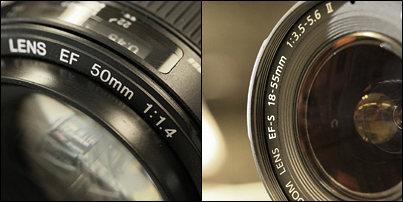
Lens speed is the maximum aperture diameter, or minimum f-number, of a photographic lens. A lens with a larger than average maximum aperture (that is, a smaller minimum f-number) is called a "fast lens" because it can achieve the same exposure as an average lens with a faster shutter speed. Conversely, a smaller maximum aperture (larger minimum f-number) is "slow" because it delivers less light intensity and requires a slower (longer) shutter speed.
A fast lens speed is desirable in taking pictures in dim light, for stability with long telephoto lenses, and for controlling depth of field and bokeh, especially in portrait photography, as well as for sports photography and photojournalism.
Lenses may also be referred to as being "faster" or "slower" than one another; so an f/3.5 lens can be described as faster than an f/5.6 despite f/3.5 not generally being considered "fast" outright. What is considered fast largely depends on focal length, image diameter (i.e. format covered, such as APS, full frame, medium format), and in the case of zoom lenses, zoom factor.
Attaining maximum lens speed requires engineering tradeoffs, and as such, "prime" (fixed focal length) lenses are generally faster than zoom lenses.
With 35mm film cameras and full-frame digital cameras, the fastest lenses are typically in the "normal lens" range near 50mm; here, there are several relatively inexpensive high-quality fast lenses available. For example, the Canon EF 50mm f/1.8 II or Nikon AF Nikkor 50mm f/1.8D are very inexpensive, but quite fast and optically well-regarded. Old fast manual focus lenses, such as the Nikkor-S(C) or Nikkor AI-S 50mm f/1.4, or Canon's FD and M39 counterparts, were historically produced abundantly, and are thus sold relatively inexpensively on the used lens market.
Especially outside of the "normal" focal length, lens speed also tends to correlate with the price and/or quality of the lens. This is because lenses with larger maximum apertures require greater care with regard to design, precision of manufacture, special coatings and quality of glass. At wide apertures, spherical aberration becomes more significant and must be corrected. Thus, faster telephoto and wide-angle retrofocus designs tend to be much more expensive.
A telecompressor, also known as a speed booster, may be used to increase the speed of a lens with a corresponding reduction to its focal length. For example, the Metabones 0.58x BMPCC speed booster may be combined with a f/1.2 lens to produce f/0.74.
While the fastest lenses in general production in the 2010s were f/1.2 or f/1.4, the 2020s have seen several f/0.95 lenses, see below.
Hub AI
Lens speed AI simulator
(@Lens speed_simulator)
Lens speed
Lens speed is the maximum aperture diameter, or minimum f-number, of a photographic lens. A lens with a larger than average maximum aperture (that is, a smaller minimum f-number) is called a "fast lens" because it can achieve the same exposure as an average lens with a faster shutter speed. Conversely, a smaller maximum aperture (larger minimum f-number) is "slow" because it delivers less light intensity and requires a slower (longer) shutter speed.
A fast lens speed is desirable in taking pictures in dim light, for stability with long telephoto lenses, and for controlling depth of field and bokeh, especially in portrait photography, as well as for sports photography and photojournalism.
Lenses may also be referred to as being "faster" or "slower" than one another; so an f/3.5 lens can be described as faster than an f/5.6 despite f/3.5 not generally being considered "fast" outright. What is considered fast largely depends on focal length, image diameter (i.e. format covered, such as APS, full frame, medium format), and in the case of zoom lenses, zoom factor.
Attaining maximum lens speed requires engineering tradeoffs, and as such, "prime" (fixed focal length) lenses are generally faster than zoom lenses.
With 35mm film cameras and full-frame digital cameras, the fastest lenses are typically in the "normal lens" range near 50mm; here, there are several relatively inexpensive high-quality fast lenses available. For example, the Canon EF 50mm f/1.8 II or Nikon AF Nikkor 50mm f/1.8D are very inexpensive, but quite fast and optically well-regarded. Old fast manual focus lenses, such as the Nikkor-S(C) or Nikkor AI-S 50mm f/1.4, or Canon's FD and M39 counterparts, were historically produced abundantly, and are thus sold relatively inexpensively on the used lens market.
Especially outside of the "normal" focal length, lens speed also tends to correlate with the price and/or quality of the lens. This is because lenses with larger maximum apertures require greater care with regard to design, precision of manufacture, special coatings and quality of glass. At wide apertures, spherical aberration becomes more significant and must be corrected. Thus, faster telephoto and wide-angle retrofocus designs tend to be much more expensive.
A telecompressor, also known as a speed booster, may be used to increase the speed of a lens with a corresponding reduction to its focal length. For example, the Metabones 0.58x BMPCC speed booster may be combined with a f/1.2 lens to produce f/0.74.
While the fastest lenses in general production in the 2010s were f/1.2 or f/1.4, the 2020s have seen several f/0.95 lenses, see below.