
Recent from talks
Leonardo's robot
Knowledge base stats:
Talk channels stats:
Members stats:
Leonardo's robot
Leonardo's robot, or Leonardo's mechanical knight (Italian: Automa cavaliere, lit. "Automaton knight"), is a humanoid automaton designed and possibly constructed by Leonardo da Vinci in the late 15th century.
The robot’s design largely consists of a series of pulleys that allow it to mimic human movements. Operational versions of the robot have been reconstructed by multiple researchers after the discovery of Leonardo’s sketches in the 1950s. Leonardo’s designs may have served as inspirations for robotics projects backed by NASA and Intuitive Surgical.
Leonardo possibly started sketching ideas for his robot before he began work on The Last Supper. Though no complete drawings of the automaton survived, Leonardo’s notes suggest he may have constructed a prototype around 1495, while he was under the patronage of Ludovico Sforza, the Duke of Milan.
Leonardo’s initial studies in anatomy and kinesiology, as recorded in his Codex Huygens, may have informed his desire to design an automated device. The principles of his humanoid robot can be found among a set of folios composed of anatomical sketches that are believed to follow his Vitruvian Canon of Proportions.
Leonardo’s interest in engineering may have also inspired him to create his automaton, which appears in the form of a mechanical knight. Before Leonardo designed his mechanical knight, eyewitness accounts detail how he created a mechanical lion that could move independently of human intervention. The mechanical lion was displayed in many public venues including the wedding of Maria de Medici and at the arrival of the French King Francis I in Lyon in 1515.
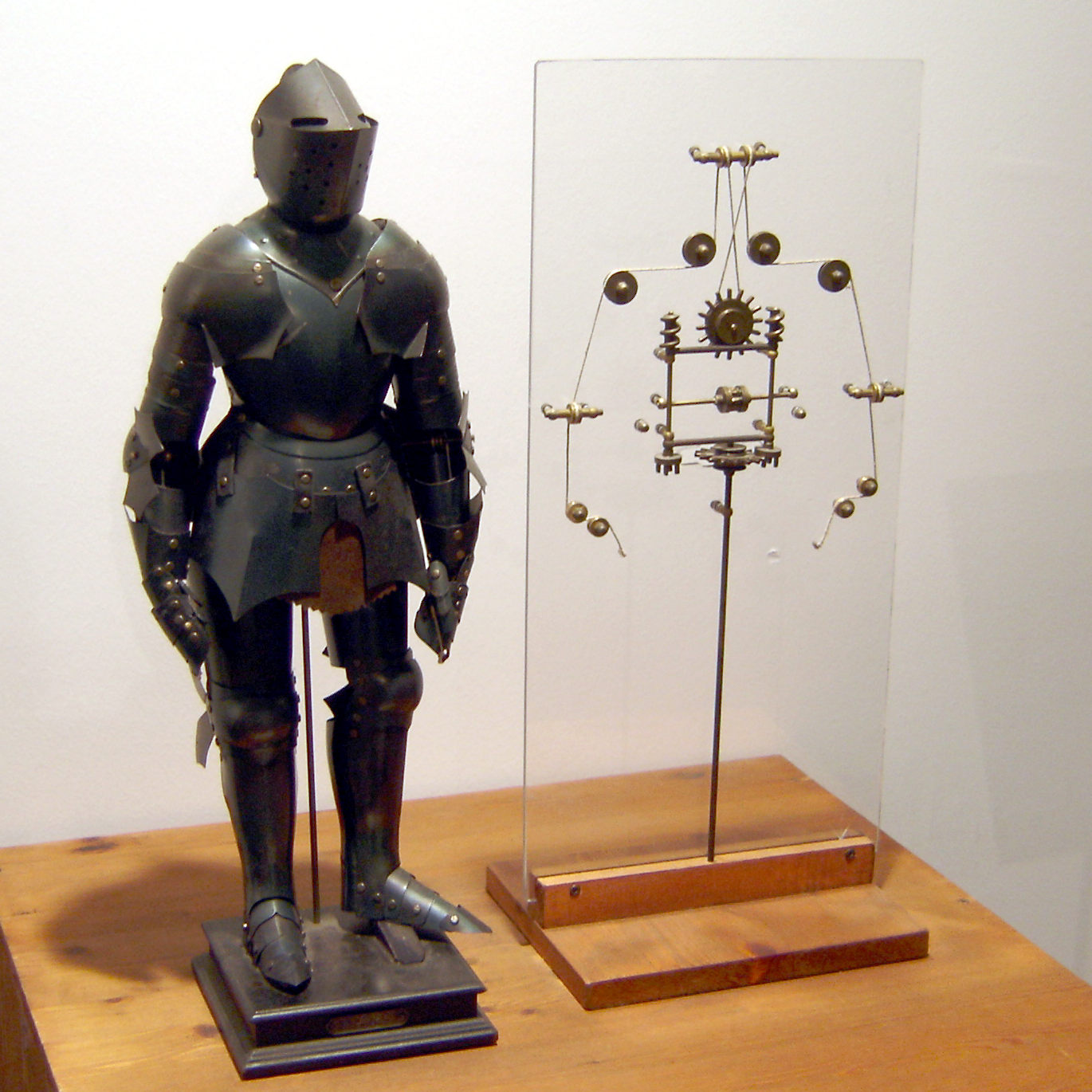
Leonardo’s robot is largely controlled by a system of pulleys composed of a central driver, individual drivers, and supporting idler pulleys. The inside of the robot's chest contains a mechanical controller for the arms. This controller triggers the worm gears connected to the robot’s pulley system, enabling the robot to wave its arms. The robot’s legs are controlled with an external crank and cable system attached to key pivots on the ankles, knees, and hips. The robot’s inner mechanisms are hidden behind a German-Italian suit of medieval armor.
The robot’s head has a hinged jaw and is attached to a flexible neck. The robot’s body can sit upright and move its arms around in various directions. The robot's lower body operates with three degrees of freedom while the arms utilize a four-degree-of-freedom system, possibly so the robot can perform whole-arm grasping.
Drums located inside of the robot produce sounds as the rest of the body moves. Like many other mechanical forms of palatial entertainment at the time, the robot may have been designed to scare audiences.
Hub AI
Leonardo's robot AI simulator
(@Leonardo's robot_simulator)
Leonardo's robot
Leonardo's robot, or Leonardo's mechanical knight (Italian: Automa cavaliere, lit. "Automaton knight"), is a humanoid automaton designed and possibly constructed by Leonardo da Vinci in the late 15th century.
The robot’s design largely consists of a series of pulleys that allow it to mimic human movements. Operational versions of the robot have been reconstructed by multiple researchers after the discovery of Leonardo’s sketches in the 1950s. Leonardo’s designs may have served as inspirations for robotics projects backed by NASA and Intuitive Surgical.
Leonardo possibly started sketching ideas for his robot before he began work on The Last Supper. Though no complete drawings of the automaton survived, Leonardo’s notes suggest he may have constructed a prototype around 1495, while he was under the patronage of Ludovico Sforza, the Duke of Milan.
Leonardo’s initial studies in anatomy and kinesiology, as recorded in his Codex Huygens, may have informed his desire to design an automated device. The principles of his humanoid robot can be found among a set of folios composed of anatomical sketches that are believed to follow his Vitruvian Canon of Proportions.
Leonardo’s interest in engineering may have also inspired him to create his automaton, which appears in the form of a mechanical knight. Before Leonardo designed his mechanical knight, eyewitness accounts detail how he created a mechanical lion that could move independently of human intervention. The mechanical lion was displayed in many public venues including the wedding of Maria de Medici and at the arrival of the French King Francis I in Lyon in 1515.
Leonardo’s robot is largely controlled by a system of pulleys composed of a central driver, individual drivers, and supporting idler pulleys. The inside of the robot's chest contains a mechanical controller for the arms. This controller triggers the worm gears connected to the robot’s pulley system, enabling the robot to wave its arms. The robot’s legs are controlled with an external crank and cable system attached to key pivots on the ankles, knees, and hips. The robot’s inner mechanisms are hidden behind a German-Italian suit of medieval armor.
The robot’s head has a hinged jaw and is attached to a flexible neck. The robot’s body can sit upright and move its arms around in various directions. The robot's lower body operates with three degrees of freedom while the arms utilize a four-degree-of-freedom system, possibly so the robot can perform whole-arm grasping.
Drums located inside of the robot produce sounds as the rest of the body moves. Like many other mechanical forms of palatial entertainment at the time, the robot may have been designed to scare audiences.
Recent media