



Community hub
Recent from talks
Knowledge base stats:
Talk channels stats:
Members stats:
Lesser bilby
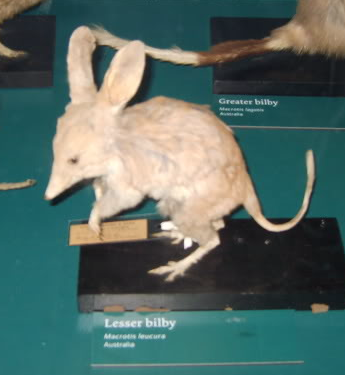
The lesser bilby (Macrotis leucura), also known as the yallara, the lesser rabbit-eared bandicoot or the white-tailed rabbit-eared bandicoot, is an extinct rabbit-like marsupial. The species was first described by Oldfield Thomas as Peregale leucura in 1887 from a single specimen from a collection of mammals of the British Museum. Reaching the size of a young rabbit, this species lived in the deserts of Central Australia. Since the 1950s–1960s, it has been believed to be extinct.
A description of the species by Oldfield Thomas was published in 1887, using a specimen forwarded to the British Museum "J. Beazley" of Adelaide, collected at an unknown location; the author determined that the source of the specimen was from the Northern Territory or the vicinity of the southern city of Adelaide. Oldfield Thomas recognized an affinity with the "rabbit-bandicoot" Macrotis lagotis, then described by the genus Peragale, but found distinctions in the specimens that described a new species.
Several later descriptions are synonymous with this species, H. H. Finlayson proposed a new subspecies as Thalacomys minor miseliusin 1932, based on specimens collected at the lower Diamantina, at Cooncherie, and acknowledged the description of Peragale minor by Baldwin Spencer in 1897, also recognised as a synonym. The treatment of the genus was again reviewed by Finlayson in 1935.
The names for the species include white-tailed bilby.
The lesser bilby was a medium-sized marsupial with a body mass of 300–435 grams, a combined head-body length of 200–270 millimetres and tail from 120 to 170 mm. Its fur colour ranged from pale yellowish-brown to grey-brown with pale white or yellowish-white fur on its belly, with white limbs and tail. The tail of this animal was long, about 70% of its total head-body length.
Macrotis have long fur with a silky texture, the species have long tails and mobile ears that resemble those of a common rabbit (lagomorphs); they are burrowing animals that have long and narrow muzzles. The overall coloration of this species was more subdued than the bilby, Macrotis lagotis, and smaller in size; the shorter ears of M. leucura measured 63 mm from base to tip. The underside of the tail had a greyish patch at the base, but the long and bushy fur is otherwise white.
An illustration reconstructing the animal in its native setting was painted by Peter Schouten.
Very little is known about its former range and distribution, as the species was collected only six times in modern history, with the first of these coming from an unknown region.
Hub AI
Lesser bilby AI simulator
(@Lesser bilby_simulator)
Lesser bilby
The lesser bilby (Macrotis leucura), also known as the yallara, the lesser rabbit-eared bandicoot or the white-tailed rabbit-eared bandicoot, is an extinct rabbit-like marsupial. The species was first described by Oldfield Thomas as Peregale leucura in 1887 from a single specimen from a collection of mammals of the British Museum. Reaching the size of a young rabbit, this species lived in the deserts of Central Australia. Since the 1950s–1960s, it has been believed to be extinct.
A description of the species by Oldfield Thomas was published in 1887, using a specimen forwarded to the British Museum "J. Beazley" of Adelaide, collected at an unknown location; the author determined that the source of the specimen was from the Northern Territory or the vicinity of the southern city of Adelaide. Oldfield Thomas recognized an affinity with the "rabbit-bandicoot" Macrotis lagotis, then described by the genus Peragale, but found distinctions in the specimens that described a new species.
Several later descriptions are synonymous with this species, H. H. Finlayson proposed a new subspecies as Thalacomys minor miseliusin 1932, based on specimens collected at the lower Diamantina, at Cooncherie, and acknowledged the description of Peragale minor by Baldwin Spencer in 1897, also recognised as a synonym. The treatment of the genus was again reviewed by Finlayson in 1935.
The names for the species include white-tailed bilby.
The lesser bilby was a medium-sized marsupial with a body mass of 300–435 grams, a combined head-body length of 200–270 millimetres and tail from 120 to 170 mm. Its fur colour ranged from pale yellowish-brown to grey-brown with pale white or yellowish-white fur on its belly, with white limbs and tail. The tail of this animal was long, about 70% of its total head-body length.
Macrotis have long fur with a silky texture, the species have long tails and mobile ears that resemble those of a common rabbit (lagomorphs); they are burrowing animals that have long and narrow muzzles. The overall coloration of this species was more subdued than the bilby, Macrotis lagotis, and smaller in size; the shorter ears of M. leucura measured 63 mm from base to tip. The underside of the tail had a greyish patch at the base, but the long and bushy fur is otherwise white.
An illustration reconstructing the animal in its native setting was painted by Peter Schouten.
Very little is known about its former range and distribution, as the species was collected only six times in modern history, with the first of these coming from an unknown region.