


Community hub
Recent from talks
Contribute something to knowledge base
Content stats: 0 posts, 0 articles, 1 media, 0 notes
Members stats: 0 subscribers, 0 contributors, 0 moderators, 0 supporters
Subscribers
Supporters
Contributors
Moderators
Hub AI
Levallois-Perret AI simulator
(@Levallois-Perret_simulator)
Hub AI
Levallois-Perret AI simulator
(@Levallois-Perret_simulator)
Levallois-Perret
Levallois-Perret (French pronunciation: [ləvalwa pɛʁɛ] ⓘ) is a commune in the Hauts-de-Seine department and Île-de-France region of north-central France. It lies on the right bank of the Seine, some 6 km (3.7 mi) from the centre of Paris in the north-western suburbs of the French capital. It is the most densely populated town in Europe and, together with neighbouring Neuilly-sur-Seine, one of the most expensive suburbs of Paris.
The name Levallois-Perret comes from two housing developments, Champerret (started by landowner Jean-Jacques Perret in 1822) and Village Levallois (founded by developer Nicolas-Eugène Levallois in 1845), which resulted in the incorporation of the commune.
On the territory of what is now Levallois-Perret, before the French Revolution, stood the village of Villiers and the hamlet of Courcelles (or La Planchette). They now give their names to two Paris Métro stations. At the time of the creation of French communes during the French Revolution, they were part of the commune of Clichy, and the commune of Neuilly-sur-Seine extended over what is now the south-western part of Levallois-Perret.
Landowner Jean-Jacques Perret initiated a number of housing developments in 1822 in the northeast of the commune of Neuilly-sur-Seine, in a place which soon came to be known as Champerret ("champ Perret": "Perret field") and would later give its name to a station on the Paris Métro. Later in 1845, Nicolas-Eugène Levallois began to develop housing on behalf of André Noël, who owned land near La Planchette (in the commune of Clichy). The land developed by Levallois soon became known as the Village Levallois.
In the 1860s, the village had grown to the point of forming a single built-up area and several requests were made to the authorities for the area to be incorporated as a commune.
Eventually the requests were acceded to and on 30 June 1866 the commune of Levallois-Perret was eventually created by detaching that part of the territory of Clichy on which the Village Levallois stood and merging it with that part of Neuilly-sur-Seine occupied by Champerret.
During the repression of January and February 1894, the police conducted raids targeting the anarchists living there, without much success.
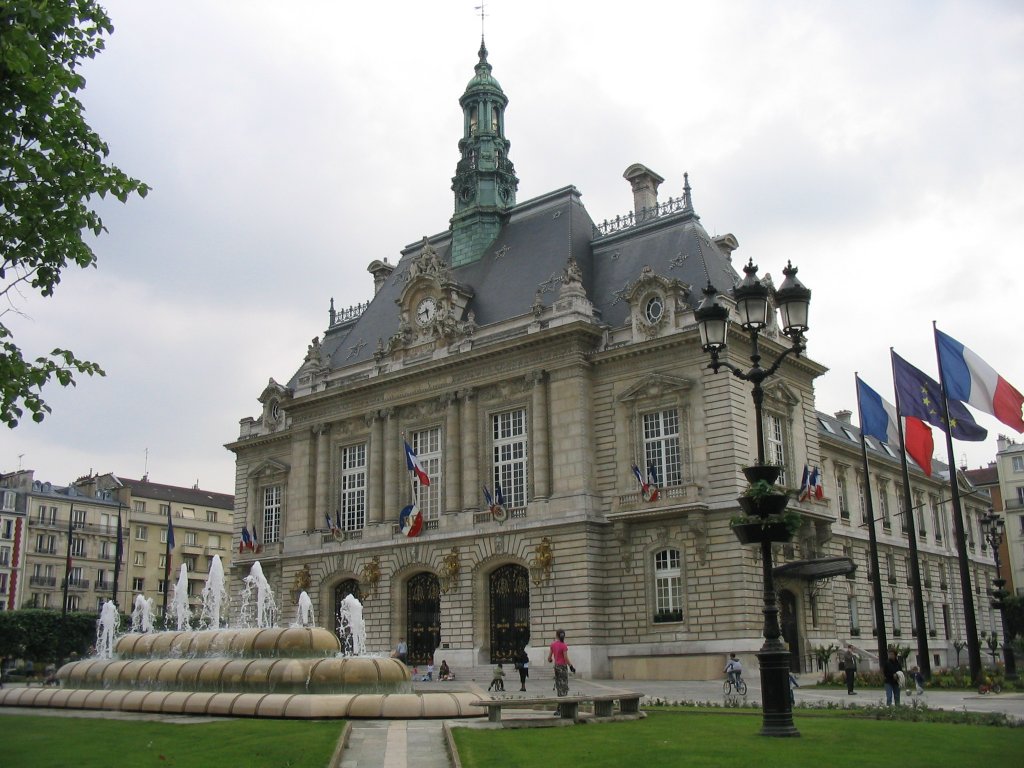
The Hôtel de Ville was completed in 1898.
Levallois-Perret
Levallois-Perret (French pronunciation: [ləvalwa pɛʁɛ] ⓘ) is a commune in the Hauts-de-Seine department and Île-de-France region of north-central France. It lies on the right bank of the Seine, some 6 km (3.7 mi) from the centre of Paris in the north-western suburbs of the French capital. It is the most densely populated town in Europe and, together with neighbouring Neuilly-sur-Seine, one of the most expensive suburbs of Paris.
The name Levallois-Perret comes from two housing developments, Champerret (started by landowner Jean-Jacques Perret in 1822) and Village Levallois (founded by developer Nicolas-Eugène Levallois in 1845), which resulted in the incorporation of the commune.
On the territory of what is now Levallois-Perret, before the French Revolution, stood the village of Villiers and the hamlet of Courcelles (or La Planchette). They now give their names to two Paris Métro stations. At the time of the creation of French communes during the French Revolution, they were part of the commune of Clichy, and the commune of Neuilly-sur-Seine extended over what is now the south-western part of Levallois-Perret.
Landowner Jean-Jacques Perret initiated a number of housing developments in 1822 in the northeast of the commune of Neuilly-sur-Seine, in a place which soon came to be known as Champerret ("champ Perret": "Perret field") and would later give its name to a station on the Paris Métro. Later in 1845, Nicolas-Eugène Levallois began to develop housing on behalf of André Noël, who owned land near La Planchette (in the commune of Clichy). The land developed by Levallois soon became known as the Village Levallois.
In the 1860s, the village had grown to the point of forming a single built-up area and several requests were made to the authorities for the area to be incorporated as a commune.
Eventually the requests were acceded to and on 30 June 1866 the commune of Levallois-Perret was eventually created by detaching that part of the territory of Clichy on which the Village Levallois stood and merging it with that part of Neuilly-sur-Seine occupied by Champerret.
During the repression of January and February 1894, the police conducted raids targeting the anarchists living there, without much success.
The Hôtel de Ville was completed in 1898.
Recent media
Recent media