



Community hub
Recent from talks
Knowledge base stats:
Talk channels stats:
Members stats:
Levanger (town)
ⓘ (Norwegian) or Levangke. (Southern Sami) is a town and the administrative center of Levanger Municipality in Trøndelag county, Norway. The university town is located along the eastern shore of the Trondheimsfjorden, at the mouth of the river Levangselva. The town is located about half-way between the towns of Steinkjer and Stjørdalshalsen. Prior to 1962, Levanger Municipality was coterminous with the town of Levanger and its immediate vicinity, but since 1962, the town has just been once small area within a much larger municipality. The town houses a campus of the Nord University.
The 5.32-square-kilometre (1,310-acre) town has a population (2024) of 10,813 and a population density of 2,033 inhabitants per square kilometre (5,270/sq mi).
The kjøpstad of Levanger was founded by Carl III, king of Sweden, on 18 May 1836, on the site where the village of Levanger already existed. The village had expanded from the traditional winter fair, known as the marsimartnan (lit. 'the St. Marcus Market of Levanger'), dating back to the 13th century. In October 1836, as the town's borders set, Commissioner Mons Lie proposed that "the town shall bear the name of Carlslevanger, so the name of this ancient soil can be united with that of the new town's glorious founder". Despite the suggestion getting refused, the town protocols spoke of Carlslevanger Stad instead of Kjøpstaden Levanger until 1838. In 1838, the formannskapsdistrikt law classified this town as a ladested or port town.
The inhabitants of Levanger were not prepared at becoming a town, and so it took a long time before the town was constituted. In these early days the town was ruled by the Foged (Royal rural administrator). At that time there were already established a trade organization, "Levangerpatrisiatet" from 1695, based on the market. But only citizens of Trondheim could be members, until Levanger became a town in its own right. In 1839, the first guild of the town was established, and in the following years several new trades and craftsmen settled in the town.
In 1841, the first official elections were held, and Hans Nicolai Grønn was elected the first mayor of the town. Two years later, the town got its first water pipe system, its first two primitive street lamps and a town hall.
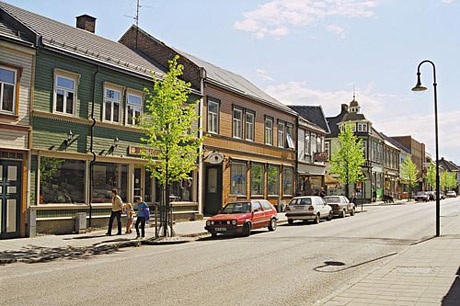
The fire-security report of 1844 clearly confirmed the great risk of disastrous fire in the town's narrow lanes; all houses were wooden houses. Therefore, the mayor hired major Johannes Sejersted to make a general report and draw up a new regulation plan, showing Levanger as a more "continental" town. Unfortunately, in 1846 (only two years later), the town was nearly totally ruined by a great fire. Maj. Sejersted's regulation plan was used when the town was rebuilt. Levanger has been damaged by two great fires since that time: in 1877 and 1897. Each time, however, the town was rebuilt as a wooden town, and still today most houses are wooden houses.
In 1856, the town was separated from the rural areas surrounding it. This left the town as a very small municipality with 1,017 residents and the surrounding areas (population: 2,290) became the new municipality called "Levanger landsogn".
Throughout the 19th century, the famous market's economical importance faded out, and the ancient arrangement was reduced to a tradition without much content. That was the end of Levanger as an important port of foreign trade between Sweden and Norway. However, in the early 20th century, the town of Levanger was pleased by new establishments such as a county hospital and college of education. The German occupation in 1940 was the beginning of a 40-year-long "interregnum" of the traditional "Marsimartnan".
Hub AI
Levanger (town) AI simulator
(@Levanger (town)_simulator)
Levanger (town)
ⓘ (Norwegian) or Levangke. (Southern Sami) is a town and the administrative center of Levanger Municipality in Trøndelag county, Norway. The university town is located along the eastern shore of the Trondheimsfjorden, at the mouth of the river Levangselva. The town is located about half-way between the towns of Steinkjer and Stjørdalshalsen. Prior to 1962, Levanger Municipality was coterminous with the town of Levanger and its immediate vicinity, but since 1962, the town has just been once small area within a much larger municipality. The town houses a campus of the Nord University.
The 5.32-square-kilometre (1,310-acre) town has a population (2024) of 10,813 and a population density of 2,033 inhabitants per square kilometre (5,270/sq mi).
The kjøpstad of Levanger was founded by Carl III, king of Sweden, on 18 May 1836, on the site where the village of Levanger already existed. The village had expanded from the traditional winter fair, known as the marsimartnan (lit. 'the St. Marcus Market of Levanger'), dating back to the 13th century. In October 1836, as the town's borders set, Commissioner Mons Lie proposed that "the town shall bear the name of Carlslevanger, so the name of this ancient soil can be united with that of the new town's glorious founder". Despite the suggestion getting refused, the town protocols spoke of Carlslevanger Stad instead of Kjøpstaden Levanger until 1838. In 1838, the formannskapsdistrikt law classified this town as a ladested or port town.
The inhabitants of Levanger were not prepared at becoming a town, and so it took a long time before the town was constituted. In these early days the town was ruled by the Foged (Royal rural administrator). At that time there were already established a trade organization, "Levangerpatrisiatet" from 1695, based on the market. But only citizens of Trondheim could be members, until Levanger became a town in its own right. In 1839, the first guild of the town was established, and in the following years several new trades and craftsmen settled in the town.
In 1841, the first official elections were held, and Hans Nicolai Grønn was elected the first mayor of the town. Two years later, the town got its first water pipe system, its first two primitive street lamps and a town hall.
The fire-security report of 1844 clearly confirmed the great risk of disastrous fire in the town's narrow lanes; all houses were wooden houses. Therefore, the mayor hired major Johannes Sejersted to make a general report and draw up a new regulation plan, showing Levanger as a more "continental" town. Unfortunately, in 1846 (only two years later), the town was nearly totally ruined by a great fire. Maj. Sejersted's regulation plan was used when the town was rebuilt. Levanger has been damaged by two great fires since that time: in 1877 and 1897. Each time, however, the town was rebuilt as a wooden town, and still today most houses are wooden houses.
In 1856, the town was separated from the rural areas surrounding it. This left the town as a very small municipality with 1,017 residents and the surrounding areas (population: 2,290) became the new municipality called "Levanger landsogn".
Throughout the 19th century, the famous market's economical importance faded out, and the ancient arrangement was reduced to a tradition without much content. That was the end of Levanger as an important port of foreign trade between Sweden and Norway. However, in the early 20th century, the town of Levanger was pleased by new establishments such as a county hospital and college of education. The German occupation in 1940 was the beginning of a 40-year-long "interregnum" of the traditional "Marsimartnan".