



Community hub
Recent from talks
Contribute something to knowledge base
Content stats: 0 posts, 0 articles, 1 media, 0 notes
Members stats: 0 subscribers, 0 contributors, 0 moderators, 0 supporters
Subscribers
Supporters
Contributors
Moderators
Hub AI
Lewis gun AI simulator
(@Lewis gun_simulator)
Hub AI
Lewis gun AI simulator
(@Lewis gun_simulator)
Lewis gun
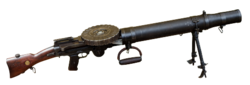
The Lewis gun (or Lewis automatic machine gun or Lewis automatic rifle) is a First World War–era light machine gun. Designed privately in the United States though not adopted there, the design was finalised and mass-produced in the United Kingdom, and widely used by troops of the British Empire during the war. It had a distinctive barrel cooling shroud (containing a finned breech-to-muzzle aluminium heat sink to cool the gun barrel), and top-mounted pan magazine. The Lewis served until the end of the Korean War, and was widely used as an aircraft machine gun during both World Wars, almost always with the cooling shroud removed, as air flow during flight offered sufficient cooling.
A predecessor to the Lewis gun incorporating the principles upon which it was based was designed by Ferdinand Mannlicher. The Lewis gun was invented by U.S. Army colonel Isaac Newton Lewis in 1911, based on initial work by Samuel Maclean. Despite its origins, the Lewis gun was not initially adopted by the U.S. military, most likely because of political differences between Lewis and General William Crozier, the chief of the Ordnance Department. Lewis became frustrated with trying to persuade the U.S. Army to adopt his design, claiming that he was "slapped by rejections from ignorant hacks", and retired from the army.
Lewis left the United States in 1913 and went to Belgium, where he established the Armes Automatique Lewis company in Liège to facilitate commercial production of the gun. Lewis had been working closely with British arms manufacturer the Birmingham Small Arms Company Limited (BSA) in an effort to overcome some of the production difficulties of the weapon. The Belgians bought a small number of Lewis guns in 1913, using the .303 British round and, in 1914, BSA purchased a licence to manufacture the Lewis machine gun in England, which resulted in Lewis receiving significant royalty payments and becoming very wealthy. Lewis and his factory moved to England before 1914, away from possible seizure in the event of a German invasion.
The onset of the First World War increased demand for the Lewis gun, and BSA began production, under the designation "Model 1914". The design was officially approved for service on 15 October 1915 under the designation "Gun, Lewis, .303-cal." No Lewis guns were produced in Belgium during the war. All manufacture was carried out by BSA in England and the Savage Arms Company in the US, and although the two versions were largely similar, enough differences existed to stop them being completely interchangeable, although this had been rectified by the time of the Second World War.
The major difference between the two designs was that the BSA weapons were chambered for .303 British ammunition, whereas the Savage guns were chambered for .30-06 cartridges, which necessitated some difference in the magazine, feed mechanism, bolt, barrel, extractors, and gas operation system. Savage did make Lewis guns in .303 British calibre, though. The Model 1916 and Model 1917 were exported to Canada and the United Kingdom, and a few were supplied to the US military, particularly the Navy. The Savage Model 1917 was generally produced in .30-06 calibre. A number of these guns were supplied to the UK under lend-lease during the Second World War.
The Lewis gun was gas operated. A portion of the expanding propellant gas was tapped off from the barrel, driving a piston to the rear against a spring. The piston was fitted with a vertical post at its rear which rode in a helical cam track in the bolt, rotating it at the end of its travel nearest the breech. This allowed the three locking lugs at the rear of the bolt to engage in recesses in the gun's body to lock it into place. The post also carried a fixed firing pin, which protruded through an aperture in the front of the bolt, firing the next round at the foremost part of the piston's travel.
The gun's aluminium barrel-shroud caused the muzzle blast to draw air over the barrel and cool it, due to the muzzle-to-breech, radially finned aluminium heat sink within the shroud's barrel, and protruding behind the shroud's aft end, running lengthwise in contact with the gun barrel (somewhat like the later American M1917/18 Marlin-Rockwell machine gun's similar gun barrel cooling design) from the "bottleneck" near the shroud's muzzle end and protruding externally behind the shroud's rear end. Some discussion occurred over whether the shroud was necessary: in the Second World War, many old aircraft guns that did not have the tubing were issued to anti-aircraft units of the British Home Guard and to British airfields, and others were used on vehicle mounts in the Western Desert; all were found to function properly without it, which led to the suggestion that Lewis had insisted on the cooling arrangement largely to show that his design was different from Maclean's earlier prototypes. Only the Royal Navy retained the tube/heatsink cooling system on their deck-mounted AA-configuration Lewis guns.
The Lewis gun used a pan magazine holding 47 or 97 rounds. Pan magazines hold the ammunition nose-inwards toward the center, in a radial fan. Unlike the more common drum magazines, which hold the rounds parallel to the axis and are fed by spring tension, pan magazines are mechanically indexed. The Lewis magazine was driven by a cam on top of the bolt which operated a pawl mechanism via a lever.
Lewis gun
The Lewis gun (or Lewis automatic machine gun or Lewis automatic rifle) is a First World War–era light machine gun. Designed privately in the United States though not adopted there, the design was finalised and mass-produced in the United Kingdom, and widely used by troops of the British Empire during the war. It had a distinctive barrel cooling shroud (containing a finned breech-to-muzzle aluminium heat sink to cool the gun barrel), and top-mounted pan magazine. The Lewis served until the end of the Korean War, and was widely used as an aircraft machine gun during both World Wars, almost always with the cooling shroud removed, as air flow during flight offered sufficient cooling.
A predecessor to the Lewis gun incorporating the principles upon which it was based was designed by Ferdinand Mannlicher. The Lewis gun was invented by U.S. Army colonel Isaac Newton Lewis in 1911, based on initial work by Samuel Maclean. Despite its origins, the Lewis gun was not initially adopted by the U.S. military, most likely because of political differences between Lewis and General William Crozier, the chief of the Ordnance Department. Lewis became frustrated with trying to persuade the U.S. Army to adopt his design, claiming that he was "slapped by rejections from ignorant hacks", and retired from the army.
Lewis left the United States in 1913 and went to Belgium, where he established the Armes Automatique Lewis company in Liège to facilitate commercial production of the gun. Lewis had been working closely with British arms manufacturer the Birmingham Small Arms Company Limited (BSA) in an effort to overcome some of the production difficulties of the weapon. The Belgians bought a small number of Lewis guns in 1913, using the .303 British round and, in 1914, BSA purchased a licence to manufacture the Lewis machine gun in England, which resulted in Lewis receiving significant royalty payments and becoming very wealthy. Lewis and his factory moved to England before 1914, away from possible seizure in the event of a German invasion.
The onset of the First World War increased demand for the Lewis gun, and BSA began production, under the designation "Model 1914". The design was officially approved for service on 15 October 1915 under the designation "Gun, Lewis, .303-cal." No Lewis guns were produced in Belgium during the war. All manufacture was carried out by BSA in England and the Savage Arms Company in the US, and although the two versions were largely similar, enough differences existed to stop them being completely interchangeable, although this had been rectified by the time of the Second World War.
The major difference between the two designs was that the BSA weapons were chambered for .303 British ammunition, whereas the Savage guns were chambered for .30-06 cartridges, which necessitated some difference in the magazine, feed mechanism, bolt, barrel, extractors, and gas operation system. Savage did make Lewis guns in .303 British calibre, though. The Model 1916 and Model 1917 were exported to Canada and the United Kingdom, and a few were supplied to the US military, particularly the Navy. The Savage Model 1917 was generally produced in .30-06 calibre. A number of these guns were supplied to the UK under lend-lease during the Second World War.
The Lewis gun was gas operated. A portion of the expanding propellant gas was tapped off from the barrel, driving a piston to the rear against a spring. The piston was fitted with a vertical post at its rear which rode in a helical cam track in the bolt, rotating it at the end of its travel nearest the breech. This allowed the three locking lugs at the rear of the bolt to engage in recesses in the gun's body to lock it into place. The post also carried a fixed firing pin, which protruded through an aperture in the front of the bolt, firing the next round at the foremost part of the piston's travel.
The gun's aluminium barrel-shroud caused the muzzle blast to draw air over the barrel and cool it, due to the muzzle-to-breech, radially finned aluminium heat sink within the shroud's barrel, and protruding behind the shroud's aft end, running lengthwise in contact with the gun barrel (somewhat like the later American M1917/18 Marlin-Rockwell machine gun's similar gun barrel cooling design) from the "bottleneck" near the shroud's muzzle end and protruding externally behind the shroud's rear end. Some discussion occurred over whether the shroud was necessary: in the Second World War, many old aircraft guns that did not have the tubing were issued to anti-aircraft units of the British Home Guard and to British airfields, and others were used on vehicle mounts in the Western Desert; all were found to function properly without it, which led to the suggestion that Lewis had insisted on the cooling arrangement largely to show that his design was different from Maclean's earlier prototypes. Only the Royal Navy retained the tube/heatsink cooling system on their deck-mounted AA-configuration Lewis guns.
The Lewis gun used a pan magazine holding 47 or 97 rounds. Pan magazines hold the ammunition nose-inwards toward the center, in a radial fan. Unlike the more common drum magazines, which hold the rounds parallel to the axis and are fed by spring tension, pan magazines are mechanically indexed. The Lewis magazine was driven by a cam on top of the bolt which operated a pawl mechanism via a lever.
Recent media
Recent media