
Recent from talks
Lex Malacitana
Knowledge base stats:
Talk channels stats:
Members stats:
Lex Malacitana
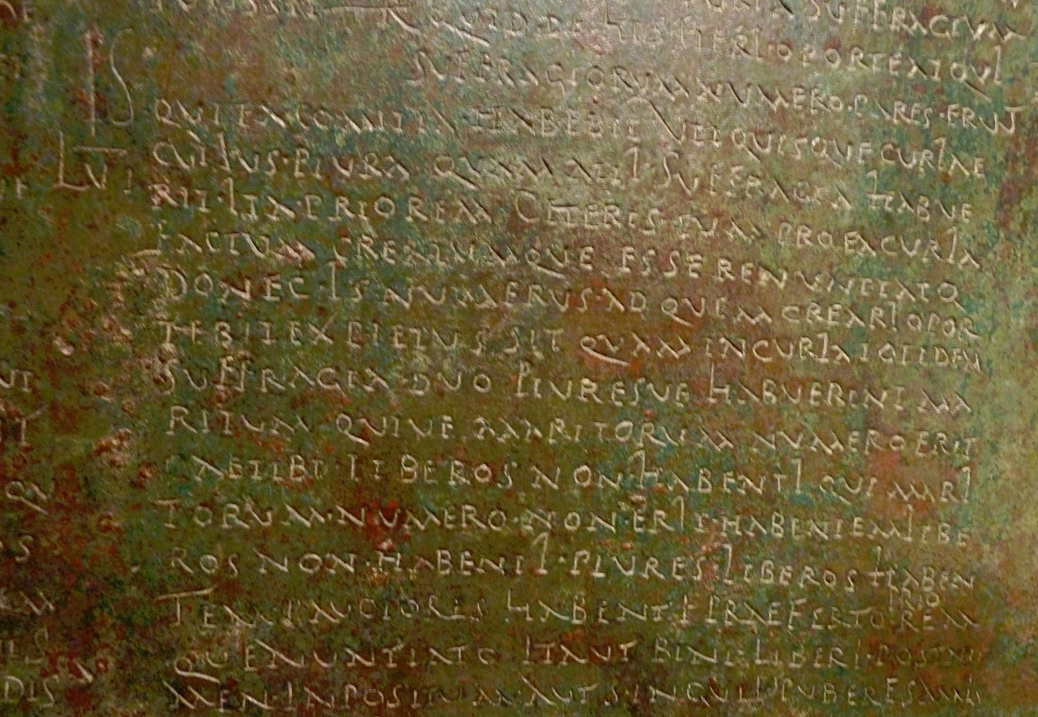
Lex Malacitana or Lex Flavia Malacitana ("Flavian law of Malaca") is a bronze tablet bearing Latin local statutes which deal with the official activities of the duoviri iuri dicundo. The tablet was found in the 20th century near Malaca (modern Málaga) with the lex Salpensana, and it was dated from AD 81–84, i.e. the early reign of Domitian. Malaca was governed under this law, which granted free-born persons the privileges of Roman citizenship.
Together with the lex Salpensana and the lex Irnitana it provides the most complete version of the lex Flavia municipalis, or the Flavian municipal law. and has allowed new insights into the workings of Roman law. The tablets are exhibited in the National Archaeological Museum, Madrid. Since the tablets provide the only surviving copy of large parts of the Flavian municipal law, they have provided new insights into the procedural side of municipal courts.
In December 2016 a petition to Congreso de los Diputados was offered to give it back to the Museo de Málaga. The Ministerio de Cultura studied the case, and on 12 March 2018 Spanish Government denied it.
The Romanization of Málaga, as in most of the southern Hispania Ulterior, was peaceful and conducted through agreements, foedus aequum, of mutual friendship and equality. During this era, the Municipium Malacitanum was a transit and exchange hub within the Via Herculea, invigorating the city both economically and culturally. It connected the city with other settlements in the interior of Hispania and with other ports in the Mediterranean.
Following the civil wars that occurred in the Empire in 68-69 (known as the "Year of the Four Emperors"), Vespasian emerged as the victor. He founded the Flavian dynasty and had strong allies in Hispania. In the year 74, the city of Malaca might have requested the emperor to grant them the Lex Flavia, under the provision of granting Latin rights to all of Hispania. However, this grant of citizenship did not materialize until sometime between the years 81 and 96, during the reign of Domitian, who is mentioned in the oaths of the text.
The tablets were discovered in 1851 in the area of Monte de El Ejido, in the city of Málaga by local workers. Their initial intention was to sell these pieces as scrap metal to the Luque family, who were bronze craftsmen. Before they could be melted down, news of the tablets' existence reached the Malaga-based couple Amalia Heredia Livermore and Jorge Loring Oyarzábal. They acquired the tablets with the intention of starting an archaeological collection. Subsequently, Manuel Rodríguez de Berlanga y Rosado, Jorge Loring's brother-in-law, studied, translated, and disseminated the Lex Flavia Malacitana among specialists. For his efforts, he was knighted with the Order of Isabella the Catholic.
For years, these tablets were displayed in the Loringiano Museum on the La Concepción estate. However, the Loring family decided to sell their collection of legal bronzes to the state to ensure that this valuable find would not be dispersed after their death. As a result, they became part of the collection of the National Archaeological Museum. Currently, the city council owns a copy of these tablets, which is displayed in its Plenary Hall. A replica can also be seen in the Customs House of Málaga.
The Lex Flavia Malacitana consists of municipal tablets typically placed in a prominent location within the forum, which was the political and religious center of cities. Their purpose was to ensure that all citizens were familiar with the municipality's regulations.
Hub AI
Lex Malacitana AI simulator
(@Lex Malacitana_simulator)
Lex Malacitana
Lex Malacitana or Lex Flavia Malacitana ("Flavian law of Malaca") is a bronze tablet bearing Latin local statutes which deal with the official activities of the duoviri iuri dicundo. The tablet was found in the 20th century near Malaca (modern Málaga) with the lex Salpensana, and it was dated from AD 81–84, i.e. the early reign of Domitian. Malaca was governed under this law, which granted free-born persons the privileges of Roman citizenship.
Together with the lex Salpensana and the lex Irnitana it provides the most complete version of the lex Flavia municipalis, or the Flavian municipal law. and has allowed new insights into the workings of Roman law. The tablets are exhibited in the National Archaeological Museum, Madrid. Since the tablets provide the only surviving copy of large parts of the Flavian municipal law, they have provided new insights into the procedural side of municipal courts.
In December 2016 a petition to Congreso de los Diputados was offered to give it back to the Museo de Málaga. The Ministerio de Cultura studied the case, and on 12 March 2018 Spanish Government denied it.
The Romanization of Málaga, as in most of the southern Hispania Ulterior, was peaceful and conducted through agreements, foedus aequum, of mutual friendship and equality. During this era, the Municipium Malacitanum was a transit and exchange hub within the Via Herculea, invigorating the city both economically and culturally. It connected the city with other settlements in the interior of Hispania and with other ports in the Mediterranean.
Following the civil wars that occurred in the Empire in 68-69 (known as the "Year of the Four Emperors"), Vespasian emerged as the victor. He founded the Flavian dynasty and had strong allies in Hispania. In the year 74, the city of Malaca might have requested the emperor to grant them the Lex Flavia, under the provision of granting Latin rights to all of Hispania. However, this grant of citizenship did not materialize until sometime between the years 81 and 96, during the reign of Domitian, who is mentioned in the oaths of the text.
The tablets were discovered in 1851 in the area of Monte de El Ejido, in the city of Málaga by local workers. Their initial intention was to sell these pieces as scrap metal to the Luque family, who were bronze craftsmen. Before they could be melted down, news of the tablets' existence reached the Malaga-based couple Amalia Heredia Livermore and Jorge Loring Oyarzábal. They acquired the tablets with the intention of starting an archaeological collection. Subsequently, Manuel Rodríguez de Berlanga y Rosado, Jorge Loring's brother-in-law, studied, translated, and disseminated the Lex Flavia Malacitana among specialists. For his efforts, he was knighted with the Order of Isabella the Catholic.
For years, these tablets were displayed in the Loringiano Museum on the La Concepción estate. However, the Loring family decided to sell their collection of legal bronzes to the state to ensure that this valuable find would not be dispersed after their death. As a result, they became part of the collection of the National Archaeological Museum. Currently, the city council owns a copy of these tablets, which is displayed in its Plenary Hall. A replica can also be seen in the Customs House of Málaga.
The Lex Flavia Malacitana consists of municipal tablets typically placed in a prominent location within the forum, which was the political and religious center of cities. Their purpose was to ensure that all citizens were familiar with the municipality's regulations.
Recent media