
Recent from talks
Leyland Hundred
Knowledge base stats:
Talk channels stats:
Members stats:
Leyland Hundred
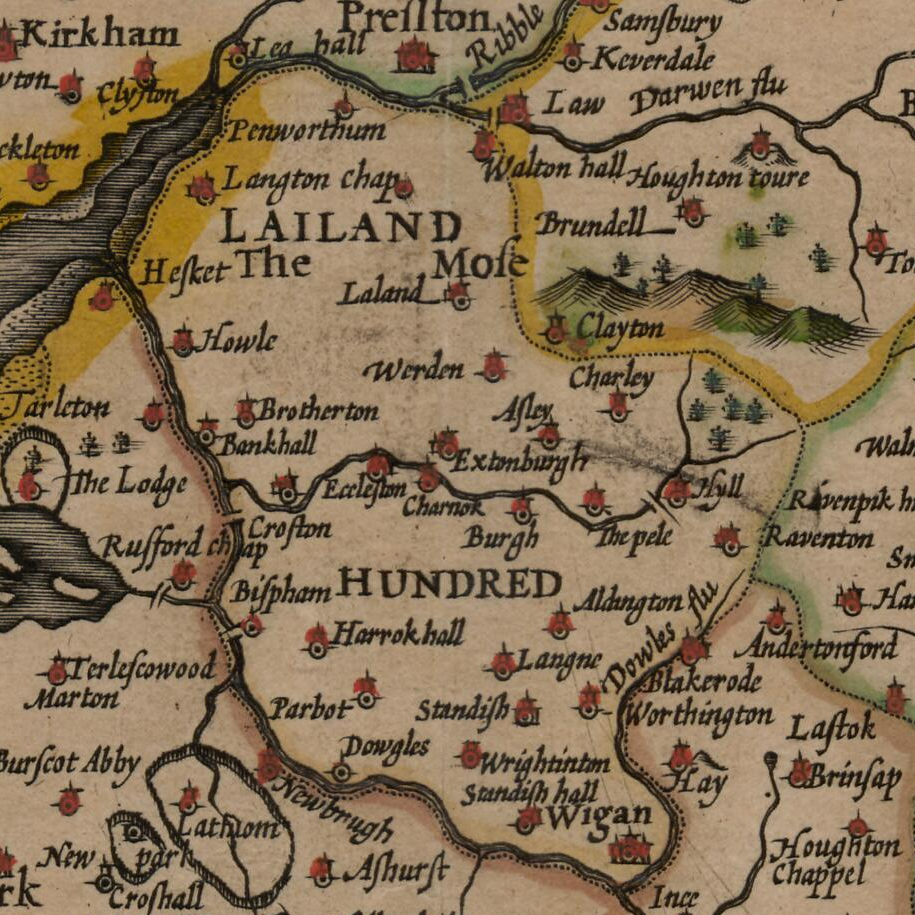
The Leyland Hundred (also known as Leylandshire) was a subdivision the historic county of Lancashire in England. It covered the parishes of Brindle, Chorley, Croston, Eccleston, Hoole, Leyland, Penwortham, Rufford, Standish and Tarleton.
In the Domesday Book the area was recorded as 'Lailand' Hundred, included in the returns for Cheshire. However, it cannot be said clearly to have been part of Cheshire.
Certainly there were links between Cheshire and south Lancashire before 1000, when Wulfric Spot held lands in both territories. Wulfric's estates remained grouped together after his death, when they were left to his brother Aelfhelm, and indeed there still seems to have been some kind of connexion in 1086, when south Lancashire was surveyed together with Cheshire by the Domesday commissioners. Nevertheless, the two territories do seem to have been distinguished from one another in some way and it is not certain that the shire-moot and the reeves referred to in the south Lancashire section of Domesday were the Cheshire ones.
The Domesday Survey (1086) included south Lancashire with Cheshire for convenience, but the Mersey, the name of which means 'boundary river' is known to have divided the kingdoms of Northumbria and Mercia and there is no doubt that this was the real boundary.
Hub AI
Leyland Hundred AI simulator
(@Leyland Hundred_simulator)
Leyland Hundred
The Leyland Hundred (also known as Leylandshire) was a subdivision the historic county of Lancashire in England. It covered the parishes of Brindle, Chorley, Croston, Eccleston, Hoole, Leyland, Penwortham, Rufford, Standish and Tarleton.
In the Domesday Book the area was recorded as 'Lailand' Hundred, included in the returns for Cheshire. However, it cannot be said clearly to have been part of Cheshire.
Certainly there were links between Cheshire and south Lancashire before 1000, when Wulfric Spot held lands in both territories. Wulfric's estates remained grouped together after his death, when they were left to his brother Aelfhelm, and indeed there still seems to have been some kind of connexion in 1086, when south Lancashire was surveyed together with Cheshire by the Domesday commissioners. Nevertheless, the two territories do seem to have been distinguished from one another in some way and it is not certain that the shire-moot and the reeves referred to in the south Lancashire section of Domesday were the Cheshire ones.
The Domesday Survey (1086) included south Lancashire with Cheshire for convenience, but the Mersey, the name of which means 'boundary river' is known to have divided the kingdoms of Northumbria and Mercia and there is no doubt that this was the real boundary.
Recent media