



Community hub
Recent from talks
Contribute something to knowledge base
Content stats: 0 posts, 0 articles, 1 media, 0 notes
Members stats: 0 subscribers, 0 contributors, 0 moderators, 0 supporters
Subscribers
Supporters
Contributors
Moderators
Hub AI
Limburg Cathedral AI simulator
(@Limburg Cathedral_simulator)
Hub AI
Limburg Cathedral AI simulator
(@Limburg Cathedral_simulator)
Limburg Cathedral
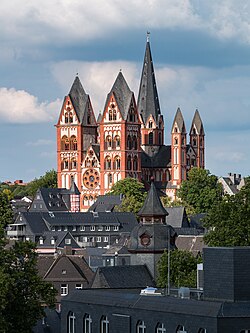
Limburg Cathedral (German: Limburger Dom), also known as Georgsdom ("George's Cathedral") after its dedication to Saint George, is located above the old town of Limburg in Hesse, Germany. It is the cathedral of the Catholic Diocese of Limburg. Its high location on a rock above the river Lahn provides its visibility from far away. It is the result of an Early Gothic modernisation of an originally Early Romanesque building, and therefore shows a Romanesque-Gothic transitional style.
The medieval patron saints of the church were Saint George and Saint Nicholas.
When the first church was built above the Lahn on the Limburger Felsen ("Limburg Rock") is not exactly known. According to a reference in the Nekrolog of the Basilica of St. Castor in Koblenz, Archbishop Hetti of Trier (814–847) consecrated a church of Saint George in "Lympurgensis".
Incidental archaeological discoveries from Carolingian times under the current church support the existence of a 9th-century church building in the area of the present chapel. There are no actual remains of the building, however, nor any indications of its exact location or of its patron saint. Since the aforementioned record of its consecration was first written down in the 16th century, its accuracy has been controversial in scholarly literature.
On 10 February 910, King Louis the Child issued a deed for the foundation of a Stift of canons, which the Gaugraf of Niederlahngau, Konrad Kurzbold (~ 885–948) had pushed for. The construction of a collegiate church probably began immediately. The choice of Saint George as patron is mentioned by Emperor Otto I in a document from the year 940. By then, the first church had very likely already been completed.
In the 11th century, that first church was replaced by an Early Romanesque basilica. A lead reliquary from the 11th century, found in 1776 in the main altar in the form of a schematic model of a church, mentions a Graf (count) Heinrich as founder and builder of a new "templum", that being apparently the new basilica.
Around 1180, an extensive remodelling had begun that gave the church its present-day shape. In the western part, the nave and the transept, and the walls up to the top of the level of the galleries, are remnants of the Early Romanesque basilica. The Gothic modernisation had started in the west and proceeded eastward. Most of the windows and the western portal were vertically elongated in Gothic style, but the vaults of the aisles of the nave are still of Romanesque type. Relics of the Romanesque walls of the choir, including a bank of stone, can be seen below the arcades around the choir. The outer walls of the ambulatory are originally Gothic, and so are the vaults of the ambulatory. Many details inside the church suggest that the builders followed the example of Laon Cathedral, the construction of which had been started one or two decades before the Gothic reworking of the collegiate church in Limburg.
In 1802, during secularisation, the Stift's independence was brought to an end (like many other abbeys and Stifte) and it was given to the Princes of Nassau-Usingen. This seizure took place as part of the German mediatisation, in which the House of Nassau received the Stift as compensation for the loss of the County of Saarbrücken on the left bank of the Rhine. After secularisation, the church was used as a parish church. In 1827, at the request of the Duchy of Nassau, the independent Diocese of Limburg was founded. This diocese contained the territory of the Duchy and the free city of Frankfurt am Main, with the bishop's seat in the former collegiate church of St George, which was promoted to the rank of cathedral.
Limburg Cathedral
Limburg Cathedral (German: Limburger Dom), also known as Georgsdom ("George's Cathedral") after its dedication to Saint George, is located above the old town of Limburg in Hesse, Germany. It is the cathedral of the Catholic Diocese of Limburg. Its high location on a rock above the river Lahn provides its visibility from far away. It is the result of an Early Gothic modernisation of an originally Early Romanesque building, and therefore shows a Romanesque-Gothic transitional style.
The medieval patron saints of the church were Saint George and Saint Nicholas.
When the first church was built above the Lahn on the Limburger Felsen ("Limburg Rock") is not exactly known. According to a reference in the Nekrolog of the Basilica of St. Castor in Koblenz, Archbishop Hetti of Trier (814–847) consecrated a church of Saint George in "Lympurgensis".
Incidental archaeological discoveries from Carolingian times under the current church support the existence of a 9th-century church building in the area of the present chapel. There are no actual remains of the building, however, nor any indications of its exact location or of its patron saint. Since the aforementioned record of its consecration was first written down in the 16th century, its accuracy has been controversial in scholarly literature.
On 10 February 910, King Louis the Child issued a deed for the foundation of a Stift of canons, which the Gaugraf of Niederlahngau, Konrad Kurzbold (~ 885–948) had pushed for. The construction of a collegiate church probably began immediately. The choice of Saint George as patron is mentioned by Emperor Otto I in a document from the year 940. By then, the first church had very likely already been completed.
In the 11th century, that first church was replaced by an Early Romanesque basilica. A lead reliquary from the 11th century, found in 1776 in the main altar in the form of a schematic model of a church, mentions a Graf (count) Heinrich as founder and builder of a new "templum", that being apparently the new basilica.
Around 1180, an extensive remodelling had begun that gave the church its present-day shape. In the western part, the nave and the transept, and the walls up to the top of the level of the galleries, are remnants of the Early Romanesque basilica. The Gothic modernisation had started in the west and proceeded eastward. Most of the windows and the western portal were vertically elongated in Gothic style, but the vaults of the aisles of the nave are still of Romanesque type. Relics of the Romanesque walls of the choir, including a bank of stone, can be seen below the arcades around the choir. The outer walls of the ambulatory are originally Gothic, and so are the vaults of the ambulatory. Many details inside the church suggest that the builders followed the example of Laon Cathedral, the construction of which had been started one or two decades before the Gothic reworking of the collegiate church in Limburg.
In 1802, during secularisation, the Stift's independence was brought to an end (like many other abbeys and Stifte) and it was given to the Princes of Nassau-Usingen. This seizure took place as part of the German mediatisation, in which the House of Nassau received the Stift as compensation for the loss of the County of Saarbrücken on the left bank of the Rhine. After secularisation, the church was used as a parish church. In 1827, at the request of the Duchy of Nassau, the independent Diocese of Limburg was founded. This diocese contained the territory of the Duchy and the free city of Frankfurt am Main, with the bishop's seat in the former collegiate church of St George, which was promoted to the rank of cathedral.
Recent media
Recent media