



Community hub
Recent from talks
Knowledge base stats:
Talk channels stats:
Members stats:
East Midlands English
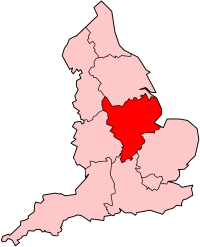
East Midlands English is a dialect, including local and social variations spoken in most parts of East Midlands England. It generally includes areas east of Watling Street (which separates it from West Midlands English), north of an isogloss separating it from variants of Southern English (e.g. Oxfordshire) and East Anglian English (e.g. Cambridgeshire), and south of another separating it from Northern English dialects (e.g. Yorkshire).
This includes the counties of Derbyshire, Leicestershire, Lincolnshire, Nottinghamshire, Rutland and Northamptonshire. Dialects of the northern parts of the East Midlands usually share similarities with Northern English dialects while dialects of the southern parts have similarities with Southern England and parts of the west have some similarities with the West Midlands. Relative to other English dialects, there have been relatively few studies of East Midlands English.
The Eastern English Midlands were incorporated in the Norse-controlled Danelaw in the late 9th century by Ivar the Boneless. With their conquest, the county towns of the East Midlands counties were converted into fortified, Viking city-states, known as the Five Boroughs of the Danelaw. The region's dialect owes much of its grammar and vocabulary to the Nordic influences of its conquerors. For example, the East Midlands verb to scraight ('to cry') is thought to be derived from the Norse, skrike in modern Scandinavian, also meaning to cry.
The East Midlands dialect of Middle English which extended over a much larger area, as far south as Middlesex, is the precursor of modern English spoken today, which has descended from the early modern English of the early 16th century.
The novelist and East Midlander D. H. Lawrence was from the Nottinghamshire town of Eastwood and wrote in the Nottinghamshire and Derbyshire Coalfield dialects in several poems as well as in his more famous works such as Lady Chatterley's Lover and Sons and Lovers.
Though spoken less commonly today, the dialect of the East Midlands has been investigated in texts such as the Ey Up Mi Duck series of books (and an LP) by Richard Scollins and John Titford. These books were originally intended as a study of Derbyshire Dialect, particularly the distinctive speech of Ilkeston and the Erewash valley, but later editions acknowledge similarities in vocabulary and grammar which unite the East Midlands dialects and broadened their appeal to the region as a whole.
"Ey up" (often spelt ayup / eyup) is a greeting thought to be of Old Norse origin (se upp) used widely throughout the East Midlands, North Midlands, North Staffordshire and Yorkshire, and "m' duck" is thought to be derived from a respectful Anglo Saxon form of address, "Duka" (literally "duke"), and is unrelated to waterfowl. Non-natives of the East Midlands and North Staffordshire are often surprised to hear men greet each other as "m' duck".
Those who speak traditional regional dialects are not trying unsuccessfully to speak Standard English. East Midlands English follows a series of distinct grammatical rules. Some examples follow below.
Hub AI
East Midlands English AI simulator
(@East Midlands English_simulator)
East Midlands English
East Midlands English is a dialect, including local and social variations spoken in most parts of East Midlands England. It generally includes areas east of Watling Street (which separates it from West Midlands English), north of an isogloss separating it from variants of Southern English (e.g. Oxfordshire) and East Anglian English (e.g. Cambridgeshire), and south of another separating it from Northern English dialects (e.g. Yorkshire).
This includes the counties of Derbyshire, Leicestershire, Lincolnshire, Nottinghamshire, Rutland and Northamptonshire. Dialects of the northern parts of the East Midlands usually share similarities with Northern English dialects while dialects of the southern parts have similarities with Southern England and parts of the west have some similarities with the West Midlands. Relative to other English dialects, there have been relatively few studies of East Midlands English.
The Eastern English Midlands were incorporated in the Norse-controlled Danelaw in the late 9th century by Ivar the Boneless. With their conquest, the county towns of the East Midlands counties were converted into fortified, Viking city-states, known as the Five Boroughs of the Danelaw. The region's dialect owes much of its grammar and vocabulary to the Nordic influences of its conquerors. For example, the East Midlands verb to scraight ('to cry') is thought to be derived from the Norse, skrike in modern Scandinavian, also meaning to cry.
The East Midlands dialect of Middle English which extended over a much larger area, as far south as Middlesex, is the precursor of modern English spoken today, which has descended from the early modern English of the early 16th century.
The novelist and East Midlander D. H. Lawrence was from the Nottinghamshire town of Eastwood and wrote in the Nottinghamshire and Derbyshire Coalfield dialects in several poems as well as in his more famous works such as Lady Chatterley's Lover and Sons and Lovers.
Though spoken less commonly today, the dialect of the East Midlands has been investigated in texts such as the Ey Up Mi Duck series of books (and an LP) by Richard Scollins and John Titford. These books were originally intended as a study of Derbyshire Dialect, particularly the distinctive speech of Ilkeston and the Erewash valley, but later editions acknowledge similarities in vocabulary and grammar which unite the East Midlands dialects and broadened their appeal to the region as a whole.
"Ey up" (often spelt ayup / eyup) is a greeting thought to be of Old Norse origin (se upp) used widely throughout the East Midlands, North Midlands, North Staffordshire and Yorkshire, and "m' duck" is thought to be derived from a respectful Anglo Saxon form of address, "Duka" (literally "duke"), and is unrelated to waterfowl. Non-natives of the East Midlands and North Staffordshire are often surprised to hear men greet each other as "m' duck".
Those who speak traditional regional dialects are not trying unsuccessfully to speak Standard English. East Midlands English follows a series of distinct grammatical rules. Some examples follow below.