Hubbry Logo
IsoglossIsoglossMain
Open search
Isogloss
Community hub
Isogloss
logo
8 pages, 0 posts
0 subscribers
Be the first to start a discussion here.
Isogloss
Isogloss
from Wikipedia
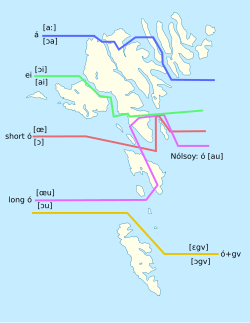
Isoglosses on the Faroe Islands
High German subdivides into Upper German (green) and Central German (cyan), and is distinguished from Low Franconian and Low German (yellow). The main isoglosses, the Benrath and Speyer lines, are marked in black.

An isogloss, also called a heterogloss, is the geographic boundary of a certain linguistic feature, such as the pronunciation of a vowel, the meaning of a word, or the use of some morphological or syntactic feature. Isoglosses are a subject of study in dialectology, in which they demarcate the differences between regional dialects of a language; in areal linguistics, in which they represent the extent of borrowing of features between languages in contact with one another; and in the wave model of historical linguistics, in which they indicate the similarities and differences between members of a language family.

Major dialects are typically demarcated by bundles of isoglosses, such as the Benrath line that distinguishes High German from the other West Germanic languages and the La Spezia–Rimini Line that divides the Northern Italian languages and Romance languages west of Italy from Central Italian dialects and Romance languages east of Italy. However, an individual isogloss may or may not have any coterminus with a language border. For example, the front-rounding of /y/ cuts across France and Germany, while the /y/ is absent from Italian and Spanish words that are cognates with the /y/-containing French words.

One of the best-known isoglosses is the centum–satem isogloss.

Similar to an isogloss, an isograph is a distinguishing feature of a writing system. Both concepts are also used in historical linguistics.

Etymology

[edit]

The term isogloss (Ancient Greek ἴσος ísos 'equal, similar' and γλῶσσα glōssa 'tongue, dialect, language') is inspired by contour lines, or isopleths, such as isobars. However, the isogloss separates rather than connects points. Consequently, it has been proposed for the term heterogloss (ἕτερος héteros 'other') to be used instead.[1]

Examples

[edit]

Centum–satem isogloss

[edit]

The centum–satem isogloss of the Indo-European language family relates to the different evolution of the dorsal consonants of Proto-Indo-European (PIE). In the standard reconstruction, three series of dorsals are recognised:

Labiovelars: *, *, *gʷʰ
Velars: *k, *g, *
Palatals: *, *ǵ, *ǵʰ

In some branches (for example Greek, Italic and Germanic), the palatals merged with the velars: PIE *keup- "tremble (inwardly)" became Latin cupiō "desire" and *m̥tom "hundred" became Latin centum (pronounced [kentum]); but *o- "interrogative pronoun" became quō "how? where?". They are known as centum branches, named after the Latin word for hundred.

In other branches (for example, Balto-Slavic and Indo-Iranian), the labiovelars merged with the velars: PIE *keup- became Vedic Sanskrit kopáyati "shaken" and *o- became Avestan "who?"; but *ḱm̥tom became Avestan satəm. They are known as satem branches, after the Avestan word for hundred.[2][3]

Since the Balto-Slavic family, the Indo-Iranian family, and the other satem families are spoken in adjacent geographic regions, they can be grouped by an isogloss: a geographic line separating satem branches on one side from centum branches on the other.

North–Midland isogloss (American English)

[edit]

A major isogloss in American English has been identified as the NorthMidland isogloss, which demarcates numerous linguistic features, including the Northern Cities vowel shift: regions north of the line (including Western New York; Cleveland, Ohio; lower Michigan; northern Illinois; and eastern Wisconsin) have the shift, while regions south of the line (including Pennsylvania, central and southern Ohio, and most of Indiana) do not.

Northwest Semitic

[edit]

A feature of the ancient Northwest Semitic languages is w becoming y at the beginning of a word. Thus, in Proto-Semitic and subsequent non-Northwest Semitic languages and dialects, the root letters for a word for "child" were w-l-d. However, in the ancient Northwest Semitic languages, the word was y-l-d, with w- > y-.

Similarly, Proto-Semitic ā becomes ō in the Canaanite dialects of Northwest Semitic.[4] Within the Aramaic languages and dialects of Northwest Semitic, the historic ā is preserved. Thus, an ancient Northwest Semitic language whose historic ā became ō can be classed as part of the Canaanite branch of Northwest Semitic.

Such features can be used as data of fundamental importance for the purposes of linguistic classification.

Isographs

[edit]

Just as there are distinguishing features of related languages, there are also distinguishing features of related scripts.[5]

For example, a distinguishing feature of the Iron Age Old Hebrew script is that the letters bet, dalet, ayin and resh do not have an open head, but contemporary Aramaic has open-headed forms. Similarly, the bet of Old Hebrew has a distinctive stance (it leans to the right), but the bet of the Aramaic and Phoenician scripts series has a different stance (in both, it leans to the left).

In 2006, Christopher Rollston suggested using the term isograph to designate a feature of the script that distinguishes it from a related script series, such as a feature that distinguishes the script of Old Hebrew from Old Aramaic and Phoenician.[6]

See also

[edit]
  • Areal feature – Linguistic feature arising through language contact rather than common descent
  • Dialect – Variant of a language
  • Dialectology – Scientific study of linguistic dialect
  • Dialect continuum – Geographic range of dialects that vary more strongly at the distant ends
  • Cultural boundary – Geographical area associated with a specific cultural orientation
  • Language border – Geolinguistic boundary between mutually intelligible speech communities
  • Joret line – Isogloss in northern France
  • Sprachbund – Languages similar by contact, not origin
  • Uerdingen line – Isogloss in German dialectology

References

[edit]

Bibliography

[edit]
[edit]
Revisions and contributorsEdit on WikipediaRead on Wikipedia
from Grokipedia
An isogloss is a geographic boundary line that delineates the area in which a distinctive linguistic feature, such as a specific , item, or grammatical pattern, occurs, separating regions where that feature is present from those where it is absent or differs. This concept is fundamental in , where isoglosses are mapped to visualize spatial variations in language use across populations. The term "isogloss" originates from the Greek words isos (equal or same) and glōssa ( or ), reflecting the idea of lines connecting areas with shared linguistic traits. It was coined in 1892 by the German-Baltic linguist August Johann Gottfried Bielenstein in his work on Latvian dialects, drawing inspiration from geographical terms like "isotherm." Although the concept of mapping linguistic boundaries predates the term—appearing implicitly in early dialect atlases such as Georg Wenker's Sprachatlas des Deutschen Reichs (1881)—Bielenstein's introduction formalized its use in linguistic geography. In practice, isoglosses rarely align perfectly for all features, often crossing or bundling to form complex patterns on dialect maps that reveal historical , migration, and . Bundles of multiple coinciding isoglosses typically mark major dialect boundaries, such as the in or the La Spezia-Rimini Line separating Western and Eastern Romance languages. These patterns help identify relic areas, transition zones, and the layered history of languages, though modern mobility can blur traditional isoglosses.

Definition and Fundamentals

Definition

An isogloss is defined as a geographic boundary separating regions that exhibit differing linguistic features across various domains, including , , , and morphology. This boundary delineates areas where a particular linguistic trait is present on one side and absent or variant on the other, reflecting patterns of dialectal variation within a . Traditionally, an isogloss has been conceptualized as a discrete line marking the transition between features, but recent linguistic discussions emphasize its reference to the areal extent—the space where a specific occurs—with the boundary line arising as a metonymic extension for analytical convenience. This refinement, highlighted in 2023 analyses, acknowledges that isoglosses represent projections of spatial constructions rather than empirically fixed lines, accommodating the continuity of linguistic change while maintaining their utility in identifying discrete units. Isoglosses are categorized by the type of linguistic feature they bound. Phonological isoglosses demarcate variations in sound patterns, such as vowel shifts or pronunciations that differ regionally. Lexical isoglosses highlight differences in , including distinct words or semantic shifts in meanings for equivalent concepts. Grammatical isoglosses, meanwhile, separate regions based on syntactic or morphological structures, such as varying rules for sentence formation or word . In the broader field of , these isoglosses provide essential tools for mapping and understanding areal .

Historical Context

The concept of the isogloss emerged in the late through the pioneering work of dialect geographers, particularly Georg Wenker, who initiated the Deutscher Sprachatlas in 1876 by surveying over 50,000 schoolteachers across German-speaking regions using 40 standardized sentences to capture phonetic and lexical variations. This massive postal questionnaire effort, published starting in 1881, visualized dialect boundaries on maps, implicitly introducing isoglosses as lines demarcating areas of linguistic uniformity versus difference, though without a formal term at the time. Wenker's atlas marked a shift from philological to empirical geographic methods in , emphasizing over historical reconstruction. The term "Isoglosse" was formally coined in 1892 by August Bielenstein in his study of Latvian dialects, drawing an analogy to scientific terms such as "isotherm" in meteorology or "isobar" to describe boundaries of linguistic features like vocabulary or pronunciation. This neologism, combining Greek "isos" (equal) and "glossa" (tongue), quickly entered German dialectology and spread to other European traditions, such as Jules Gilliéron's Atlas Linguistique de la France (1902–1910), which mapped Romance dialect isoglosses using field interviews. By the early 20th century, isoglosses became central to pre-World War II European surveys, including Italian and Spanish linguistic atlases, where bundles of coinciding lines were used to delineate major dialect regions. A key milestone was the integration of isoglosses into areal linguistics via Nikolai Trubetzkoy's theory, formalized in his 1928 paper at the , which described "language unions" like the as areas where shared innovations cross genetic boundaries, defined by converging isoglosses rather than strict genealogical lines. This wave-model approach, building on Johannes Schmidt's 1872 Wellentheorie, highlighted diffusion over divergence, influencing studies of multilingual contact zones. Post-1950s, the concept evolved from static structuralist views—treating isoglosses as fixed relics of sound laws—to dynamic sociolinguistic perspectives, incorporating migration, social networks, and contact as factors blurring boundaries, as seen in William Labov's 1963 study, which linked linguistic shifts to community identity. This transition emphasized fuzzy, probabilistic isoglosses over sharp lines, reflecting urban and mobile populations. Technological advances further transformed isogloss analysis: while early 20th-century work relied on hand-drawn paper maps and overlays, 21st-century digital tools like GIS-based platforms (e.g., REDE SprachGIS since 2015) and web applications (e.g., Gabmap) enable interactive mapping, quantitative overlay of large datasets, and simulation of diffusion patterns for more precise identification of isoglosses.

Etymology and Terminology

Etymology

The term isogloss derives from Ancient Greek ἴσος (ísos, "equal" or "similar") and γλῶσσα (glôssa, "tongue" or "language"), forming a compound that literally means "equal-tongue" or "similar language," reflecting lines or boundaries where linguistic features remain consistent. The original German term was Isoglosse. This neologism was intentionally modeled on scientific terminology to denote geographic boundaries of uniform linguistic traits, much like contour lines in cartography. The word was first coined in 1892 by the Baltic German linguist August Johann Gottfried Bielenstein in his atlas Die Grenzen des lettischen Volksstammes und der lettischen Sprache in der Gegenwart und im 13. Jahrhundert on Latvian dialectology, where he applied it to map dialect divisions with explicit analogy to meteorological terms such as isotherm (equal temperature) and isobar (equal pressure). Bielenstein's innovation borrowed from German linguistic scholarship, adapting the prefix iso-—popularized in 19th-century sciences—to dialect mapping, thereby establishing a precise tool for visualizing linguistic variation. In some contexts, isogloss is alternatively termed heterogloss, emphasizing the boundary where linguistic features rather than converge, though this variant is less common in modern . Heterogloss serves as an alternative designation for isogloss in some linguistic contexts, denoting the geographic boundary separating areas with differing linguistic features, such as phonological or lexical variations. This term highlights the in features across the boundary, in contrast to the "iso-" prefix in isogloss, which etymologically implies zones of relative uniformity on either side. A describes a chain of mutually intelligible dialects distributed across a geographic , where adjacent varieties exhibit minimal differences, but cumulative variations lead to unintelligibility over greater distances. Within a , isoglosses typically mark subtle, transitional shifts rather than abrupt demarcations, illustrating the fluid nature of dialectal evolution through spatial proximity and interaction. In , the term locus refers to the geographic position or location of an isogloss, such as why it follows a particular path influenced by , settlement patterns, or communication barriers. This concept helps explain the placement of isoglosses in relation to physical and . , or linguistic area, designates a geographic zone where genetically unrelated languages converge on shared structural traits—such as or morphology—due to extended contact and borrowing, rather than common ancestry. Unlike isoglosses that primarily delineate intra-language boundaries, those in a often span multiple languages, reflecting areal diffusion. These terms interconnect in dialectological analysis: for instance, bundles of isoglosses may delineate segments of a , with loci identifying key positions within it, while Sprachbünde demonstrate how cross-linguistic isoglosses foster convergence beyond genetic ties.

Key Concepts

Dialect Boundaries

Isoglosses form as linguistic boundaries through processes of feature divergence driven by geographic isolation, which limits interaction and allows distinct phonological, lexical, or syntactic traits to develop independently in separated speech communities. Migration further contributes by relocating speakers and introducing variations from contact zones, while social barriers, such as class or ethnic divisions, restrict and reinforce local norms. , conversely, can initiate divergence when borrowing or interference creates hybrid features that spread unevenly, leading to transitional zones where traits overlap. These mechanisms collectively produce isoglosses as markers of gradual or abrupt separation in continua. Dialect boundaries delineated by isoglosses vary in sharpness, with discrete changes occurring where features shift abruptly across a line, often due to strong pressures or physical obstacles that halt . In contrast, transitional boundaries manifest as gradual clines, where linguistic traits vary incrementally over space, reflecting ongoing contact and blending in fluid populations. blurs these lines by increasing mobility and mixing, which erodes sharp distinctions through accelerated feature exchange in dense, interconnected areas. Such dynamics highlight how isoglosses adapt to environmental and social contexts, with surface tension-like forces smoothing irregular boundaries over time. In , isoglosses signal dialect divergence by tracing the spread of innovations that accumulate in isolated subgroups, supporting tree models where bifurcations represent splits from a common ancestor. They also indicate convergence when shared traits cross-cut lineages, aligning with wave models that depict across continua rather than discrete branches. This duality allows isogloss patterns to reveal both hierarchical splits and networked overlaps, informing hybrid approaches to reconstructing linguistic histories. Influencing factors such as demographic shifts, including population migrations and density gradients, propel isogloss migration and reshape boundaries by altering interaction frequencies. Media influence typically reinforces existing changes rather than initiating them, disseminating standardized forms that may weaken peripheral isoglosses post-diffusion. Standardization efforts, through and policy, further strengthen central boundaries by promoting uniform norms while diminishing variation in contact-heavy regions. Social networks modulate these effects, with dense ties preserving isogloss and weak ties facilitating erosion via innovation spread. Bundles emerge where multiple isoglosses concentrate, amplifying boundary salience.

Isogloss Bundles

An isogloss bundle refers to a cluster of two or more isoglosses—geographic boundaries delineating distinct linguistic features—that coincide closely in location, often involving three or more such lines to form a reinforced division. These bundles are characterized by their alignment, which strengthens the indication of major splits or even language borders, as opposed to isolated isoglosses that may represent minor variations. The degree of bundling reflects the consistency among features, such as phonological, lexical, or morphological traits, creating patterns that highlight homogeneity on one side and divergence on the other. Isogloss bundles typically form through prolonged linguistic isolation or historical events, including migrations, settlements, or geographic barriers that limit interaction between speech communities. Such alignments arise when multiple independent changes, like sound shifts or lexical innovations, occur in parallel due to shared social or environmental factors, resulting in "dialect areas" where features reinforce each other. For instance, and conformity pressures can drive these coincidences, minimizing boundary lengths analogous to in physical systems. In theoretical terms, isogloss bundles serve as key evidence for identifying subgroups within proto-languages, where shared innovations cluster to suggest common ancestry or divergence points. They also highlight relic areas, preserving archaic features amid surrounding innovations, thus illuminating historical stratification in evolution. Single isoglosses act as foundational elements, but bundles amplify their reliability in delineating enduring regions. However, isogloss bundles are not invariably permanent; they can shift or dissipate due to cultural exchanges, mobility, or ongoing , leading to blurred or relocated boundaries over time. Their clarity varies by region, with diffuse or complex areas showing weaker alignments compared to sharply defined ones.

Examples

Indo-European Centum-Satem

The centum-satem isogloss represents a fundamental phonological division within the , arising from differing evolutions of the Proto-Indo-European () palatal and velar stops. In centum languages, the palatal series (*ḱ, *ǵ, *ǵh) merged with the plain velars (*k, *g, *gh), preserving them as velar or labiovelar sounds such as /k/ or /kw/. In contrast, satem languages underwent a palatalization process where the palatals shifted to or affricates, typically /s/, /z/, /ʃ/, or /tʃ/, while plain velars remained distinct. This split is exemplified by the PIE word *ḱm̥tóm 'hundred', which developed into Latin centum (pronounced /ˈkentum/) in centum branches and satəm (pronounced /ˈsatəm/) in satem branches. Geographically, the isogloss delineates a broad west-east boundary across the Indo-European dispersal area, separating western centum branches—such as Italic (e.g., Latin), Celtic, Germanic, Hellenic (Greek), Anatolian, and Tocharian—from eastern satem branches, including Indo-Iranian (, ), Balto-Slavic (Lithuanian, Russian), and Armenian. This division roughly follows a line from the through to the and extends into , reflecting an areal rather than strictly genetic split, with some languages like Albanian exhibiting transitional features that preserve elements of both. The isogloss's path underscores the dialect continuum in early Indo-European speech communities, where innovations spread unevenly across regions. Historically, the centum-satem divergence signals an early dialectal fragmentation within , likely emerging during the 4th millennium BCE or earlier as part of the broader dispersal of Proto-Indo-European speakers, estimated around 6000–4000 BCE in recent linguistic and genetic studies. This phonological provides key evidence for reconstructing the internal dynamics of , highlighting how sound changes like satem palatalization may have originated in eastern dialects before spreading, while centum mergers occurred independently in western ones. The isogloss often intersects with other early features, such as the RUKI law in satem languages, forming bundles that reinforce the east-west divide. In contemporary , remnants of the centum-satem isogloss persist in lexical cognates, illustrating its enduring impact. For instance, English hundred derives from PIE *ḱm̥tóm through Germanic centum development, where the initial palatal became /h/ via (/k/ > /x/ > /h/), while Russian sto 'hundred' reflects the satem sibilant shift from the same root. Similar patterns appear in other vocabulary, such as Greek kardia 'heart' (centum /k/) versus Avestan *zərəd- 'heart' (satem /z/ from *ḱṛd-), demonstrating how this ancient phonological boundary continues to shape modern word forms across and .

American English North-Midland

The North-Midland represents a prominent boundary in , separating the Inland North dialect region to the north from the North Midland to the south, and highlighting differences in both vocabulary and pronunciation that reflect historical linguistic divergence. This boundary functions as a classic example of an , where multiple linguistic features align to demarcate regional speech patterns without forming an absolute divide. A key lexical feature along this isogloss involves terms for carbonated soft drinks, with "pop" predominating in the Inland North and much of the North Midland, while "soda" is more common in the eastern and southern extensions of the Midland, as well as the Northeast. This variation, elicited through questions like "What's the general term for a carbonated drink?" in surveys, shows high regional consistency, with "pop" usage aligning closely with the broader North-Midland phonological patterns (Map 21.1). Phonologically, the absence of the cot-caught merger in the Inland North contrasts with its presence in the North Midland, where the low back vowels in words like "cot" (/ɑ/) and "caught" (/ɔ/) are merged into a single sound, typically [ɑ]. This merger, assessed via minimal pairs and acoustic measurements, covers over half of but skips the Inland North, creating a historically sharp isogloss that reinforces the dialect divide, though recent studies show some encroachment of the merger into the Inland North as of the 2020s (Map 9.1). Geographically, the North-Midland boundary extends approximately from westward through , , , , , and into , forming a transitional zone influenced by 19th-century settlement patterns. Northern areas were primarily settled by migrants from and , carrying dialect traits, while the Midland drew from and Appalachian sources, including Scotch-Irish and German settlers, which contributed to distinct phonological and lexical developments. Data from the (2006), based on telephone surveys of over 800 urban speakers, reveal urban-rural variations, with urban centers advancing sound changes like the merger more uniformly than rural pockets, though the isogloss holds across both. These patterns underscore how migration streams from New England versus shaped the cultural and linguistic fabric of the region.

Semitic Northwest

The Northwest Semitic isogloss delineates a within the Semitic language family, encompassing languages spoken primarily in the , including Canaanite dialects such as Hebrew, Phoenician, Moabite, Ammonite, and Edomite, as well as and its varieties. This boundary separates Northwest Semitic from East Semitic (exemplified by Akkadian in ) to the east and Central Semitic (including ) to the south and southeast, with the geographic divide roughly aligning along the River and the eastern edges of the from the BCE onward. The isogloss bundle highlights shared innovations that distinguish these languages, reflecting migrations and cultural interactions in the ancient Near East. A prominent phonological isogloss for Northwest Semitic involves the shift of initial *w- to y-, as in Proto-Semitic *w- > y- in forms like *walad- "child" becoming yald in Hebrew and Aramaic, contrasting with walad in Arabic. Another key distinction lies in the development of emphatic consonants, where Northwest Semitic languages, particularly Aramaic, exhibit a tendency toward fricative realizations or mergers differing from the pharyngealized emphatics preserved in Central Semitic Arabic; for instance, Proto-Semitic *ś (emphatic sibilant) merges to š (as in shin) in Aramaic and Canaanite, while becoming emphatic ṣ in Arabic. These shifts, along with sibilant mergers (e.g., *š and *ś to š), form a diagnostic bundle that underscores the subgroup's unity against broader Semitic patterns. Grammatically, the loss of the inherited Proto-Semitic case system—nominative, accusative, and genitive—is a defining isogloss for Northwest Semitic branches, occurring early in both Canaanite and , unlike its retention in Akkadian and . This erosion, evident by the late 2nd millennium BCE, led to innovations like prepositional replacements for case endings and the of pronouns as direct object markers (e.g., Hebrew ʾet). Historical for these features appears in ancient texts, such as inscriptions from the 14th–12th centuries BCE in the northern , which show case remnants but align phonologically with later Northwest Semitic (e.g., initial w > y), in contrast to Akkadian cuneiform records from preserving full cases and distinct emphatics. In modern times, traces of the Northwest Semitic isogloss persist in revived Hebrew, which retains Canaanite phonological mergers and grammatical structures like verbless clauses, and in Aramaic-influenced dialects, where substrate effects include shared vocabulary and simplified case-like distinctions via particles. These enduring features illustrate how the ancient isogloss continues to shape linguistic diversity in the region, bridging biblical-era languages with contemporary usage.

Mapping and Visualization

Isogloss Mapping Techniques

Traditional methods for mapping isoglosses primarily involve field surveys and structured questionnaires administered to local informants to gather data on linguistic features across geographic areas. These approaches, foundational to dialect geography, typically entail researchers or trained fieldworkers visiting communities to record pronunciations, vocabulary, and grammatical variations through direct interviews or by distributing questionnaires to reliable respondents such as schoolteachers. A seminal example is Georg Wenker's method from the , where he mailed questionnaires containing 40 standardized sentences to over 50,000 schoolmasters across the to elicit dialectal responses, enabling the compilation of the first comprehensive linguistic atlas with hand-drawn isoglosses based on aggregated data. Similarly, the Linguistic Atlas of the Middle and South Atlantic States (LAMSAS), conducted from to the 1970s, employed fieldworkers who interviewed over 1,100 s using a detailed of 800+ items, recording responses in phonetic notation and standard to facilitate manual plotting of isoglosses on maps. These techniques rely on data points to delineate boundaries where linguistic features change, often drawing isoglosses as lines separating areas of presence versus absence of a feature. In modern , digital tools have transformed isogloss mapping by enabling precise overlaying and analysis of large datasets. Geographic Information Systems (GIS) software allows researchers to informant responses or feature occurrences as spatial layers, apply overlay functions to bundle multiple isoglosses, and generate boundary lines automatically, improving accuracy over manual drawing. Corpus analysis complements this by extracting linguistic features from digitized text or speech corpora, quantifying variation across regions to infer isogloss positions through statistical measures of divergence rather than discrete boundaries. Crowdsourced data, collected via mobile apps since the , further expands coverage; for instance, the English Dialects App (launched in ) gathers user-submitted responses to dialect quizzes and audio recordings from thousands of participants, which can be mapped to reveal emerging isogloss patterns in real-time. Despite these advances, mapping isoglosses presents challenges, particularly in handling fuzzy boundaries where linguistic features transition gradually rather than abruptly, often forming clines that defy sharp lines. sparsity, common in traditional surveys with limited sampling sites, exacerbates this by creating gaps that require interpolation methods—such as or in GIS—to estimate feature distributions between points and smooth clinal variations. These techniques derive isoglosses or isographs as probabilistic boundaries rather than fixed lines, accounting for uncertainty in continua.

Isographs

An isograph is a line on a dialect map that connects adjacent regions exhibiting the smallest percentage differences in the usage of specific linguistic variants, such as phonological, lexical, or morphological traits, providing a quantitative visualization of dialect similarities and trends. This tool highlights spatial patterns in multivariate data, offering a more nuanced alternative to traditional binary isoglosses. The construction of isographs involves plotting variant usage proportions across surveyed locations, often from dialect questionnaires or corpora. Lines are drawn between neighboring regions with the minimal calculated percentage differences, forming networks that reveal clusters of similarity; graph-based algorithms in software facilitate this process for clarity and efficiency. Solid lines may represent strong connections, while dashed lines indicate weaker or transitional links. In interpretation, the alignment of multiple isographs indicates robust divisions, where converging lines suggest historical or social influences. Color-coding can differentiate feature types—for instance, red for phonological variants and blue for lexical ones—enabling analysis of convergence or divergence patterns. Isographs gained prominence in late 20th- and early 21st-century dialect topography projects, such as the Dialect Topography of (1999–2002), which applied them to map dialects using large-scale respondent data. Their use has advanced with computational tools, including GIS for automated network generation and dynamic visualizations of complex datasets.

Significance and Applications

In Historical Linguistics

In historical linguistics, isoglosses serve as crucial evidence for reconstructing proto-languages by identifying shared innovations that define subgroups within language families. These innovations, such as phonological shifts or morphological patterns unique to a set of languages, indicate descent from a common intermediate , allowing linguists to posit genetic relationships and trace divergence from ancestral forms. For instance, bundles of isoglosses—concentrations of coinciding linguistic boundaries—provide stronger support for subgrouping than isolated features, as they reflect coordinated historical developments rather than sporadic changes. Methodologically, comparative analysis of isogloss bundles enables the dating of language divergences by examining the layering and overlap of innovations, often visualized through glottometric diagrams that sequence splits chronologically. This approach integrates the traditional model, which assumes bifurcating lineages, with the wave model, accommodating areal diffusion where innovations spread across boundaries via contact, thus refining reconstructions of family trees. Such methods emphasize exclusively shared innovations to validate subgroups while accounting for incomplete lineage sorting, where overlapping isoglosses challenge strict hierarchical structures. Isoglosses have been generally applied in the reconstruction of major language families, including Indo-European and Austronesian, where they help delineate branches and infer prehistoric dispersals without relying solely on lexical correspondences. In these contexts, bundles act as key indicators of historical cohesion, supporting the identification of proto-forms and cultural inferences tied to linguistic evolution. However, limitations arise because borrowing through can mimic genuine shared innovations, creating false isoglosses that suggest non-genetic affiliations and complicate subgrouping. Linguists must therefore exercise caution, cross-verifying isoglosses against multiple lines of evidence to distinguish inherited features from diffused ones.

In Sociolinguistics

In , isoglosses serve as boundaries that delineate linguistic variations tied to social identities, where speakers use dialect features to signal group affiliations or personal stances, often reinforcing communal bonds or individual agency. These lines frequently correlate with , as higher-status groups tend to favor standardized forms associated with overt prestige, while working-class varieties may carry linked to solidarity and authenticity. Migration patterns further shape isoglosses by introducing , leading to shifts where immigrant communities blend features from origin and host dialects, altering traditional boundaries through intergenerational transmission. accelerates this dynamic, promoting dialect leveling and hybrid forms as increased mobility and media exposure diffuse features across former isoglosses, thereby weakening rigid demarcations. Isoglosses find practical applications in examining language prestige, where they highlight how certain dialects gain or lose social value, influencing speaker attitudes and usage patterns in stratified societies. In multilingual settings, these boundaries inform studies of , a strategy speakers employ to navigate social contexts, such as alternating between dialects to assert identity or accommodate interlocutors across isogloss lines. For minority dialects, isogloss analysis supports development, including revitalization efforts that recognize these boundaries in educational programs and community initiatives to preserve linguistic diversity amid pressures from dominant varieties. Modern research in urban dialectology, particularly post-2000, leverages digital tools to track how isoglosses evolve, revealing through processes like feature diffusion in densely connected populations. Studies using data demonstrate that platforms facilitate the spread of dialectal elements among younger , blurring traditional isoglosses as informal interactions promote convergence over isolation. For instance, geospatial analysis of shows higher rates of variation diffusion in urban networks, underscoring the role of digital communication in reconfiguring dialect boundaries. Interdisciplinary connections to emphasize isoglosses as markers of cultural practices within ethnic enclaves, where linguistic boundaries reflect and sustain community structures and shared heritage. boundaries often function as social markers, indexing identity and group membership in ways that align linguistic variation with broader ethnographic patterns.

References

Add your contribution
Related Hubs
User Avatar
No comments yet.