



Community hub
Recent from talks
Contribute something to knowledge base
Content stats: 0 posts, 0 articles, 1 media, 0 notes
Members stats: 0 subscribers, 0 contributors, 0 moderators, 0 supporters
Subscribers
Supporters
Contributors
Moderators
Hub AI
Linear motor AI simulator
(@Linear motor_simulator)
Hub AI
Linear motor AI simulator
(@Linear motor_simulator)
Linear motor
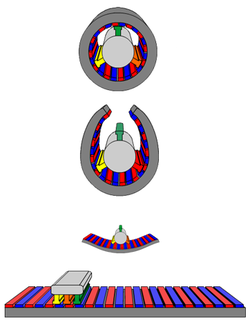
A linear motor is an electric motor that has had its stator and rotor "unrolled", thus, instead of producing a torque (rotation), it produces a linear force along its length. However, linear motors are not necessarily straight. Characteristically, a linear motor's active section has ends, whereas more conventional motors are arranged as a continuous loop.
Linear motors are used by the millions in high accuracy CNC machining and in industrial robots. In 2024, this market was USD 1.8 billion.
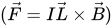
A typical mode of operation is as a Lorentz-type actuator, in which the applied force is linearly proportional to the current and the magnetic field .
Many designs have been put forward for linear motors, falling into two major categories, low-acceleration and high-acceleration linear motors. Low-acceleration linear motors are suitable for maglev trains and other ground-based transportation applications. High-acceleration linear motors are normally rather short, and are designed to accelerate an object to a very high speed; for example, see the coilgun.
High-acceleration linear motors are used in studies of hypervelocity collisions, as weapons, or as mass drivers for spacecraft propulsion.[citation needed] They are usually of the AC linear induction motor (LIM) design with an active three-phase winding on one side of the air-gap and a passive conductor plate on the other side. However, the direct current homopolar linear motor railgun is another high acceleration linear motor design. The low-acceleration, high speed and high power motors are usually of the linear synchronous motor (LSM) design, with an active winding on one side of the air-gap and an array of alternate-pole magnets on the other side. These magnets can be permanent magnets or electromagnets. The motor for the Shanghai maglev train, for instance, is an LSM.
Brushless linear motors are members of the Synchronous motor family. They are typically used in standard linear stages or integrated into custom, high performance positioning systems. Invented in the late 1980s by Anwar Chitayat at Anorad Corporation, now Rockwell Automation, and helped improve the throughput and quality of industrial manufacturing processes.
Brushed linear motors were used in industrial automation applications prior to the invention of Brushless linear motors. Compared with three-phase brushless motors, which are typically being used today, brush motors operate on a single phase. Brush linear motors have a lower cost since they do not need moving cables or three-phase servo drives. However, they require higher maintenance since their brushes wear out.
In this design the rate of movement of the magnetic field is controlled, usually electronically, to track the motion of the rotor. For cost reasons synchronous linear motors rarely use commutators, so the rotor often contains permanent magnets, or soft iron. Examples include coilguns and the motors used on some maglev systems, as well as many other linear motors. In high precision industrial automation linear motors are typically configured with a magnet stator and a moving coil. A Hall effect sensor is attached to the rotor to track the magnetic flux of the stator. The electric current is typically provided from a stationary servo drive to the moving coil by a moving cable inside a cable carrier.
Linear motor
A linear motor is an electric motor that has had its stator and rotor "unrolled", thus, instead of producing a torque (rotation), it produces a linear force along its length. However, linear motors are not necessarily straight. Characteristically, a linear motor's active section has ends, whereas more conventional motors are arranged as a continuous loop.
Linear motors are used by the millions in high accuracy CNC machining and in industrial robots. In 2024, this market was USD 1.8 billion.
A typical mode of operation is as a Lorentz-type actuator, in which the applied force is linearly proportional to the current and the magnetic field .
Many designs have been put forward for linear motors, falling into two major categories, low-acceleration and high-acceleration linear motors. Low-acceleration linear motors are suitable for maglev trains and other ground-based transportation applications. High-acceleration linear motors are normally rather short, and are designed to accelerate an object to a very high speed; for example, see the coilgun.
High-acceleration linear motors are used in studies of hypervelocity collisions, as weapons, or as mass drivers for spacecraft propulsion.[citation needed] They are usually of the AC linear induction motor (LIM) design with an active three-phase winding on one side of the air-gap and a passive conductor plate on the other side. However, the direct current homopolar linear motor railgun is another high acceleration linear motor design. The low-acceleration, high speed and high power motors are usually of the linear synchronous motor (LSM) design, with an active winding on one side of the air-gap and an array of alternate-pole magnets on the other side. These magnets can be permanent magnets or electromagnets. The motor for the Shanghai maglev train, for instance, is an LSM.
Brushless linear motors are members of the Synchronous motor family. They are typically used in standard linear stages or integrated into custom, high performance positioning systems. Invented in the late 1980s by Anwar Chitayat at Anorad Corporation, now Rockwell Automation, and helped improve the throughput and quality of industrial manufacturing processes.
Brushed linear motors were used in industrial automation applications prior to the invention of Brushless linear motors. Compared with three-phase brushless motors, which are typically being used today, brush motors operate on a single phase. Brush linear motors have a lower cost since they do not need moving cables or three-phase servo drives. However, they require higher maintenance since their brushes wear out.
In this design the rate of movement of the magnetic field is controlled, usually electronically, to track the motion of the rotor. For cost reasons synchronous linear motors rarely use commutators, so the rotor often contains permanent magnets, or soft iron. Examples include coilguns and the motors used on some maglev systems, as well as many other linear motors. In high precision industrial automation linear motors are typically configured with a magnet stator and a moving coil. A Hall effect sensor is attached to the rotor to track the magnetic flux of the stator. The electric current is typically provided from a stationary servo drive to the moving coil by a moving cable inside a cable carrier.
Recent media
Recent media