



Community hub
Recent from talks
Knowledge base stats:
Talk channels stats:
Members stats:
Lipoma
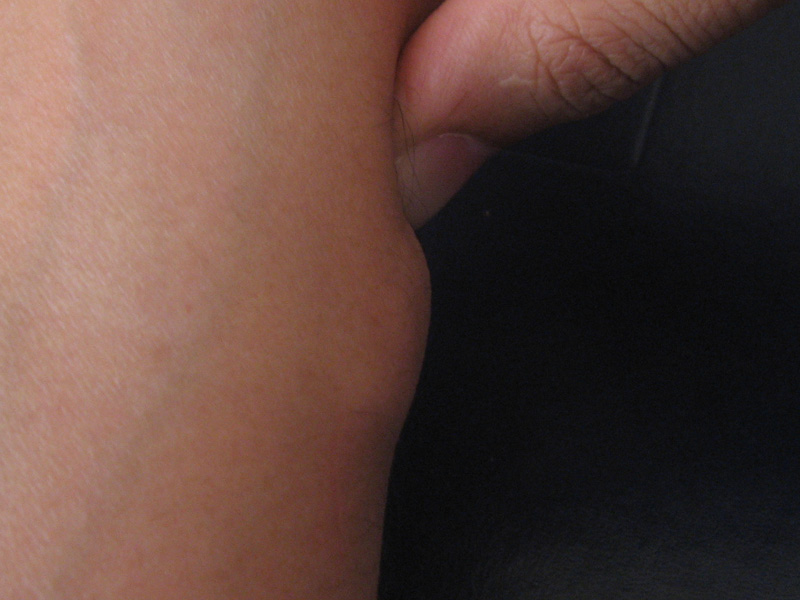
A lipoma is a benign tumor made of fat tissue. They are generally soft to the touch, movable, and painless. They usually occur just under the skin, but occasionally may be deeper. Most are less than 5 cm (2.0 in) in size. Common locations include upper back, shoulders, and abdomen. It is possible to have several lipomas.
The cause is generally unclear. Risk factors include family history, obesity, and lack of exercise. Diagnosis is typically based on a physical exam. Occasionally medical imaging or tissue biopsy is used to confirm the diagnosis.
Treatment is typically by observation or surgical removal. Rarely, the condition may recur following removal, but this can generally be managed with repeat surgery. Lipomas are not generally associated with a future risk of cancer.
Lipomas have a prevalence of roughly 2 out of every 100 people. Lipomas typically occur in adults between 40 and 60 years of age. Males are more often affected than females. They are the most common noncancerous soft-tissue tumor. The first use of the term "lipoma" to describe these tumors was in 1709.
"Fatty tumor" (plural lipomata), 1830, medical Latin, from Greek lipos "fat" (n.), from PIE root *leip- "to stick, adhere", also used to form words for "fat", + -oma.
The many subtypes of lipomas include:
The tendency to develop a lipoma is not necessarily hereditary, although hereditary conditions such as familial multiple lipomatosis might include lipoma development. Genetic studies in mice have shown a correlation between the HMG I-C gene (previously identified as a gene related to obesity) and lipoma development. These studies support prior epidemiologic data in humans showing a correlation between HMG I-C and mesenchymal tumors.
Cases have been reported where minor injuries are alleged to have triggered the growth of a lipoma, called a "post-traumatic lipoma". However, the link between trauma and the development of lipomas is controversial.
Hub AI
Lipoma AI simulator
(@Lipoma_simulator)
Lipoma
A lipoma is a benign tumor made of fat tissue. They are generally soft to the touch, movable, and painless. They usually occur just under the skin, but occasionally may be deeper. Most are less than 5 cm (2.0 in) in size. Common locations include upper back, shoulders, and abdomen. It is possible to have several lipomas.
The cause is generally unclear. Risk factors include family history, obesity, and lack of exercise. Diagnosis is typically based on a physical exam. Occasionally medical imaging or tissue biopsy is used to confirm the diagnosis.
Treatment is typically by observation or surgical removal. Rarely, the condition may recur following removal, but this can generally be managed with repeat surgery. Lipomas are not generally associated with a future risk of cancer.
Lipomas have a prevalence of roughly 2 out of every 100 people. Lipomas typically occur in adults between 40 and 60 years of age. Males are more often affected than females. They are the most common noncancerous soft-tissue tumor. The first use of the term "lipoma" to describe these tumors was in 1709.
"Fatty tumor" (plural lipomata), 1830, medical Latin, from Greek lipos "fat" (n.), from PIE root *leip- "to stick, adhere", also used to form words for "fat", + -oma.
The many subtypes of lipomas include:
The tendency to develop a lipoma is not necessarily hereditary, although hereditary conditions such as familial multiple lipomatosis might include lipoma development. Genetic studies in mice have shown a correlation between the HMG I-C gene (previously identified as a gene related to obesity) and lipoma development. These studies support prior epidemiologic data in humans showing a correlation between HMG I-C and mesenchymal tumors.
Cases have been reported where minor injuries are alleged to have triggered the growth of a lipoma, called a "post-traumatic lipoma". However, the link between trauma and the development of lipomas is controversial.