
Recent from talks
List of Korean War flying aces
Knowledge base stats:
Talk channels stats:
Members stats:
List of Korean War flying aces
Dozens of aviators were credited as flying aces in the Korean War from 1950 to 1953. The number of total flying aces, who are credited with downing five or more enemy aircraft in air-to-air combat, is disputed in the war.
The Korean War saw the first widespread use of jet engine-powered fighter aircraft for both sides of a war. Subsequently, difficulty arose in crediting the number of victories for each side, thanks in part to poor records, intentional overestimation, and the difficulty of confirming crashes in MiG Alley, where the majority of air-to-air combat took place in the war. As a result, there is a large discrepancy on both sides as to the number of victories claimed versus aircraft lost, and it is extremely difficult to determine the accuracy of many victories. The ace status of dozens of pilots still remains in question.
Aviators from four nations may have qualified as aces during the Korean War; between six and nine aces have been estimated for China and up to four in North Korea. Pilots of the Soviet Union had the most difficulty confirming victories and accurately determining which pilots achieved ace status, and between 34 and 60 pilots from that nation have been postulated as possible aces in the war. For the United Nations, the United States was the only country with pilots to attain ace status, with 40. No pilot from another UN country attained ace status, though many claimed victories. Among these, Royal Canadian Air Force pilot Ernest A. Glover claimed three victories.
The status of many claimed aces in the Korean War has been increasingly debated as more data becomes available, showing that instances of over-claiming abounded on both sides.
An example of this occurred on 20 May 1951, when the war's largest fighter battle to date took place between 28 F-86 Sabres and 30 MiG-15s. After this battle the Americans claimed three MiGs (including two for James Jabara) and the Soviets claimed four Sabres (including one for Yevgeny Pepelyaev). In fact, each side lost only one aircraft.
The Americans claimed that Jabara was their first jet ace after the 20 May combat but, apart from the discrepancy on that date, he was also credited with a kill in a 12 April 1951 combat in which the Americans claimed a total of 11 MiGs shot down when the Soviets actually lost only one fighter. For their part, the Soviets claimed 15 Boeing B-29 kills on that date when the Americans only lost four in the combat itself and six written-off later.
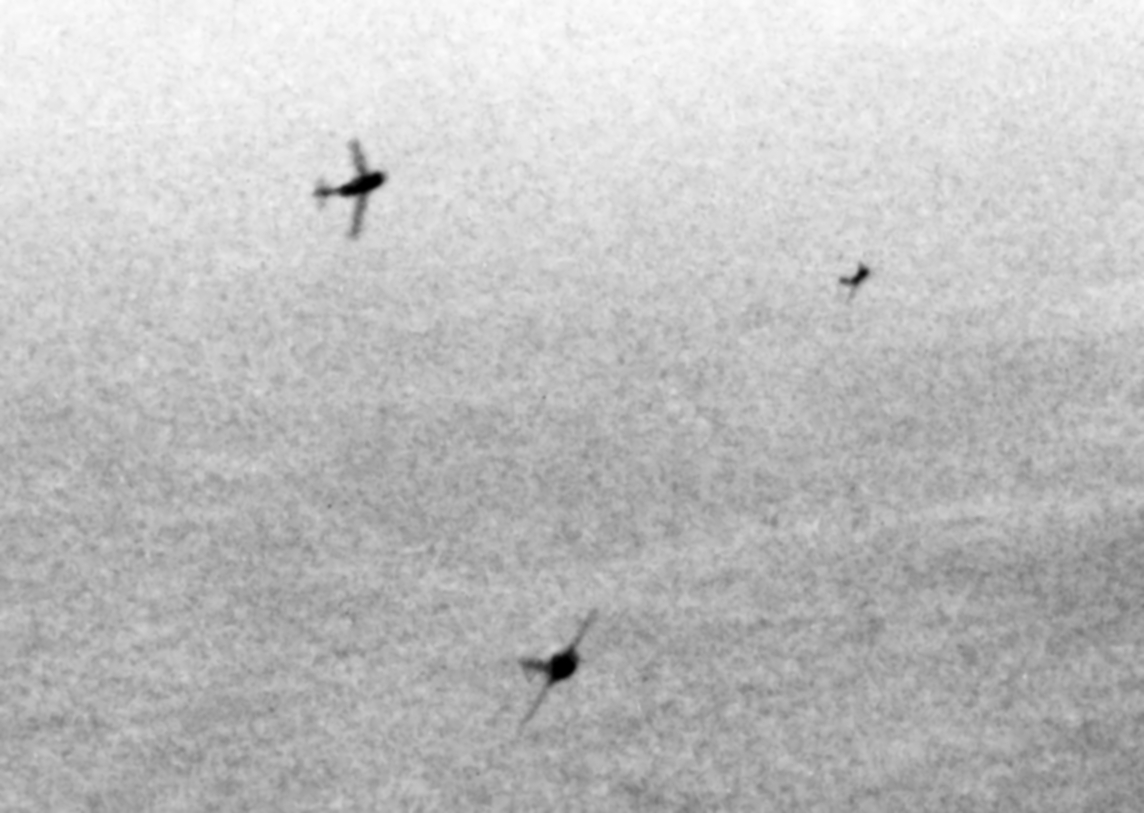
Compounding the problem, both sides were using jet engine-powered fighter aircraft on a large scale for the first time, and the high speeds of combat made visual identification of damaged and destroyed aircraft difficult. USAF pilots were credited with a kill if the gun camera showed their guns striking the enemy aircraft even if no one actually saw it go down. After the war the USAF reviewed its figures in an investigation code-named Sabre Measure Charlie and downgraded the kill ratio of the North American F-86 Sabre against the Mikoyan-Gurevich MiG-15 by half. The Soviets also had lax standards for confirming kills at the beginning of the war, leading to widespread over-claiming. Both sides made extensive use of gun cameras to better track effectiveness, but Soviet cameras were less effective, further contributing to over-claiming.
Records from the United Nations show that 40 American pilots reached ace status. However, records from China, the Soviet Union, and North Korea conflict widely and accounts vary on how many aircraft on each side were lost and who is credited with the victories. Air victory claims, which are often controversial between two sides of a war, were particularly difficult to measure in Korea thanks to the difficulty recovering crashed aircraft and confirming losses, as well as poor records for the two sides which fought the bulk of their engagements in an area known as MiG Alley.
Hub AI
List of Korean War flying aces AI simulator
(@List of Korean War flying aces_simulator)
List of Korean War flying aces
Dozens of aviators were credited as flying aces in the Korean War from 1950 to 1953. The number of total flying aces, who are credited with downing five or more enemy aircraft in air-to-air combat, is disputed in the war.
The Korean War saw the first widespread use of jet engine-powered fighter aircraft for both sides of a war. Subsequently, difficulty arose in crediting the number of victories for each side, thanks in part to poor records, intentional overestimation, and the difficulty of confirming crashes in MiG Alley, where the majority of air-to-air combat took place in the war. As a result, there is a large discrepancy on both sides as to the number of victories claimed versus aircraft lost, and it is extremely difficult to determine the accuracy of many victories. The ace status of dozens of pilots still remains in question.
Aviators from four nations may have qualified as aces during the Korean War; between six and nine aces have been estimated for China and up to four in North Korea. Pilots of the Soviet Union had the most difficulty confirming victories and accurately determining which pilots achieved ace status, and between 34 and 60 pilots from that nation have been postulated as possible aces in the war. For the United Nations, the United States was the only country with pilots to attain ace status, with 40. No pilot from another UN country attained ace status, though many claimed victories. Among these, Royal Canadian Air Force pilot Ernest A. Glover claimed three victories.
The status of many claimed aces in the Korean War has been increasingly debated as more data becomes available, showing that instances of over-claiming abounded on both sides.
An example of this occurred on 20 May 1951, when the war's largest fighter battle to date took place between 28 F-86 Sabres and 30 MiG-15s. After this battle the Americans claimed three MiGs (including two for James Jabara) and the Soviets claimed four Sabres (including one for Yevgeny Pepelyaev). In fact, each side lost only one aircraft.
The Americans claimed that Jabara was their first jet ace after the 20 May combat but, apart from the discrepancy on that date, he was also credited with a kill in a 12 April 1951 combat in which the Americans claimed a total of 11 MiGs shot down when the Soviets actually lost only one fighter. For their part, the Soviets claimed 15 Boeing B-29 kills on that date when the Americans only lost four in the combat itself and six written-off later.
Compounding the problem, both sides were using jet engine-powered fighter aircraft on a large scale for the first time, and the high speeds of combat made visual identification of damaged and destroyed aircraft difficult. USAF pilots were credited with a kill if the gun camera showed their guns striking the enemy aircraft even if no one actually saw it go down. After the war the USAF reviewed its figures in an investigation code-named Sabre Measure Charlie and downgraded the kill ratio of the North American F-86 Sabre against the Mikoyan-Gurevich MiG-15 by half. The Soviets also had lax standards for confirming kills at the beginning of the war, leading to widespread over-claiming. Both sides made extensive use of gun cameras to better track effectiveness, but Soviet cameras were less effective, further contributing to over-claiming.
Records from the United Nations show that 40 American pilots reached ace status. However, records from China, the Soviet Union, and North Korea conflict widely and accounts vary on how many aircraft on each side were lost and who is credited with the victories. Air victory claims, which are often controversial between two sides of a war, were particularly difficult to measure in Korea thanks to the difficulty recovering crashed aircraft and confirming losses, as well as poor records for the two sides which fought the bulk of their engagements in an area known as MiG Alley.
Recent media