
Recent from talks
List of Pennsylvania state parks
Knowledge base stats:
Talk channels stats:
Members stats:
List of Pennsylvania state parks
As of 2025[update], there are 124 state parks in the U.S. state of Pennsylvania. The Pennsylvania Bureau of State Parks, a division of the Pennsylvania Department of Conservation and Natural Resources (DCNR), is the governing body for all these parks, and directly operates 116 of them. The remaining parks are operated in cooperation with other public and private organizations.[a]
The first Pennsylvania state park, at Valley Forge, opened in 1893 and was given to the National Park Service (NPS) for the United States Bicentennial in 1976. There are a total of seventeen former Pennsylvania state parks: four former parks have been transferred to the NPS, four to the Pennsylvania Historical Museum Commission, two to the U.S. Army Corps of Engineers, one to both the Corps and the Pennsylvania Game Commission, five to the Pennsylvania Bureau of Forestry, and one has ceased to exist. Nine current and two former state parks have had major name changes or have been known under alternate names.
The list gives an overview of Pennsylvania state parks and a brief history of their development since the first park opened in 1893. State parks range in size from 3 acres (1.2 ha) to 21,122 acres (8,548 ha) and comprise one percent of Pennsylvania's total land area. According to Dan Cupper (1993), "Pennsylvania is the thirty-third largest state, but only Alaska and California have more park land".
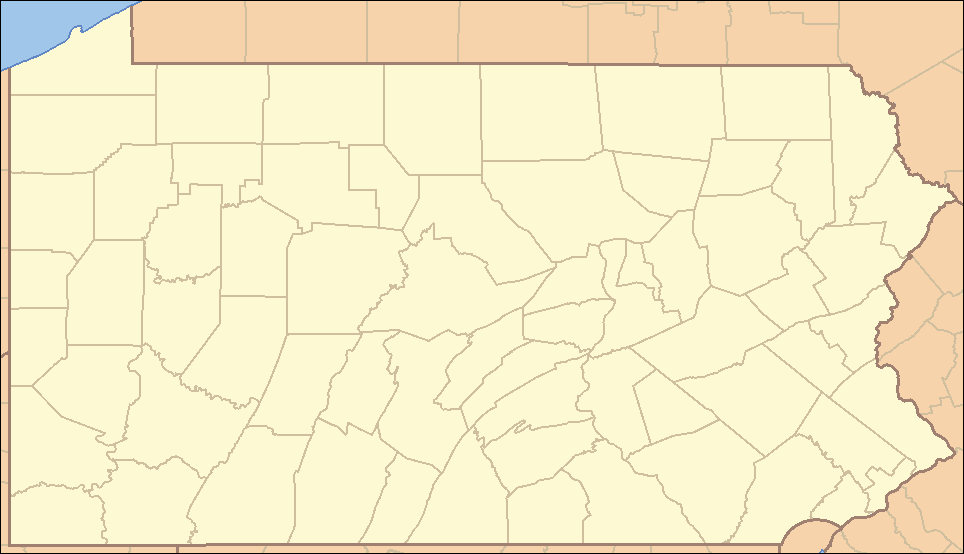
There are state parks in 62 of Pennsylvania's 67 counties,[b] which nearly reaches Pennsylvania's goal of having a state park within 25 miles (40 km) of every resident in the Commonwealth.[c] Eleven parks do not have "State Park" in their name. Three are "Conservation Areas": Boyd Big Tree Preserve, Joseph E. Ibberson, and Varden; four are "Environmental Education Centers": Jacobsburg, Jennings, Kings Gap (also a "Training Center") and Nolde Forest; White Clay Creek is a "Preserve"; Norristown is a "Farm Park"; and Big Spring is a "State Forest Picnic Area".
Seven parks are undeveloped with no facilities: Allegheny Islands, Benjamin Rush, Bucktail, Erie Bluffs, Prompton, Swatara, and Varden; the last four of these are in the process of being developed. Five state parks are small picnic areas: Laurel Summit, Patterson, Prouty Place, Sand Bridge, and Upper Pine Bottom. Five state parks have major U.S. Army Corps of Engineers dams and/or lakes: Bald Eagle, Beltzville, Elk, Kettle Creek, and Sinnemahoning. Three former parks now belong, at least partly, to the U.S. Army Corps of Engineers. Seven parks preserve the industrial past: Canoe Creek is the site of a former lime kiln, and Caledonia, French Creek, Greenwood Furnace, Kings Gap, Mont Alto, and Pine Grove Furnace (plus one former park) are all former iron furnace sites. Eight current parks and one former park contain at least part of eight different National Natural Landmarks.[d]
According to the DCNR, the state parks in Pennsylvania are on more than 300,000 acres (120,000 ha) with some 606 full-time and more than 1,600 part-time employees serving approximately 36 million visitors each year. Admission to all Pennsylvania state parks is free, although there are fees charged for use of cabins, marinas, etc. Pennsylvania's state parks offer "over 7,000 family campsites, 286 cabins, nearly 30,000 picnic tables, 56 major recreational lakes, 10 marinas, 61 beaches for swimming, 17 swimming pools" and over 1,000 miles (1,600 km) of trails.
Pennsylvania's first state park was Valley Forge State Park, purchased by the Commonwealth on May 30, 1893, to preserve Valley Forge. It was transferred to the National Park Service (NPS) on the Bicentennial of the United States, July 4, 1976. Many state parks still preserve history: as of 2012, forty-two Pennsylvania state park sites are on the National Register of Historic Places, including two National Historic Landmarks (Delaware Canal and Point), twenty-eight Civilian Conservation Corps sites in nineteen parks, and twelve other parks' historic sites and districts. Eight of the former state parks were also chiefly historic.
In addition to preserving historic sites, Pennsylvania also sought to preserve natural beauty and offer opportunities for recreation in its state parks. In 1902, Mont Alto State Forest Park was the second park established, a year after the state "Bureau of Forestry" was set up to purchase, preserve, and restore Pennsylvania's forests, which had been ravaged by lumbering, charcoal production, and wild fires. Parks were added sporadically until the 1930s, some mere camping and picnic areas in state forests, while others preserved unique sites. The 1930s saw a great expansion of parks and their facilities under Governor Gifford Pinchot, who cooperated with President Franklin Roosevelt, despite their being of different political parties. The Civilian Conservation Corps (CCC) established 113 CCC camps in Pennsylvania (second only to California). Using CCC and Works Progress Administration (WPA) labor, the NPS built five Recreation Demonstration Areas, which became Pennsylvania state parks in 1945 and 1946: Blue Knob, French Creek, Hickory Run, Laurel Hill, and Raccoon Creek. The CCC also "fought forest fires, planted trees, built roads, buildings, picnic areas, swimming areas, campgrounds and created many state parks".[e]
Hub AI
List of Pennsylvania state parks AI simulator
(@List of Pennsylvania state parks_simulator)
List of Pennsylvania state parks
As of 2025[update], there are 124 state parks in the U.S. state of Pennsylvania. The Pennsylvania Bureau of State Parks, a division of the Pennsylvania Department of Conservation and Natural Resources (DCNR), is the governing body for all these parks, and directly operates 116 of them. The remaining parks are operated in cooperation with other public and private organizations.[a]
The first Pennsylvania state park, at Valley Forge, opened in 1893 and was given to the National Park Service (NPS) for the United States Bicentennial in 1976. There are a total of seventeen former Pennsylvania state parks: four former parks have been transferred to the NPS, four to the Pennsylvania Historical Museum Commission, two to the U.S. Army Corps of Engineers, one to both the Corps and the Pennsylvania Game Commission, five to the Pennsylvania Bureau of Forestry, and one has ceased to exist. Nine current and two former state parks have had major name changes or have been known under alternate names.
The list gives an overview of Pennsylvania state parks and a brief history of their development since the first park opened in 1893. State parks range in size from 3 acres (1.2 ha) to 21,122 acres (8,548 ha) and comprise one percent of Pennsylvania's total land area. According to Dan Cupper (1993), "Pennsylvania is the thirty-third largest state, but only Alaska and California have more park land".
There are state parks in 62 of Pennsylvania's 67 counties,[b] which nearly reaches Pennsylvania's goal of having a state park within 25 miles (40 km) of every resident in the Commonwealth.[c] Eleven parks do not have "State Park" in their name. Three are "Conservation Areas": Boyd Big Tree Preserve, Joseph E. Ibberson, and Varden; four are "Environmental Education Centers": Jacobsburg, Jennings, Kings Gap (also a "Training Center") and Nolde Forest; White Clay Creek is a "Preserve"; Norristown is a "Farm Park"; and Big Spring is a "State Forest Picnic Area".
Seven parks are undeveloped with no facilities: Allegheny Islands, Benjamin Rush, Bucktail, Erie Bluffs, Prompton, Swatara, and Varden; the last four of these are in the process of being developed. Five state parks are small picnic areas: Laurel Summit, Patterson, Prouty Place, Sand Bridge, and Upper Pine Bottom. Five state parks have major U.S. Army Corps of Engineers dams and/or lakes: Bald Eagle, Beltzville, Elk, Kettle Creek, and Sinnemahoning. Three former parks now belong, at least partly, to the U.S. Army Corps of Engineers. Seven parks preserve the industrial past: Canoe Creek is the site of a former lime kiln, and Caledonia, French Creek, Greenwood Furnace, Kings Gap, Mont Alto, and Pine Grove Furnace (plus one former park) are all former iron furnace sites. Eight current parks and one former park contain at least part of eight different National Natural Landmarks.[d]
According to the DCNR, the state parks in Pennsylvania are on more than 300,000 acres (120,000 ha) with some 606 full-time and more than 1,600 part-time employees serving approximately 36 million visitors each year. Admission to all Pennsylvania state parks is free, although there are fees charged for use of cabins, marinas, etc. Pennsylvania's state parks offer "over 7,000 family campsites, 286 cabins, nearly 30,000 picnic tables, 56 major recreational lakes, 10 marinas, 61 beaches for swimming, 17 swimming pools" and over 1,000 miles (1,600 km) of trails.
Pennsylvania's first state park was Valley Forge State Park, purchased by the Commonwealth on May 30, 1893, to preserve Valley Forge. It was transferred to the National Park Service (NPS) on the Bicentennial of the United States, July 4, 1976. Many state parks still preserve history: as of 2012, forty-two Pennsylvania state park sites are on the National Register of Historic Places, including two National Historic Landmarks (Delaware Canal and Point), twenty-eight Civilian Conservation Corps sites in nineteen parks, and twelve other parks' historic sites and districts. Eight of the former state parks were also chiefly historic.
In addition to preserving historic sites, Pennsylvania also sought to preserve natural beauty and offer opportunities for recreation in its state parks. In 1902, Mont Alto State Forest Park was the second park established, a year after the state "Bureau of Forestry" was set up to purchase, preserve, and restore Pennsylvania's forests, which had been ravaged by lumbering, charcoal production, and wild fires. Parks were added sporadically until the 1930s, some mere camping and picnic areas in state forests, while others preserved unique sites. The 1930s saw a great expansion of parks and their facilities under Governor Gifford Pinchot, who cooperated with President Franklin Roosevelt, despite their being of different political parties. The Civilian Conservation Corps (CCC) established 113 CCC camps in Pennsylvania (second only to California). Using CCC and Works Progress Administration (WPA) labor, the NPS built five Recreation Demonstration Areas, which became Pennsylvania state parks in 1945 and 1946: Blue Knob, French Creek, Hickory Run, Laurel Hill, and Raccoon Creek. The CCC also "fought forest fires, planted trees, built roads, buildings, picnic areas, swimming areas, campgrounds and created many state parks".[e]
Recent media