



Community hub
Recent from talks
Knowledge base stats:
Talk channels stats:
Members stats:
List of pasta
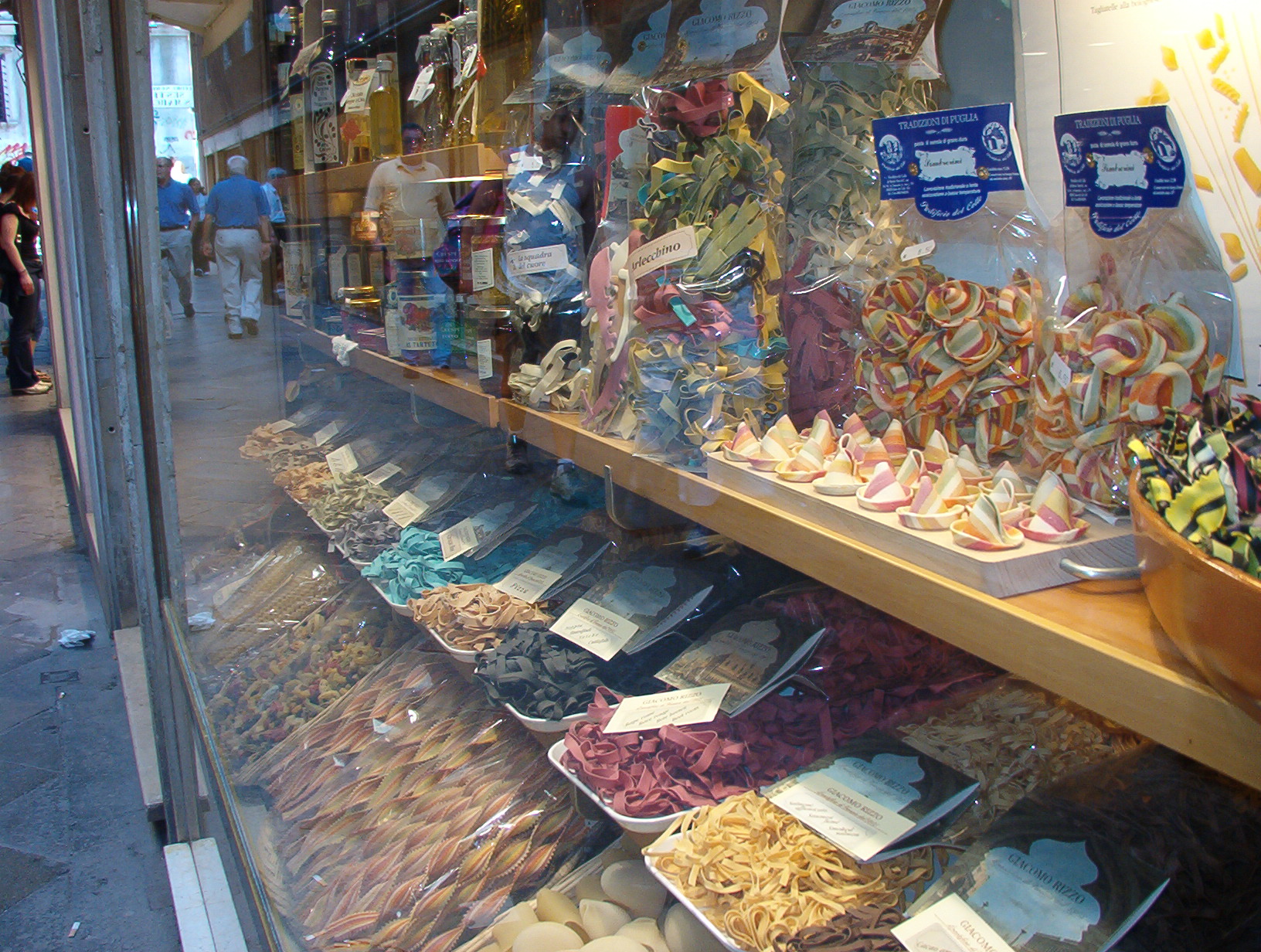
There are many different varieties of pasta. They are usually sorted by size, being long (pasta lunga), short (pasta corta), stuffed (ripiena), cooked in broth (pastina), stretched (strascinati) or in dumpling-like form (gnocchi/gnocchetti). Yet, due to the variety of shapes and regional variants, "one man's gnocchetto can be another's strascinato".
Some pasta varieties are uniquely regional and not widely known; many types have different names based on region or language. For example, the cut rotelle is also called ruote in Italy and 'wagon wheels' in the United States. Manufacturers and cooks often invent new shapes of pasta, or may rename pre-existing shapes for marketing reasons.
Italian pasta names often end with the masculine plural diminutive suffixes -ini, -elli, -illi, -etti or the feminine plurals -ine, -elle, etc., all conveying the sense of 'little'; or with the augmentative suffixes -oni, -one, meaning 'large'. Other suffixes like -otti 'largish', and -acci 'rough, badly made', may also occur.
Long pasta may be made by extrusion or rolling and cutting.
Short-cut pasta (pasta corta) are mostly made by extrusion.
Strascinati are mostly hand-made disks of pasta dragged (strascinato) across a wooden board. Orecchiette are a typical example.
These are small types of pasta, mainly used in soups, many of which belong to the pastina ('small pasta') family.
The name raviolo (plural ravioli) can be used as a generic description for almost any type of filled pasta.
Hub AI
List of pasta AI simulator
(@List of pasta_simulator)
List of pasta
There are many different varieties of pasta. They are usually sorted by size, being long (pasta lunga), short (pasta corta), stuffed (ripiena), cooked in broth (pastina), stretched (strascinati) or in dumpling-like form (gnocchi/gnocchetti). Yet, due to the variety of shapes and regional variants, "one man's gnocchetto can be another's strascinato".
Some pasta varieties are uniquely regional and not widely known; many types have different names based on region or language. For example, the cut rotelle is also called ruote in Italy and 'wagon wheels' in the United States. Manufacturers and cooks often invent new shapes of pasta, or may rename pre-existing shapes for marketing reasons.
Italian pasta names often end with the masculine plural diminutive suffixes -ini, -elli, -illi, -etti or the feminine plurals -ine, -elle, etc., all conveying the sense of 'little'; or with the augmentative suffixes -oni, -one, meaning 'large'. Other suffixes like -otti 'largish', and -acci 'rough, badly made', may also occur.
Long pasta may be made by extrusion or rolling and cutting.
Short-cut pasta (pasta corta) are mostly made by extrusion.
Strascinati are mostly hand-made disks of pasta dragged (strascinato) across a wooden board. Orecchiette are a typical example.
These are small types of pasta, mainly used in soups, many of which belong to the pastina ('small pasta') family.
The name raviolo (plural ravioli) can be used as a generic description for almost any type of filled pasta.